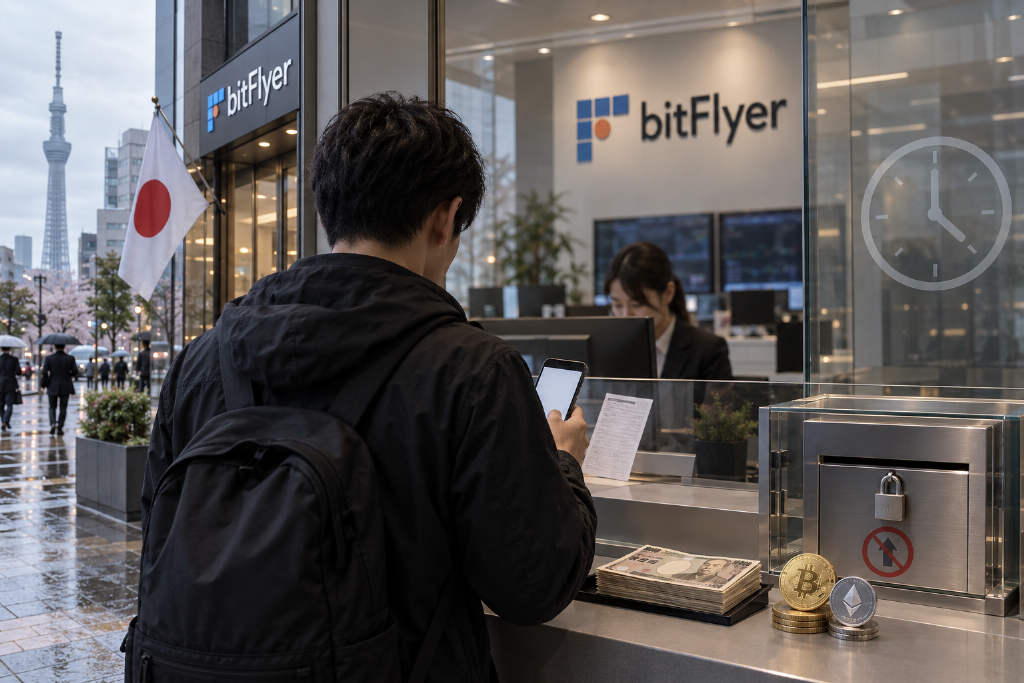
Japan’s largest crypto exchange, bitFlyer, said it will roll out an anti-scam measure called "Cooldown" on Oct. 15. Under the new rule, individual users who completed identity verification less than 90 days ago will face a 48-hour holding period on part of their crypto assets after each yen deposit, during which those assets cannot be sent to external addresses. The restricted amount is calculated as the total yen deposited over the past 48 hours minus 100,000 yen, roughly $634. If cumulative deposits stay at or below 100,000 yen, the rule does not apply. Deposits made through Quick Deposit are exempt. bitFlyer said the measure will not affect yen deposits and withdrawals, crypto trading, holding, or receiving digital assets. The update was carried by Techub News and attributed to Wu Blockchain.
bitFlyer, Japan’s largest crypto exchange, said it will launch an anti-scam measure called "Cooldown" on Oct. 15.
Under the policy, individual users who completed identity verification less than 90 days ago will have part of their crypto assets placed under a 48-hour cooling-off period after each yen deposit. During that period, those assets cannot be transferred to external addresses.
The restricted amount will be the portion of total yen deposits made in the past 48 hours that exceeds 100,000 yen, or about $634. Users whose cumulative deposits do not exceed 100,000 yen will not be affected. The rule does not apply to deposits made through Quick Deposit.
bitFlyer said the Cooldown measure will not affect yen deposits or withdrawals, crypto asset trading, holding, or receiving.
The item was published by Techub News and attributed to Wu Blockchain.
This article was originally published by Bit.Fan. For more cryptocurrency news and market insights, visit www.bit.fan. Disclaimer:
The market information, project data, and third-party content displayed on this platform are for industry information sharing only and do not constitute any form of investment advice or return commitment.
Cryptocurrency trading carries high risks. Users should fully assess their risk tolerance and make independent decisions. All profits, losses, and legal responsibilities are borne by the users themselves.