
Throughout June, major crypto exchanges have been accelerating their push into U.S. stock-related products. Bitget, one of the earlier and more aggressive platforms in this area, has launched its own RWA platform, Reality, and made a major upgrade to its U.S. stock offering. In an interview, Bitget CEO Gracy said the company began working with Ondo in the third quarter of last year and at one stage accounted for nearly 90% of the market share of Ondo’s issued stock tokens. Bitget also worked with xStocks to list U.S. stock tokens. During that process, however, the most frequent user feedback centered on insufficient liquidity and a dividend and stock-split settlement mechanism that was not clear or transparent enough.
Gracy said Bitget decided to step in directly to solve these problems. Reality, according to her, is a compliant RWA protocol whose largest distinction is its direct connection with Alpaca, a licensed U.S. broker. Orders can be routed directly to Nasdaq and the New York Stock Exchange. In practical terms, when users trade U.S. stock rTokens on Reality, the price they get for assets such as Apple or Tesla is aligned with the price in the U.S. stock market, and the liquidity is designed to benchmark traditional brokerages.
Reality also addresses dividends and stock splits. Cash dividends are automatically converted into USDT and airdropped to users, while stock splits can be synchronized on a 1:1 basis. Gracy said this is intended to avoid a mismatch between token prices and real stock prices. The feature went live on June 4, and she described it as a key reason Bitget chose tokenization rather than only offering a broker-direct model.
Under this design, a user who buys rNVDA, the Nvidia rToken, can use it directly on Bitget as futures margin. The asset can also be withdrawn through public chains such as Arbitrum and Morph and used in DeFi scenarios. Gracy said Bitget wants to make U.S. stock tokens in users’ hands active assets rather than static holdings, thereby improving overall capital efficiency.
Comparing Bitget’s U.S. Stocks 2.0 with offerings from other platforms, Gracy said many peers are still competing around broker-direct access, where users deposit stablecoins and then open accounts at traditional brokers to trade. Bitget’s route, she said, is more crypto native because Reality issues RWA stock tokens. Stocks purchased through broker-direct channels usually remain inside a U.S. stock account, while Reality-issued rTokens are on-chain assets already connected to Arbitrum and Morph. This means users can use them inside Bitget as collateral, withdraw them to their own wallets, and later enter DeFi protocols for functions such as staking or yield generation.
Gracy identified two long-standing industry problems that Bitget aims to solve. The first is liquidity: orders are routed to Nasdaq and the New York Stock Exchange, with prices, order books and depth synchronized with the real market. The second is dividend distribution and stock split or reverse split handling: cash dividends are converted directly into USDT and automatically airdropped, while splits and reverse splits are synchronized 1:1 to prevent token prices from detaching from real share prices. In a UEX environment, she said, these rTokens can deliver higher capital efficiency. A user holding rNVDA can use the same position as collateral to continue trading BTC or ETH futures, allowing one asset to function across two markets.
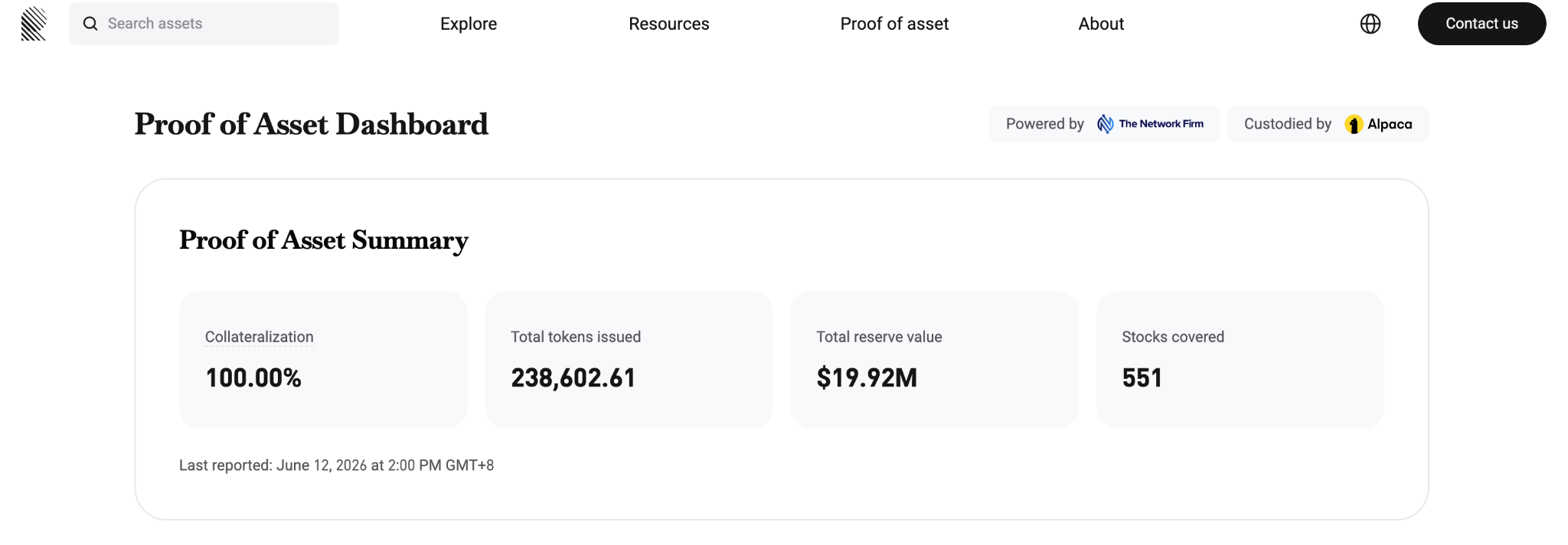
On whether rTokens are merely synthetic assets tracking prices, Gracy said Reality’s rTokens are backed by real underlying assets. The underlying shares are held in custody by Alpaca, the licensed U.S. broker, and placed in an independent SPV that is fully separated from Bitget’s own assets. She said the structure provides 1:1 full reserves. Bitget also uses a third-party U.S.-licensed audit institution for daily audits, and Reality’s official website has launched a real-time audit dashboard that allows users to check the reserve ratio. Gracy added that once a CPA-licensed audit company is ready in August, its audit report will also be added to the dashboard. Together with Bitget’s user protection fund of more than $300 million, she described this as a three-layer safeguard. The original material cited a Reality PoR dashboard screenshot from June 12, 2026 at 2:00 PM GMT+8.
Corporate actions are another area where Gracy said Reality is stronger than many existing products. She cited Netflix’s 1-for-10 stock split last year as an example: on some platforms, the corresponding tokens were not rebased, leaving certain stock token prices 10 times away from real stock prices and creating confusion for users. On Reality, a split is automatically synchronized. A user’s one token would become 10 tokens, the unit price would match the real share price, and the total asset value would remain unchanged. Cash dividends are converted into USDT and automatically sent to the Bitget account. Gracy said that for both retail users and future institutional users, especially participants that need hedging, valuation, clearing and portfolio management, a structure in which price and dividend are handled separately is closer to the habits of traditional financial systems.
The interview also covered a shift in user attention. Over the past few years, crypto users mainly followed narratives around BTC, ETH, DeFi, NFTs, memes, L2s and public-chain competition. Gracy said Bitget observed at the end of 2024 and the beginning of 2025 that altcoins were weak, while user interest in AI, U.S. stocks, gold, silver and other commodities was rising. This was the context for her proposal last September of UEX, or Universal Exchange. In December last year, cumulative trading volume of Bitget’s U.S. stock perpetual contracts exceeded $10 billion, ranking second globally. At the beginning of this year, Bitget’s TradFi segment, including gold and foreign exchange, saw daily trading volume exceed $2 billion for the first time. At present, 40% of Bitget’s trading volume comes from non-crypto assets.
Gracy said capital is profit-seeking and will flow to areas with more certain growth and wealth effects. U.S. AI giants have delivered real revenue and profits, while many crypto projects remain at the storytelling stage. She did not describe the relationship between crypto assets and U.S. tech stocks as zero-sum. In her view, crypto assets such as BTC as digital gold and U.S. technology stocks can be complementary components in user portfolios. Bitget’s task is to allow users to use stablecoins such as USDT and USDC in one account to buy different categories of assets smoothly.
She also addressed capital efficiency and fragmented assets as the largest pain points for crypto users. If funds remain on an exchange earning interest, users can miss stock market gains; if they move money to a traditional brokerage account, those funds have difficulty returning to the exchange for futures trading. Bitget’s rToken product is designed to address this. Users can buy U.S. stocks while still using their positions as futures margin, keeping capital active.

Gracy cautioned that whether U.S. stocks are expensive depends on the time horizon. Crypto users entering U.S. equities need to understand that U.S. stocks, like crypto assets, are not markets that only rise. AI, semiconductors and technology stocks have already experienced strong gains over a period of time, and short-term volatility and valuation pressure need to be considered together. Speaking outside her role as CEO, she said that as an investor managing her personal account, she had recently posted on Twitter about her view of the bottom price of Bitcoin in the current cycle and faced criticism from users who argued that an exchange CEO should not speak negatively about her own industry. Her response was that all industries have cycles. She said long-term optimism on crypto and belief in tokenized assets do not require constant bullishness, because trading opportunities come from volatility, and for increasingly mature investors, both rises and declines create opportunities.
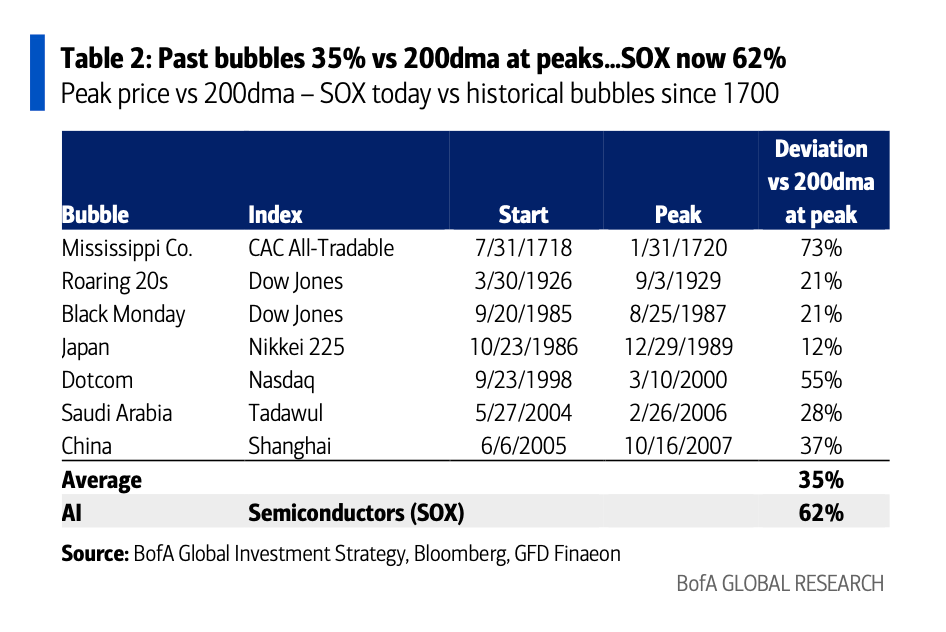
From a technical perspective, she said the current market shows a degree of extreme deviation. A Bank of America report and related charts show that the semiconductor index, or SOX, has risen to 62% above its 200-day moving average. Historically, when major market bubbles topped, the average deviation of relevant market indexes from their 200-day moving averages was around 35%. The current deviation is already higher than the Nasdaq’s 55% deviation from its 200-day moving average before the 2000 internet bubble burst. The original article cited Bank of America’s The Flow Show report from May 14, 2026 at 10:45 PM EDT. Gracy also said the current U.S. stock rally is highly dependent on a small number of technology giants, and that if super IPO projects such as SpaceX and Anthropic come to market, they could further divert market liquidity.
For crypto users newly turning toward U.S. stocks, Gracy’s main warning was not to trade U.S. stocks like memes. In crypto, users may be accustomed to reading sentiment, following community heat and opening high-leverage short-term trades. U.S. equities, however, are a highly institutionalized market that emphasizes financial reports, EPS, the interest-rate environment and macro cycles. Users familiar with crypto markets need to learn to monitor Treasury yields and inflation data. For example, when the 10-year U.S. Treasury yield approaches 5%, it can put pressure on high-valuation technology stocks.
The conversation then turned to AI. In the past, crypto was one of the areas most concentrated with young talent, venture capital, technology narratives and speculative funds. Now AI has clearly become a stronger mainline: top talent is moving into AI, venture capital is investing in AI, secondary-market funds are chasing AI, and U.S. technology giants are presenting real revenue and growth. Gracy said the impact exists, but she prefers to see it as a touchstone for crypto’s de-bubbling. Crypto money was too easy to make in the past; now that AI is drawing away capital and talent, it forces the crypto industry to settle down and search for real use cases such as stablecoin payments and RWA.

Inside Bitget, Gracy said all employees are expected to embrace AI. AI-driven innovation is one of the company’s three core strategies for 2026. Bitget has not rigidly turned AI usage into a mandatory assessment item, because useful tools are naturally adopted by employees. Gracy said she often uses tools such as Manus and NotebookLM to summarize materials. At the organizational level, Bitget has purchased enterprise Claude access for all employees, covering 2,167 staff members at a cost of $200 per person per month. She said this was not because of external pressure, but because the company observed real productivity gains after employees used AI tools and wanted to make sure team members did not fall behind in the AI adoption wave.
Even design teams without technical backgrounds have learned to use tools such as Google AI Studio and have developed six or seven AI tools that support business operations, including automated checks for UI compliance issues in external materials. On the product side, Bitget has also launched AI tools for traders, including GetAgent and GetClaw. Gracy said the company has AI-related training almost every day, and that this week she attended a data team AI product sharing session and a presentation on the digital employee plan and BG Agent platform. She described AI as a productivity lever and said both the present and the future belong to a working model in which silicon-based and carbon-based life work together.
As more crypto exchanges provide U.S. stocks, gold, foreign exchange, stock tokens and Pre-IPO products, Gracy rejected a black-and-white interpretation. On the surface, these products bring traditional financial assets into crypto. At a deeper level, she said, they test whether crypto is merely an asset class or a new financial infrastructure. The answer depends on what exchanges do. If they simply package U.S. stock price exposure as a tradable product, they can become distribution channels for traditional financial liquidity. If they reorganize issuance, trading, clearing, custody and risk control around stablecoin accounts, on-chain settlement, global accessibility, fractional trading and 24/7 markets, then they strengthen the value of crypto as next-generation financial infrastructure.

Gracy said traditional financial platforms have high user barriers, including difficult account opening, high thresholds and slow fund movement. Bitget’s goal is to use stablecoin settlement and on-chain RWA protocols to connect underlying assets, allowing its 120 million global users to trade high-quality global assets with only a phone and an email address. She said this is not outsourcing, but using crypto’s high efficiency and low friction to improve the traditional brokerage experience. Through tokenized structures such as Reality, Bitget aims to bring real-world assets onto the chain and make them part of DeFi. She said crypto’s definition has evolved: at first it represented Bitcoin, later it also included widely discussed memecoins, and in the future many crypto assets will be RWA. Regardless of the asset, blockchain and other underlying technologies remain the foundation of this new financial system.
Bitget’s UEX concept is designed to let users trade cryptocurrencies, stocks, gold, foreign exchange, ETFs and other assets within one account. Gracy described UEX as the natural evolution of an exchange, comparing it with Amazon’s move from books to a wide range of goods and the iPhone’s move from a touchscreen phone to a digital life center. Users do not only need to trade coins; they need to make money and allocate assets. Since stablecoins have become one of the world’s most useful settlement tools, she said users should be able to use them to buy and sell the world’s best assets.
Bitget proposed its UEX vision in the second half of 2025 and, according to Gracy, will keep following this transformation path for roughly the next three years. She said the current financial system is still built on walls: users go to brokers for stocks, CEXs for crypto, and banks or IB, meaning Interactive Brokers, for foreign exchange; U.S., European and Asian markets each have their own closing times, preventing 24/7 capital flow; and traditional finance and Web3 resemble parallel universes in which users manage many accounts and margin systems. This leads to low capital efficiency, complex user experience and difficulty in unifying risk-management standards.
A full-asset trading platform, in her view, is both a user demand and a broader direction. She said the exchange landscape has not fundamentally changed over the past four to five years, and first-mover advantages have remained strong under homogeneous competition. But as crypto becomes part of financial infrastructure, a turning point has appeared. Platforms with stronger teams and firmer execution can overtake others, while future competitors include not only crypto peers but also traditional finance. Bitget’s target is one account, one interface and one-stop trading for all assets.
Gracy outlined five core modules around UEX. A unified account enables cross-asset margin and maximizes capital efficiency. A unified risk engine upgrades risk management from single assets to portfolio-level controls. A unified liquidity routing system integrates CEXs, DEXs and external markets, positioning Bitget as a liquidity coordination center. A unified execution layer upgrades user access from manual trading to API and then AI Agent. An asset standardization layer turns crypto, stock ETFs, foreign exchange, commodities and RWA into programmable trading objects. In three years, she said, she hopes the outside world will no longer define Bitget only as a crypto exchange, but as a universal exchange that offers one-click access to core global assets, smooth and AI-enhanced user experience, and reliable safety.
The interview also addressed recent domestic regulatory actions involving cross-border brokers such as Futu, Tiger and Longbridge. Gracy said compliance is an irreversible trend and is the reason Bitget has made compliance-first a core strategy for 2026. In her view, regulation is essentially about protecting user assets, preventing money laundering and avoiding systemic risk. When building Reality and U.S. Stocks 2.0, she said Bitget applied high compliance standards and did not touch gray areas, instead working directly with Alpaca, the licensed U.S. broker, while keeping underlying assets within the U.S. financial regulatory framework.
Gracy acknowledged that regulatory changes can bring short-term pain, but said that over the long term they drive market restructuring and remove non-compliant operators. For users, she said, if the product experience is strong enough — including 24-hour trading, reduced foreign-exchange friction and composable on-chain assets — and if compliance and asset safety are transparent enough, such as through Reality’s daily audit dashboard, users will make rational choices. Asked for one piece of advice for crypto users encountering U.S. stocks for the first time, she said they should look for good timing, buy quality companies they truly understand and that are supported by real profits, and then leave the rest to time. In crypto, some trading resembles speculation, she said; in U.S. stocks, users should try to do more investing.