
Throughout June, major crypto exchanges accelerated their rollout of U.S. stock-related products. Bitget, one of the earlier and more aggressive platforms in this area, has launched its own RWA platform, Reality, and significantly upgraded its U.S. stock offering. In an interview, Bitget CEO Gracy said the company began working with Ondo in the third quarter of last year and once accounted for nearly 90% of the market share of Ondo-issued stock tokens. Bitget also worked with xStocks to list U.S. stock tokens. During that process, however, users repeatedly raised two concerns: liquidity was not strong enough, and the settlement mechanisms for dividends and stock splits were not clear or transparent enough.
Reality connects to Alpaca and makes rTokens usable on-chain
Gracy said Reality is Bitget’s compliant RWA protocol. Its main distinction is a direct connection to Alpaca, a U.S.-licensed broker, with orders routed through to Nasdaq and the New York Stock Exchange. In simple terms, when users trade U.S. stock rTokens on Reality, the price of assets such as Apple or Tesla is aligned with the actual U.S. stock market price, and liquidity is benchmarked against traditional brokers. Reality also addresses dividends and splits: cash dividends are automatically converted into USDT and airdropped to users, while stock splits are synchronized on a 1:1 basis to avoid divergence between token prices and real share prices.
The function went live on June 4. Gracy said this is the core reason Bitget chose tokenization rather than only offering a “broker-direct” model. A user who buys rNVDA, the Nvidia rToken, can use it directly on Bitget as futures margin. The same asset can also be withdrawn through public chains such as Arbitrum and Morph and used in DeFi scenarios. According to Gracy, Bitget wants to make U.S. stock tokens held by users more productive and improve overall capital efficiency.
Gracy argued that many platforms entering U.S. stock products are still competing around “broker-direct” access, where users deposit stablecoins and then open accounts at traditional brokers to trade. Bitget’s U.S. Stocks 2.0 chooses a more crypto-native path through RWA stock tokens. Shares bought via a broker-direct model usually remain inside the user’s U.S. stock account. By contrast, rTokens issued through Reality are on-chain assets that currently connect to Arbitrum and Morph. Users can use them as collateral inside Bitget, withdraw them to their own wallets, and later use them in DeFi protocols for operations such as staking and yield generation.
Reserves, audits, dividends and stock splits
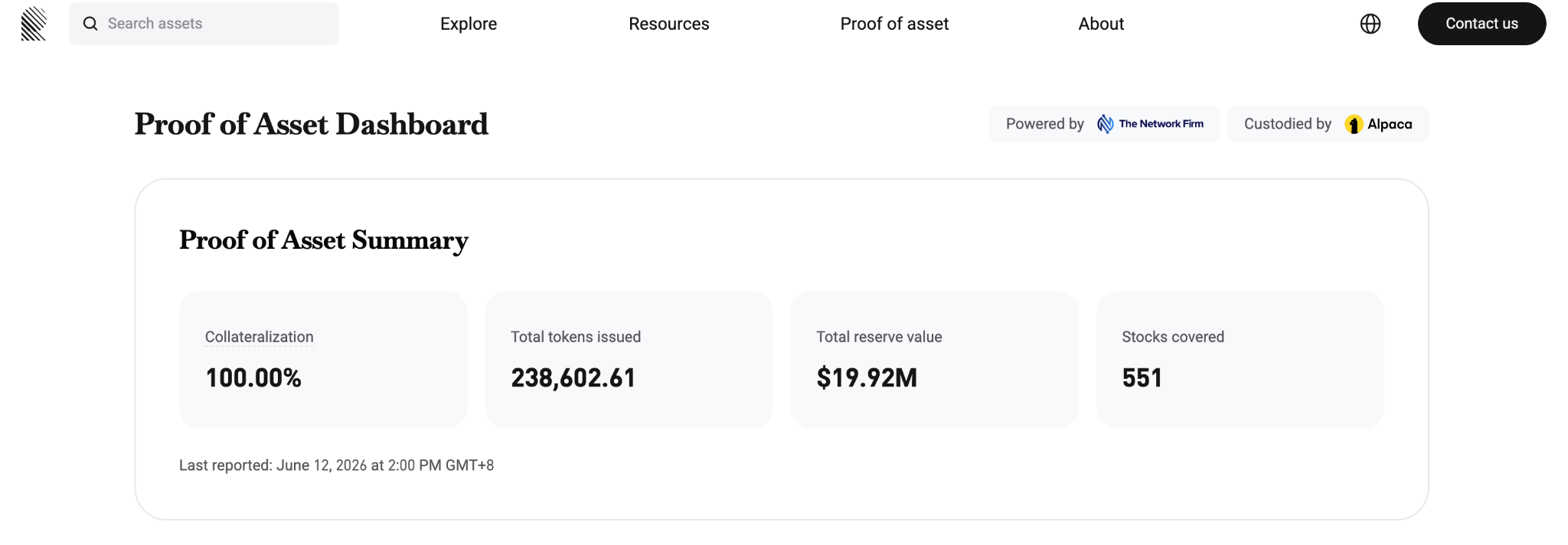
On whether rTokens are merely “synthetic assets” tracking prices, Gracy said Reality’s rTokens are backed by real underlying assets. The underlying stocks are custodied by Alpaca, a U.S.-licensed broker, and placed in an independent SPV, fully separated from Bitget’s own assets. She said Reality maintains a 1:1 full reserve. In addition, a third-party U.S.-licensed audit institution conducts daily audits. Reality’s official website has launched a real-time audit dashboard where users can check reserve ratios at any time. Gracy also said that after a CPA-licensed audit firm is ready in August, its audit reports will be added to the dashboard. Bitget also has a user protection fund of more than $300 million, which she described as another layer of protection.
Gracy also highlighted Reality’s handling of corporate actions. Taking Netflix’s 1-for-10 stock split last year as an example, she said some platforms did not rebase their tokens accordingly, leaving certain stock token prices 10 times away from the real share price and confusing users. On Reality, a split is synchronized automatically: one token held by a user becomes 10 tokens, the unit price aligns with the real share price, and the total asset value remains unchanged. Cash dividends are directly converted into USDT and automatically airdropped to the Bitget account. Gracy said the structure of “price is price, dividends are dividends” is closer to the user experience of traditional financial systems and is especially relevant for future institutional use in hedging, valuation, clearing and portfolio management.
AI, U.S. stocks and the shift in crypto capital flows
The discussion also turned to the way AI, U.S. stocks, Nvidia, OpenAI and SpaceX have absorbed capital and attention that previously flowed into crypto narratives. Gracy said Bitget had observed this trend as early as late 2024 and early 2025: altcoins were weak, while user interest in AI, U.S. stocks, gold, silver and other commodities was rising. This was why she proposed the UEX, or Universal Exchange, vision in September last year. In December, Bitget’s cumulative trading volume for U.S. stock perpetual contracts exceeded $10 billion, ranking second globally. At the beginning of this year, the daily trading volume of Bitget’s TradFi section, including gold and foreign exchange, exceeded $2 billion for the first time. At present, 40% of Bitget’s trading volume comes from non-crypto assets.
Gracy said the logic is straightforward: capital chases returns. Where there is more visible growth and wealth creation, funds will flow. U.S. AI giants have delivered real revenue and profit, while many crypto projects are still at the storytelling stage. She added that this is not a zero-sum game. Crypto assets such as BTC, as digital gold, and U.S. technology stocks can become complementary components in a user’s portfolio. Bitget’s role, in her view, is to let users buy different types of assets smoothly in one account using stablecoins such as USDT and USDC.
She also addressed the key pain point for crypto users: capital efficiency and asset fragmentation. If funds remain on an exchange to earn interest, users can miss stock market gains. If they move funds to a traditional brokerage account, the capital is harder to bring back to the exchange for futures trading. Bitget’s rToken product is designed to solve this: users can buy U.S. stocks while still using their holdings as futures margin, keeping capital active rather than isolated.
On whether U.S. stocks are expensive, Gracy said the answer depends on the time horizon. She reminded crypto users that U.S. stocks, like crypto assets, are not markets that only rise. Popular sectors such as AI, semiconductors and technology stocks have already recorded substantial gains, and short-term volatility as well as valuation pressure need to be assessed together. Speaking outside her role as CEO and referring to her personal account, she said she had recently posted views on Twitter about the bottom price of Bitcoin in the current cycle and received criticism from users who said an exchange CEO should not be bearish on her own industry. Her response was that every industry has cycles. Long-term optimism on crypto does not mean one must always be bullish, because trading opportunities come from volatility, and for increasingly mature investors both rises and declines can present opportunities.

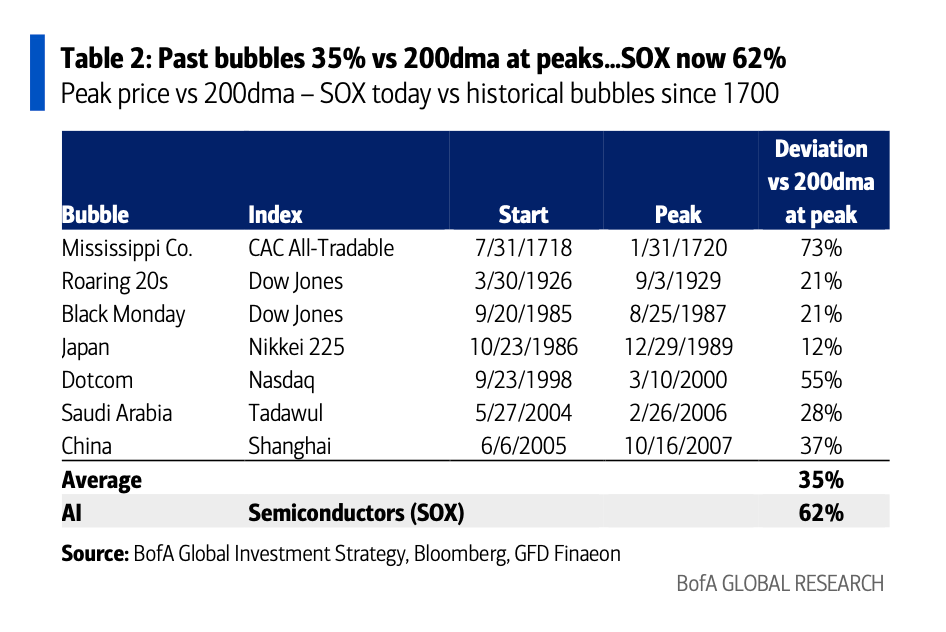
From a technical perspective, Gracy cited a Bank of America The Flow Show report and related charts. The report showed that the semiconductor index, SOX, had risen to 62% above its 200-day moving average. Based on historical experience, when major market bubbles have topped, the average deviation of related market indices from the 200-day moving average has been around 35%. The current deviation has exceeded the Nasdaq’s 55% deviation from its 200-day moving average before the 2000 dot-com bubble burst. She also said the current U.S. stock rally is highly dependent on a small number of technology giants, and listed SpaceX and Anthropic super IPO projects as factors that could further draw liquidity.
For users moving from crypto into U.S. stocks, Gracy’s main warning was not to trade U.S. stocks like Meme coins. In crypto, users may be used to watching sentiment, following community heat and opening high-leverage short-term positions. U.S. stocks are a highly institutionalized market. They focus on financial reports, EPS, interest-rate conditions and macro cycles. Users accustomed to crypto markets need to learn to monitor Treasury yields and inflation data. For example, when the 10-year U.S. Treasury yield approaches 5%, it can put pressure on high-valuation technology stocks.
AI as a productivity lever inside Bitget
Gracy said AI is clearly becoming a stronger theme than crypto in attracting top talent, venture capital and secondary-market money. She described the impact as real, but framed it as a test for the crypto industry’s “deflation of bubbles.” In her view, crypto money was too easy to make in previous cycles. Now that AI is absorbing capital and talent, the crypto industry is being forced to settle down and find real use cases, such as stablecoin payments and RWA.
Inside Bitget, Gracy said all employees are expected to embrace AI. AI-driven innovation is one of Bitget’s three core strategies for 2026. The company has not made AI usage a rigid mandatory assessment item, because tools that are genuinely useful are naturally adopted by staff. Gracy said she personally uses tools such as Manus and NotebookLM to summarize materials and finds them highly engaging. At the organizational level, Bitget has purchased enterprise Claude access for all 2,167 employees, at a cost of $200 per person per month. She said this was not driven by an external requirement, but by the productivity gains the company observed after employees actually used AI tools.
Even design teams without a technical background, she said, have learned to use tools such as Google AI Studio and have developed six or seven AI tools to support business operations, including automatic checks of UI compliance issues in external-facing materials. On the product side, Bitget has launched AI tools built for traders, including GetAgent and GetClaw. Gracy added that the company holds AI-related training almost every day; this week she attended sessions on the data team’s AI product sharing and the digital employee plan with the BG Agent platform. She called AI a productivity lever and said the present and future belong to silicon-based and carbon-based life working together.
UEX and the evolution from crypto exchange to all-asset platform
As more crypto exchanges begin to offer U.S. stocks, gold, foreign exchange, stock tokens and Pre-IPO products, Gracy rejected a black-and-white interpretation. On the surface, bringing these products into crypto looks like moving traditional financial assets into crypto. At a deeper level, she said, it tests whether crypto is merely an asset class or a new financial infrastructure. The answer depends on how exchanges implement it. If they simply package U.S. stock price exposure as another trading instrument, they may become distributors of traditional financial liquidity and direct crypto user traffic toward equities. But if they reorganize issuance, trading, clearing, custody and risk management through stablecoin accounts, on-chain settlement, global accessibility, fractional trading and 24/7 markets, they strengthen the value of crypto as next-generation financial infrastructure.
Gracy said traditional financial platforms have high user barriers: account opening is difficult, thresholds are high and fund transfers are slow. Bitget’s goal is to connect underlying assets through stablecoin settlement and on-chain RWA protocols, allowing its 120 million global users to trade high-quality global assets with only a mobile phone and an email address. She said this is not outsourcing crypto users to traditional finance, but using crypto’s efficiency and lower friction to improve the brokerage experience. Through tokenization solutions such as Reality, Bitget aims to bring real-world assets on-chain and make them part of DeFi. She added that the definition of crypto has evolved: it first meant Bitcoin, later included memecoins in public discussion, and in the future many crypto assets will be RWAs. Regardless of the asset, underlying technologies such as blockchain remain the foundation of the new financial system.

Bitget’s UEX concept is to let users trade cryptocurrencies, stocks, gold, foreign exchange, ETFs and other assets within one account. Gracy said that if blockchain is understood as an underlying network for value transfer, crypto’s ceiling remains far away. She compared the evolution to Amazon, which began by selling books and later sold almost everything, and to the iPhone, which began as a phone with a touch screen and later became a center of digital life. Users do not only need to “trade coins”; they need to earn money and allocate assets. Since stablecoins have become one of the most useful global settlement tools, she said, users should be able to use them to buy and sell the best assets in the world.
Gracy said Bitget proposed the UEX vision in the second half of 2025 and will continue this transformation path firmly for roughly the next three years. She described today’s financial system as built on “walls.” Assets are fragmented: users buy stocks through brokers, crypto through CEXs, and foreign exchange through banks or IB, meaning Interactive Brokers. Geography and time are fragmented: U.S., European and Asian stocks each have their own closing times, while funds cannot flow 24/7. Accounts and technology are fragmented: traditional finance and Web3 are like two parallel universes, forcing users to manage numerous accounts and margin systems. This lowers capital efficiency, complicates user experience and makes unified risk management difficult.
To build UEX, Bitget is constructing five core modules. A unified account enables cross-asset margin and maximizes capital efficiency. A unified risk engine upgrades single-asset risk management into portfolio-level risk management. Unified liquidity routing integrates CEX, DEX and external markets, making Bitget a liquidity coordination hub. A unified execution layer evolves user entry points from manual trading to APIs and then to AI agents. An asset standardization layer turns crypto, stock ETFs, foreign exchange, commodities and RWA into programmable trading objects. Gracy said that in three years she hopes Bitget will no longer be defined only as a crypto exchange, but as a universal exchange where users can buy and sell global core assets with one click, enjoy smooth and AI-enhanced experiences, and rely on safety standards that give them confidence.

Compliance and advice for crypto users entering U.S. stocks
Recent regulatory moves in China involving cross-border brokers such as Futu, Tiger Brokers and Longbridge have also prompted discussion. Gracy said compliance is an irreversible trend and is why Bitget has made “compliance first” a core strategy for 2026. She said the essence of regulation is to protect user asset safety and prevent money laundering and systemic risks. When building Reality and U.S. Stocks 2.0, Bitget set high compliance standards and did not touch gray boundaries. Instead, it cooperated directly with Alpaca, a U.S.-licensed broker, while the underlying assets sit within the U.S. financial regulatory framework.
Gracy said regulatory changes can bring short-term pain, but over the long run they push market restructuring and remove non-compliant operators. For users, the product must deliver a strong experience, including 24-hour trading, reduced foreign exchange friction and on-chain composability of assets. At the same time, it must be transparent enough in compliance and asset safety, including daily audit dashboards such as the one provided by Reality.
Many crypto users are now encountering U.S. stocks seriously for the first time while still carrying habits from crypto: chasing hot themes, chasing gains, using leverage, following sentiment and trading short term. Gracy said that if she could give only one sentence of advice, it would be to find the right timing, buy high-quality companies that users truly understand and that are supported by real profits, and then leave the rest to time. In crypto, she said, some trades often feel more like “speculation”; in U.S. stocks, users should try to do more “investing.”