Top developments
Federal Reserve and inflation
U.S. July PCE rose 3.7% from a year earlier and 0.2% from the prior month, both above market expectations, keeping the inflation-sticky narrative in place. The Jackson Hole global central bank conference is set to open on Thursday U.S. time, and Federal Reserve Chair Warsh is scheduled to deliver a keynote speech on Friday.

CME data showed that no rate change in September remains the base case, though the hotter inflation print has kept rate-hike pricing from fully fading out.
In the report’s framing, the stronger PCE print weighed on short-end risk appetite, while Warsh’s speech is this week’s key policy communication event and could directly affect term premium and growth-stock pricing.
International commodities
Trump said in an interview that there is “no timetable and no rush” for Iran to return to the negotiating table, while also saying Iran is facing severe inflation and that its economy is collapsing.
U.S. Energy Secretary Wright said Washington would prefer to resolve the Iran issue through diplomacy, but would destroy its nuclear facilities if necessary. Iranian President Pezeshkian replied that U.S. economic pressure at this stage would not succeed.
The report said fading hopes for geopolitical easing gave oil some support, increased the risk of a fresh reassessment of the inflation path, and left commodities facing larger short-term swings.
Macro policy
Investment firm Kimmeridge estimated that as many as half of planned U.S. data centers could be delayed or canceled because of political opposition, lawsuits, and infrastructure constraints.
The White House is seeking a new round of “most favored nation” drug-pricing agreements with several mid-sized biotech companies, covering Medicaid discounts. Trump also signed an executive order restricting some foreign large-scale power system equipment from entering the U.S. grid.
That mix of developments, according to the report, raises execution risks for AI infrastructure buildouts, draws attention to domestic power and equipment themes, and adds a policy variable for drugmakers tied to pricing talks.
Market recap
Commodities and foreign exchange
- Spot gold: about $4,605 per ounce, +0.23%
- Spot silver: about $68.7 per ounce, +0.28%
- WTI crude: about $81.9 per barrel, -0.4%
- Brent crude: about $84.68 per barrel, -0.48%
- U.S. Dollar Index (DXY): about 99.11, -0.03%
The note said hotter July PCE reinforced sticky inflation concerns and lent support to precious metals. Trump’s comments that there is no timetable for renewed talks with Iran kept geopolitical premium from fading further, helping oil stabilize. It cited institutional views that commodities are currently being driven by “hot inflation plus geopolitical uncertainty,” with the chain running from a hotter-than-expected PCE print to repricing in real rates and the policy path, support for gold through hedging and store-of-value demand, and a floor under oil through geopolitical tension.
Crypto performance
- BTC: about $78,785, +0.15%
- ETH: about $2,494, +1.8%
- Total crypto market cap: $2.74 trillion, +0.5%
- 24-hour liquidations: $285 million, including $136 million in short liquidations
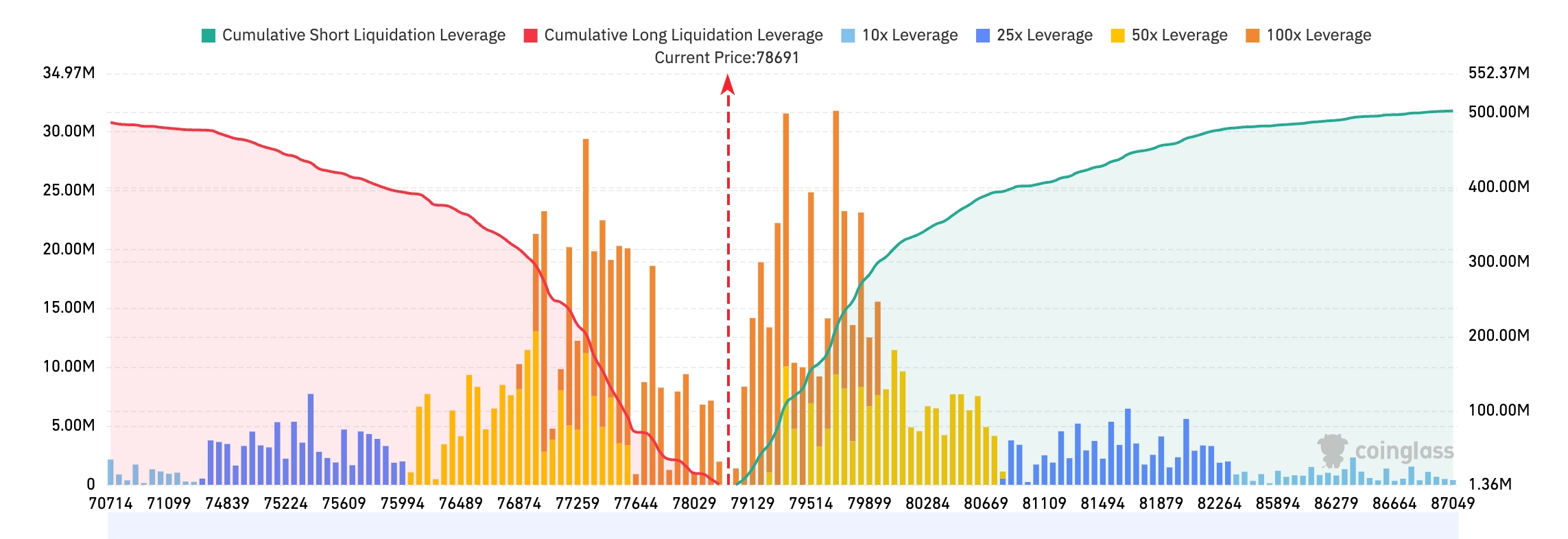
Bitget’s BTC/USDT liquidation map showed BTC trading near $78,700, with a large pocket of short liquidation pressure concentrated in the $79,500 to $80,000 range. A break above $80,000 could trigger a larger short squeeze. On the downside, long liquidation clusters were dense between $76,500 and $78,000. If BTC falls below $78,000, leveraged longs could be forced out more quickly, leaving short-term volatility elevated.
Spot ETF flows remained positive, with net inflows of $314 million yesterday and a rolling 24-hour dynamic net inflow of $31.4 million. The report said hotter PCE and caution across risk assets have put short-term pressure on crypto, but the “currency debasement trade” remains in place. Bernstein has positioned Bitcoin as a core hard-asset holding and set a $300,000 target for the end of 2029. The note said the institutional consensus still points to consolidation at high levels, with liquidity conditions and risk appetite after Warsh’s speech as the next key variables.
U.S. equity indexes
- Dow Jones Industrial Average: 53,463.88, down 0.21%
- S&P 500: 7,675.70, down 0.02%
- Nasdaq Composite: 26,130.20, down 0.08%
The major indexes slipped modestly as investors waited for Nvidia’s guidance to be digested.
Big Tech moves
- NVDA: $210.00, down 1.43%; about $218.50 after hours, up more than 4%
- AAPL: $315.20, up 1.71%
- MSFT: $496.50, up 0.97%
- GOOGL: $342.03, down 1.42%
- AMZN: $260.31, down 0.29%
- META: $576.37, up 1.11%
- TSLA: $345.65, down 1.31%
The note said the hotter PCE print left the three major indexes slightly lower and kept investors cautious ahead of Nvidia’s earnings. Memory and optical communication stocks continued to advance, and cybersecurity names broadly moved higher. Nvidia’s after-hours earnings release and its fiscal 2028 revenue growth outlook of about 70% sharply improved sentiment and lifted tech futures, shifting the focus from macro caution back to company-level fundamental validation.
Sector moves
Memory names kept climbing. Western Digital rose more than 4%, Seagate Technology gained more than 3%, Sandisk added more than 1%, and Micron Technology edged higher. The report tied the move to the ongoing DRAM supply-demand tightness narrative and continued investor positioning in memory as a bottleneck within the AI hardware chain.
Optical communications stocks jumped. Lumentum gained more than 6%, Ciena rose more than 4%, Corning advanced nearly 4%, and Coherent was up more than 2%. The stated driver was that AI high-speed interconnect demand remains intact and the rebound after an earlier pullback is still playing out.
Cybersecurity stocks moved higher across the board. Okta surged nearly 21% after hours, while CrowdStrike, Cloudflare, and Datadog each rose more than 2%. The report attributed the move to better earnings and order expectations, along with renewed inflows into defensive software.
Single-stock focus
1. Nvidia (NVDA): fiscal Q2 2027 results beat expectations and guidance stretched well beyond the near term
Nvidia reported fiscal 2027 second-quarter revenue of $96.2 billion, up 106% year over year, and adjusted EPS of $2.22, up 120%. Data center revenue reached $89 billion, up 117% and above market expectations. Both GAAP and non-GAAP gross margin were 75.0%.
CFO Colette Kress gave an unusual fiscal 2028 revenue growth outlook of about 70%, well above the roughly 44% previously expected by analysts, and said the outlook would be “much higher” without supply constraints. CEO Jensen Huang said demand growth is close to 100% and that the 70% figure is a cautious forecast based on current supply capacity. Shares rose more than 4% after hours.
The report said institutions viewed the release as a strong confirmation of durable AI demand. Giving a high-growth outlook a year in advance is rare and suggests substantially better order visibility. At the same time, supply constraints imply pricing power and capacity bottlenecks remain in place. Analysts are watching whether the guidance can be delivered, whether customer capex starts to diverge, and whether gross margin can hold up as memory costs rise.
Its investment takeaway was that the medium-term thesis has been strengthened by demand validation, though valuation already reflects part of the optimism, making supply expansion and next quarter’s data center guidance the key items to track.
2. Apple (AAPL): foldable iPhone event set for Sept. 10
Apple confirmed that it will hold its fall product event at 1:00 a.m. Beijing time on Sept. 10 under the tagline “Surprise and Shine.” The market expects Apple to unveil its first foldable iPhone along with the iPhone 18 Pro and Pro Max, featuring a faster chip and longer battery life.
The event will also be the first major product launch led by new CEO John Ternus. The report said institutions see foldables as a new starting point for a hardware innovation cycle, one that could support upgrade demand and Apple’s services ecosystem. Analysts are focused on pricing, yield, and initial shipment size, while the event itself is seen as supportive for near-term sentiment.
The note’s investment takeaway was that Apple remains suitable as a steadier technology allocation, with product pricing and early sales data as the main markers to watch.
3. Meta (META): settlement with multiple U.S. states could reach about $18 billion
Meta agreed to pay up to about $18 billion to settle litigation with multiple U.S. states over the impact of social media on minors, ending what the report described as a landmark case.
Institutional commentary in the note said the one-off payment is large, but it removes a long-running legal overhang and could help investors refocus on Meta’s advertising and AI businesses. Near-term profit may take a hit, but medium-term regulatory tail risk would decline.
The report said investors should watch the actual impact on free cash flow and share repurchases, as well as any changes in the regulatory environment that follow.
4. Lumentum (LITE): optical communications remains a leading group
Lumentum rose more than 6%, with Ciena, Corning, and Coherent also moving higher as the broader optical communications segment gained.
The note said institutions believe demand for 800G and 1.6T optical modules in AI data centers remains in an expansion phase, and that the rebound after earlier weakness still has fundamental support. Order visibility and capacity ramp remain the main points to monitor.
Its investment takeaway described the segment as a high-beta thematic allocation tied to optical-module demand and the pace of capital spending deployment.
5. Okta (OKTA): cybersecurity names surge after hours
Okta jumped nearly 21% after hours, while CrowdStrike and Cloudflare moved higher as well.
The move was tied in the report to better earnings expectations and renewed flows into defensive software in a macro environment that remains uncertain. It also said identity security and zero-trust demand retain a degree of rigidity.
The note cautioned investors to follow future guidance and order quality rather than extrapolate a single day’s price move in a straight line.
Market and project updates
1. BlackRock head of digital assets Robbie Mitchnick said Bitcoin’s recent rise is closely tied to the U.S. $40 trillion debt issue. U.S. federal debt surpassed $40 trillion on Aug. 18, double the 2017 level. Interest expense is nearing $1 trillion and accounts for more than 14% of total federal spending. Mitchnick said debt and deficit levels are the market’s main concern and that this concern is pushing investors toward Bitcoin and gold as hedges.
2. According to Bloomberg, gold and Bitcoin ETFs attracted a record combined $7 billion of inflows over the past five trading days. SPDR Gold Shares (GLD) took in nearly $3.4 billion, while BlackRock’s iShares Bitcoin Trust (IBIT) drew $1.5 billion. Both ranked among the top 10 U.S. ETF inflows for the week. Bloomberg said investors are buying both gold and Bitcoin as hedges against fiscal anxiety. U.S. Treasury Secretary Bessent’s announcement of expanded long-dated Treasury buybacks weakened the dollar and pushed yields lower, supporting demand for scarce assets. Bernstein analyst Gautam Chhugani said rising rates and heavy sovereign debt burdens benefit non-dilutable assets such as Bitcoin. Bridgewater founder Ray Dalio recommended allocating as much as 15% to gold and Bitcoin to hedge against the risk of a U.S. debt crisis. Bitcoin has already moved above $80,000 this month, while gold has risen above $4,600 an ounce.
3. Bernstein expects Bitcoin to reach $300,000 by the end of 2029 and identifies it as the core asset in the “currency debasement trade.” Analysts at K33 and Bitwise said Bitcoin’s recent historic short squeeze, combined with macro shifts linked to U.S. Treasury Secretary Scott Bessent’s intervention in the bond market, may signal a broader bull-market reset in crypto after months of weakness.
4. Apple confirmed its Sept. 10 fall launch event, with the market focused on the company’s first foldable iPhone.
5. Meta reached a settlement with multiple U.S. states in the social media case, with payments that could total about $18 billion.
6. According to CoinDesk, Ripple stablecoin RLUSD has surpassed a $2 billion market capitalization. About $963 million is deployed on the XRP Ledger, and about $1.1 billion has been issued on Ethereum. Ripple has previously said RLUSD will be paired with its global payments network to offer more efficient on-chain liquidity solutions for enterprises and financial institutions.
Today’s calendar
Data to watch
The report flagged U.S. initial jobless claims and trade balance data as key releases.
Event schedule
On Thursday, Aug. 27, the U.S. is set to release initial jobless claims, trade balance, and wholesale inventories, while the Jackson Hole conference opens. Marvell (MRVL), Ulta, and Gap are scheduled to report after the close.
On Friday, Aug. 28, Federal Reserve Chair Warsh will deliver a keynote speech at Jackson Hole at 22:00 Beijing time, with markets focused on his remarks on inflation and the policy path. The U.S. will also publish Chicago PMI, the preliminary benchmark revision to nonfarm payrolls, and final University of Michigan consumer sentiment.
Institutional view in the note
The report said investment-bank analysts remain alert to sticky inflation after the hotter July PCE reading, but that Nvidia’s upside earnings surprise and long-range growth guidance have sharply repaired the AI demand narrative. Trump’s comment that there is no timetable for renewed Iran talks has made it harder for geopolitical premium to fall further. Memory and optical communications continue to show relative strength as bottleneck segments. In crypto, the market remains in a high-level consolidation phase within the “debasement trade” framework.
Its strategy summary was to treat Warsh’s speech and Nvidia’s ability to deliver on guidance as the key near-term variables, stay flexible on richly valued growth names, and keep an eye on power equipment, memory, and optical communications, where supply constraints remain meaningful.
The original report also carried a disclaimer stating that the content was compiled with AI-assisted search and manually verified for publication, that it does not constitute investment advice, and that some data discrepancies may be unavoidable and should be checked against real-time market figures.
A separate disclaimer added that markets involve risk, investment requires caution, and readers should judge whether any opinion, view, or conclusion in the article fits their own circumstances before making investment decisions.