
Oil retreats after US-Iran pause in hostilities
Bitget UEX said in its daily report that the United States and Iran have paused military strikes against each other for several days, with both sides signaling a degree of de-escalation. That has lifted expectations for ceasefire talks and pushed down both Brent and WTI crude, removing part of the geopolitical premium that had built up in recent sessions.

The report said the fall in energy prices has eased near-term inflation worries and cooled rate-hike expectations that had intensified when oil was surging. Markets are now watching how the inflation path evolves and what the Federal Reserve does next. In Bitget UEX’s reading, lower oil prices and softer demand for safe-haven assets have given rate-sensitive and risk assets some support.
Across commodities and foreign exchange, spot gold was around $4,109 per ounce, up 1.36%, while spot silver traded near $60.0 per ounce, up 2.45%. WTI crude was about $85.4 a barrel, down 4.42%, and Brent crude was about $82.68, down 4.33%. The US Dollar Index stood near 101.7, off 0.3%.
According to the report, the pause in US-Iran attacks sharply reduced the geopolitical risk premium, making the drop in crude the dominant market driver. Gold and silver diverged as oil fell and risk appetite improved, with silver getting some support from its industrial demand profile. The dollar stayed relatively steady. Bitget UEX cited institutional views saying commodities are still being steered mainly by easing geopolitical tensions, with cross-asset moves following a chain in which lower oil prices cool inflation fears and in turn support risk assets.
Crypto market rebounds, with ETH outperforming BTC
In crypto, BTC traded around $65,195, up 1.11%, while ETH changed hands near $1,974, up 3.65%. Total cryptocurrency market capitalization rose about 1.7% to roughly $2.31 trillion. Total liquidations over 24 hours were about $213 million, including around $160 million in short liquidations.
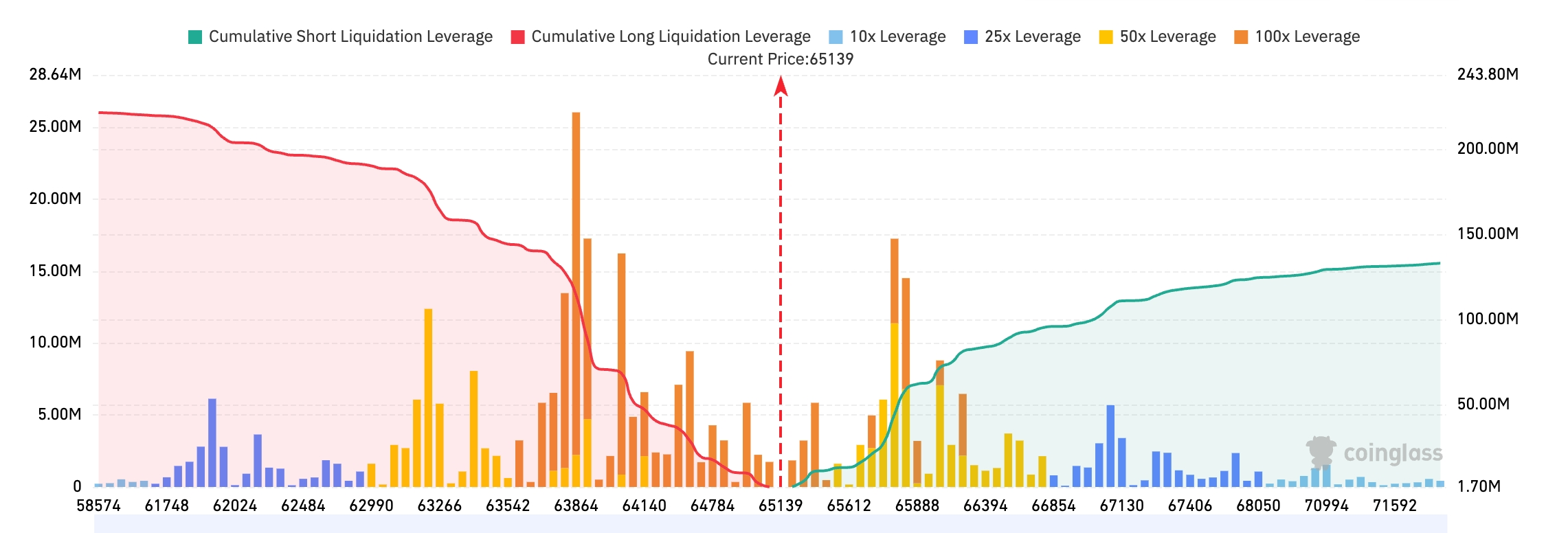
Bitget’s BTC/USDT liquidation map showed the current price near $65,139. It said downside long liquidation pressure has largely been cleared, while a sizable cluster of short liquidation orders sits in the $65,700 to $66,000 range. If price continues higher, that area could trigger short covering and amplify upside momentum. The report added that $63,800 to $64,200 had previously been a major long liquidation zone and has now been cleared to a large extent. Near-term leveraged positioning has shifted upward, leaving the market focused on possible chain-reaction short liquidations in the $65,800 to $67,100 range and on whether any breakout can hold.
The report linked the crypto rebound to easing Middle East tensions and falling oil prices, which improved appetite for risk. BTC held a key range and moved modestly higher, while ETH showed stronger elasticity. It also said a better macro backdrop and funding conditions are supporting the short-term trend, though ETF flow volatility and liquidation data suggest traders remain cautious. Any renewed geopolitical flare-up, it warned, could still affect sentiment.
US stocks close mixed as Apple rises and tech remains under pressure
As of last Friday’s close, the Dow Jones Industrial Average stood near 51,947, up 0.46%. The S&P 500 finished around 7,412, up 0.05%. The Nasdaq closed near 24,976, down 0.64%, with technology shares still facing pressure.
Moves among megacap tech names were uneven. Nvidia traded at $206.84, down 0.92%. Apple closed at $333.02, up 3.53%. Microsoft ended at $381.70, up 0.03%, and Alphabet at $319.74, up 0.65%. Amazon fell 0.66% to $232.11, Meta dropped 1.80% to $595.19, and Tesla lost 2.08% to $313.03.
Bitget UEX said Apple was the main source of support for the group, while Microsoft and Alphabet posted only modest gains. Nvidia, Amazon, Meta and Tesla all declined, with Tesla seeing the larger drop among them. The report said earlier concerns about AI capital spending are still weighing on high-valuation growth shares, though easing geopolitical stress and weaker oil prices have provided some offset. The split performance, it argued, shows the market moving away from pure thematic trading and toward repricing based on company fundamentals and capital efficiency.
Semiconductors and optical names slide, software holds up better
The report said semiconductor and memory stocks led the day’s declines. Micron fell 6.99%, Intel lost 7.89%, Western Digital dropped about 6.9%, and Marvell slipped about 7.3%. Bitget UEX said profit-taking followed an earlier run-up driven by AI demand expectations, while concerns over the pace of returns on capital spending added pressure and increased volatility in memory and semiconductor subsectors.
Optical communications and related technology names also fell sharply. Coherent dropped about 9.8% and Lumentum fell about 8.5%. The report tied that move to cooler sentiment around AI optical module and interconnect themes, with capital rotating out of higher-beta niches.
Software and some growth stocks were more resilient and in some cases advanced. ServiceNow rose about 7.4%, and the report said some software and services names held up well as investors shifted part of their exposure away from AI hardware toward software and cloud services.
Energy stocks were relatively steady. Exxon Mobil rose 0.03% and Chevron gained 0.19%. Bitget UEX said Friday’s close did not yet fully reflect the weekend de-escalation and the subsequent slide in crude, leaving the sector stable for the day but potentially exposed on Monday.
Company deep dives: Intel, Tesla, Alphabet, AMD and Nvidia
Intel: strongest revenue growth in 15 years
Bitget UEX said Intel posted second-quarter revenue of $16.13 billion, up 25% year over year, marking its strongest growth in 15 years. Adjusted EPS came in at $0.42, well above the $0.21 estimate cited in the report. Revenue from data center and AI operations reached $6.26 billion, up 59%. Client computing grew 13%, and foundry revenue rose 31%. Operating margin improved from negative territory a year earlier to about 17%, while operating cash flow increased more than 240% year over year.
The company guided for third-quarter revenue of $15.8 billion to $16.8 billion and adjusted EPS of $0.38, both above market expectations. The CEO said AI is driving unprecedented computing demand and that capital expenditures in 2027 will be significantly higher than in 2026.
The report said institutions broadly see the quarter as a genuine turning point, with AI demand reviving Intel’s server CPU business and creating strong operating leverage. It also cited a Seeking Alpha view that the foundry business remains deeply loss-making and highly dependent on internal demand, with limited progress on external customers, leading to a “hold” rating because the current valuation already prices in foundry breakeven and sustained high growth. Wall Street is also watching 18A process progress, possible large outside customers such as Apple, Microsoft and Amazon, and the effect of sharply higher capex on free cash flow.
Tesla: record deliveries, weaker profit and cash flow
Tesla reported record second-quarter revenue of $28.24 billion, up 26% year over year, with record deliveries of 480,100 vehicles. But adjusted EPS was only $0.33, below an estimate of about $0.53 in the report. Operating profit fell 57% year over year to $398 million, and operating margin dropped from 4.1% a year earlier to 1.4%.
Free cash flow turned negative at about $1.09 billion, while capital expenditures jumped 142% year over year to $5.79 billion, mainly for AI, Robotaxi and Optimus. Regulatory credit revenue dropped 67%. Energy storage deployments reached 13.5 GWh. Elon Musk continued to emphasize progress on Robotaxi and Optimus during the earnings call, but the report said the market remains highly skeptical about the timeline.
Bitget UEX said strong delivery figures do not change the core issue of deteriorating profit and cash flow. Heavy spending on AI and robotics is putting clear pressure on short-term earnings power. Some views highlighted the energy segment as a bright spot, but the report said investors still need to see how returns convert after the capex peak. It pointed to future Robotaxi operating mileage, FSD subscription growth and any changes to full-year capex guidance as the metrics to watch.
Alphabet: cloud strength versus higher capital spending
Alphabet posted second-quarter revenue of about $119.8 billion, up roughly 24% year over year. Google Cloud revenue reached $24.8 billion, up 82%, while operating profit improved sharply and cloud backlog climbed to $514 billion.
At the same time, the company raised its full-year capital spending guidance to $195 billion to $205 billion from a prior $180 billion to $190 billion. Quarterly capex was about $44.9 billion, and free cash flow turned negative by around $5.9 billion. Management said demand continues to exceed supply and that the company will keep expanding both owned and leased capacity.
The report said institutions acknowledge the strength of cloud growth and AI infrastructure demand, but worry that repeated capex increases may lengthen the payback period and weigh on short-term cash flow. Analysts are watching search advertising resilience, the pace of TPU sales and whether 2027 capex rises again. In the report’s summary, market focus has shifted from confirming growth to testing spending efficiency.
AMD: partnership with Cerebras targets AI inference split
AMD announced a partnership with Cerebras Systems to combine its Helios rack-scale system with Cerebras wafer-scale chips in a joint product aimed at ultra-low-latency inference. The solution is expected to launch later this year through Cerebras Cloud. The report said AMD chips will focus on prompt processing and large context windows, while Cerebras will focus on high-bandwidth token generation, with the two companies claiming higher performance per watt.
Bitget UEX also noted that AMD had previously announced a plan to supply up to 2 gigawatts of compute to Anthropic and invest as much as $5 billion. The report said institutions view the new partnership as a sign of workload disaggregation in AI, helping AMD build a differentiated position in the inference market relative to Nvidia. Analysts are watching the deployment timeline, real-world performance comparisons and whether the partnership converts into sustained orders.
Nvidia: $1.5 billion prepayment for US advanced packaging
Nvidia entered a multi-year strategic partnership with Amkor Technology and will provide a $1.5 billion prepayment to support the expansion of advanced semiconductor packaging and testing capacity in the United States, especially in Arizona. The two companies will also jointly develop packaging technologies for next-generation AI and accelerated computing platforms, including high-density interconnect and heterogeneous integration.
The report said institutions see the deal as strengthening Nvidia’s control over a key part of the advanced packaging supply chain and reinforcing US-based capacity, in line with continuing AI infrastructure expansion and supply-chain security needs. Analysts are watching the production timeline, with the Amkor project expected to enter mass production in 2028, and what the arrangement means for AI hardware costs and delivery schedules.
Market and project developments
The report also listed a series of market and project updates:
- Iranian military spokesperson Mohammad Akraminia told official media that Iran has halted retaliatory attacks because the United States did not strike the country over the past two nights, and that Iranian action is currently paused.
- Madhavi Arora of Emkay Global said the rebound in Brent crude is no longer driven only by known risks in the Strait of Hormuz and the latest Red Sea blockade. She said visible shipping through Hormuz has fallen close to zero, global inventories have been exhausted, and new supply disruptions are adding tension. She also said Russian fuel exports remain constrained after months of Ukrainian drone attacks, while Kazakhstan has started cutting output after the shutdown of the Caspian Pipeline Consortium export terminal.
- Based on a GitHub Trending page publicly shown by Twitter co-founder Jack Dorsey, Block’s open-source collaboration platform Buzz, permissionlesstech’s decentralized Bluetooth chat app BitChat and citrolabs’ AI browser ego-lite ranked among the top three trending repositories globally on the day.
- Data in the report said SUI, EIGEN and FF are set for large token unlocks this week, with SUI alone accounting for nearly $10 million.
- According to Fortune, the Trump administration in the United States has invested about $26.7 billion through equity or equity-like instruments in Intel, MP Materials, Vulcan Elements, xLight and several quantum computing companies via at least four agencies, including the Department of Commerce, Department of Defense, Department of Energy and US International Development Finance Corporation. The report said the Department of Commerce holds a passive stake of about 9.9% in Intel, whose market value has risen from roughly $8.9 billion to about $42.0 billion.
- Nvidia is in talks to provide about $250 billion in financial backing for OpenAI to support a massive data center project, a deal the report said could become one of the largest financing transactions in the US AI boom.
- POSCO International, described in the report as South Korea’s largest trading company, is working with LG Group technology company LG CNS to tokenize real commercial invoices on the Injective network.
This week’s calendar: Fed decision, core PCE and major tech earnings
Bitget UEX, citing PAnews, said a combination of surging energy prices, new US tariffs and rising AI capital spending has reignited global inflation fears. The Nasdaq led declines this week, with tech shares facing pressure from both macro factors and fundamentals. The Philadelphia Semiconductor Index fell 5% on Friday, and memory chips were among the hardest hit. Investors remain cautious ahead of next week’s Federal Reserve policy meeting, with some expecting a hawkish surprise.
The report highlighted the following market events for the week, all in UTC+8:
- Tuesday 20:15: US weekly ADP employment change for the week ending July 11.
- Thursday 02:00: Federal Open Market Committee rate decision.
- Thursday 02:30: Federal Reserve Chair Waller holds a monetary policy press conference.
- Thursday 17:00: Eurozone second-quarter GDP annual rate preliminary reading, June unemployment rate, July industrial sentiment index and July economic sentiment index.
- Thursday 19:00: Bank of England rate decision, meeting minutes and monetary policy report.
- Thursday 19:30: Bank of England Governor Bailey press conference.
- Thursday 20:30: US initial jobless claims, June core PCE inflation annual and monthly readings, June personal spending monthly rate, and preliminary second-quarter annualized GDP, real personal consumption expenditures and core PCE annualized quarterly rate.
- Friday 17:00: Eurozone preliminary July CPI annual and monthly readings.
- Friday 21:45: US July Chicago PMI.
- Friday 22:00: Final July University of Michigan consumer sentiment and final one-year inflation expectations.
Major technology earnings are also due this week, including Apple, Meta Platforms, Amazon, Microsoft, Qualcomm and SK Hynix.
In the institutional view section, the report said investment bank analysts see the pause in US-Iran hostilities as a major factor behind the decline in geopolitical risk premium. The drop in crude prices, it said, helps ease inflation and rate-hike expectations and lifts short-term risk sentiment. Friday’s split close in US equities showed that tech is still dealing with earlier concerns over AI spending, even as the macro backdrop has improved. Crypto, according to the report, has moved higher with the rebound in risk appetite.
The original note also carried a disclaimer saying the content was compiled using AI search and manually verified for publication, does not constitute investment advice, and may contain data discrepancies relative to live market readings.