
Bitget UEX’s July 22 daily report said U.S. stocks rebounded sharply after a run of declines, with memory-chip names leading the move, while precious metals and crude oil rose in tandem. Crypto also recovered alongside broader risk appetite, with Bitcoin back above $66,000 and spot ETF flows staying positive.

Top developments
Gold, silver and oil moved higher together
The report said gold and silver posted notable gains and crude also climbed. Geopolitical factors and supply-demand conditions were both cited as drivers. In Bitget UEX’s framing, the synchronized rise across commodities reinforced both inflation and safe-haven narratives at the same time, creating some pressure for rate-sensitive assets.
Risk sentiment improved, with technology and memory names driving the rebound
After several sessions of pullback, U.S. equities staged what the report described as a sharp rebound. Memory-chip stocks were the core engine of the move. Capital rotated out of defensive positioning and back into growth and AI-linked names. The note said short-term risk appetite had improved, but added that the durability of the rally still depends on earnings and macro data.
Market review
Commodities and the dollar
- Spot gold: about $4,115 per ounce, +0.92%
- Spot silver: about $59 per ounce, +1.65%
- WTI crude: about $85.47 per barrel, +1.32%
- Brent crude: about $92.4 per barrel, +1.15%
- U.S. Dollar Index (DXY): about 101.16, -0.03%
The report said the joint strength in precious metals and crude reflected a rise in geopolitical risk premium and safe-haven demand, with tight supply and expectations for AI-related industrial demand adding support. Silver outperformed gold, which the note said pointed to a stronger industrial-demand angle. The dollar moved only slightly, offering some headwind for metals but not enough to stop the advance.
On the institutional view cited in the report, commodities remain driven mainly by macro uncertainty in the short run, and cross-asset linkage is still pronounced. If risk events ease, prices could retrace, though the medium-term supply-demand setup remains constructive.
Crypto performance
- BTC: about $66,666, +1.45%
- ETH: about $1,940, +1.14%
- Total crypto market cap: $2.34 trillion, +1.2%
- 24-hour liquidations: $205 million in total, including $159 million in short liquidations
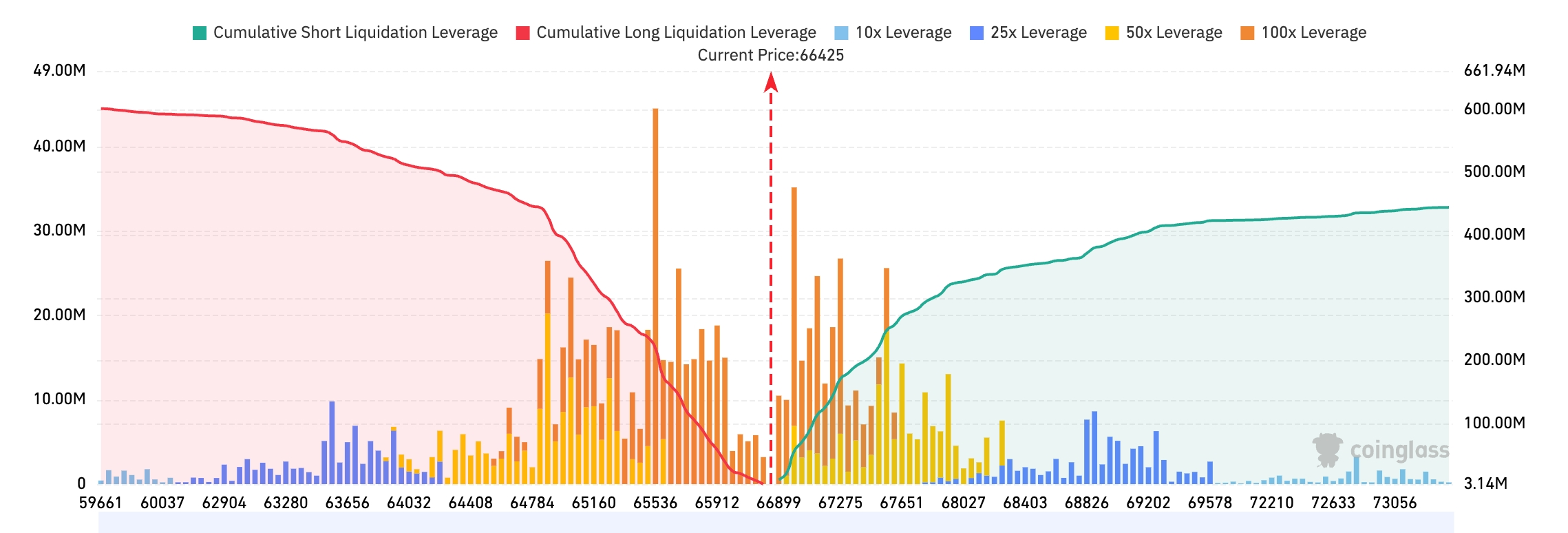
Bitget’s BTC/USDT liquidation map put the current price near $66,425. Below that, the $65,500 to $66,000 band holds a dense concentration of high-leverage long liquidations. If price drops through that zone, the report said, it could trigger a chain of long liquidations and accelerate downside. Above the market, a larger short-liquidity pool sits between $67,500 and $69,000. That leaves room for an upward liquidity sweep in the near term. A break above $67,000, the note said, could quickly lift BTC beyond $68,000.
On ETF flows, spot Bitcoin ETFs recorded net inflows of $227 million yesterday, with current rolling 24-hour net inflows at $39.3 million. That marks six consecutive days of net inflows. The report said the crypto rebound was supported by both improving equity risk appetite and ETF demand. Bitcoin held its key range and moved higher, while Ether followed but showed less upside elasticity. Liquidation data, in Bitget UEX’s view, suggested sentiment remains cautious even as technical repair and macro linkage continue to drive the market.
U.S. stock indexes
- Dow Jones Industrial Average: about 52,225, up about 0.74%, ending a run of declines
- S&P 500: up about 0.9%
- Nasdaq: up about 1.3%, leading the three major indexes
The report said technology and semiconductors were the clearest drivers of the rebound.
Large-cap tech performance
- NVDA: 207.29, +1.97%
- AAPL: 327.74, +0.35%
- MSFT: 397.75, -1.13%
- GOOGL: 347.15, -1.38%
- AMZN: 247.55, -0.98%
- META: 643.81, -0.32%
- TSLA: 378.93, +2.53%
Bitget UEX said tech stocks broadly benefited from the return of risk appetite, but the strongest gains were concentrated in memory and semiconductor sub-sectors. Expectations for AI capital spending and supply-chain tightness strengthened the trade, while single-stock performance stayed mixed. The note said money was chasing earnings sensitivity and supply-demand scarcity themes rather than a simple valuation rebound.
Sector moves: memory chips and semiconductors led
Memory and semiconductor shares outperformed sharply. Among the names highlighted, Micron Technology (MU) rose more than 12% to about $970.82, AMD gained about 7.87%, and Intel added about 8.02%.
The report tied the move to continued strength in demand for AI servers and high-bandwidth memory, a renewed expectation of supply-chain tightness, and concentrated buying after the prior pullback. The market, in the report’s wording, was pricing in an upswing in the memory cycle ahead of earnings. Institutions cited in the note said further upside remains possible if coming results validate demand, though near-term profit-taking risk should not be ignored.
Growth and technology stocks also rebounded
The report said growth-oriented technology names moved higher as well, mentioning Microsoft, Google and AI or cloud-related names such as NVDA and AMZN. The drivers were improving risk appetite and a rotation of AI-focused capital back into growth. Even so, the gains lagged the memory sub-sector, underscoring continued internal divergence.
Single-stock focus
Micron (MU): memory demand fuels a surge
Micron jumped more than 12% in a single session and closed near $970, making it the focal point of the day, according to the report. Its HBM capacity has been sold out through 2026 under fixed-price contracts, while AI data center demand for high-bandwidth memory remains tight. As discussion around AI capex has intensified, memory has become a favored bottleneck play, and the report said data center revenue now accounts for more than half of Micron’s business.
The note added that several institutions, including UBS and Citi, raised price targets into an $800 to $1,750 range and see the supply-demand gap potentially extending into 2027. Analysts cited in the report pointed to Micron’s positioning in HBM3E and HBM4, along with long-term supply agreements, as sources of unusual revenue visibility. At the same time, the report said traditional memory-cycle risk remains worth watching.
Tesla (TSLA): after-hours earnings will put Robotaxi and deliveries in focus
Tesla is scheduled to report second-quarter results after the U.S. close on July 22. The report said Q2 deliveries rose about 25% year over year to the best level for the same period on record, with production at about 452,000 vehicles. Wall Street expects non-GAAP EPS of about $0.55 and revenue of about $27.5 billion. The market is focused on gross margin, Robotaxi progress, energy storage and forward guidance.
Bitget UEX said institutions see some earlier aggressive timelines, including Robotaxi-related expectations, as not fully delivered, which has partly weakened confidence. In that reading, the recent bounce in Tesla shares owes more to broader risk appetite than to a company-specific reset. Execution, competition and the commercialization path for AI and autonomous driving remain the key variables.
IBM: earnings due after the bell, with AI and cloud growth under review
IBM is set to release full second-quarter earnings at 5 p.m. Eastern Time on July 22. The report said the company had previously guided to about $17.2 billion in Q2 revenue, up about 1% year over year, and adjusted EPS of about $2.93, both below market expectations. That miss led to an earlier one-day drop of about 25% in the stock. Investors are now watching how hybrid cloud, software and consulting perform under what the report described as pressure from AI budget reallocation.
The institutional view cited in the note said the AI capex boom could crowd out enterprise software budgets and slow growth. If guidance later on July 22 shows a warmer pipeline or faster contribution from AI solutions, the stock could recover. If not, the longer-term growth case will need more proof.
Alphabet (GOOGL): cloud growth and AI returns are the key earnings questions
Alphabet is also due to report after the bell on July 22. Wall Street expects revenue of about $100 billion to $117 billion, up roughly 21% year over year, and EPS in a range of about $2.87 to $2.93. The report said investors are also watching for Google Cloud growth of more than 60%, TPU chip sales, progress around Gemini models and full-year capital spending, which was previously guided to $180 billion to $190 billion.
According to the report, institutions believe Alphabet’s vertical integration can help with cost control and efficiency, but the speed at which AI investment turns into revenue still needs to be proven. Search-ad resilience, cloud margin improvement and performance in the “Other Bets” segment were all cited as major watch points.
AAOI: AI optical-network demand drives a volatile move
Applied Optoelectronics (AAOI) saw a large swing as AI optical-network demand strengthened, with the stock up more than 15% on the day. The report said the company is expanding manufacturing capacity in Texas to support high-end optical modules such as 800G products, benefiting from strong demand for high-speed optical interconnects from hyperscale data centers.
Institutions cited in the report said AAOI is highly sensitive to data-center optical module orders because of its role in the AI optics supply chain. Short-term volatility may amplify the theme, but long-term growth still depends on the pace of AI infrastructure buildout, order conversion and execution on capacity expansion.
AXTI: semiconductor materials niche also gains AI exposure
The report said AXTI, a compound semiconductor materials supplier, is an indirect beneficiary of AI photonics and advanced packaging demand. Its shares have shown high beta during sector rotation. The institutional view in the note was that upstream materials names are sensitive to AI supply-chain momentum, but their fundamentals still rely on downstream order confirmation and technical validation. Volatility remains high.
Market and project developments
Bitcoin approaches the $68,000 resistance area
According to The Block, Bitcoin has rebounded about 15% from its July low and is approaching the key $68,000 resistance level. Analysts said that level is close to the average cost basis for buyers over the past five months, which means many investors who were previously underwater may decide to sell once they return to breakeven, creating overhead pressure.
The report added that the $68,000 region also marks the mid-June high. The previous rally attempt failed there and was followed by a drop below $58,000. Analysts expect the first test of that resistance to trigger a strong market reaction.
On broader conditions, the report said U.S. spot Bitcoin ETFs have shifted from persistent outflows to mild inflows, though demand has not fully recovered. Bitcoin’s share of spot trading volume has risen from about 50% a year ago to nearly 67%, suggesting investors still prefer BTC over smaller-cap tokens and that positioning remains defensive. K33 Research said CME Bitcoin futures open interest has fallen to its lowest level since 2023, while 30-day spot volume stands at just 62% of the annual average. Late July is also typically one of the weakest periods of the year, which K33 described as a “typical summer lull.”
Ark Invest bought Securitize shares
Cathie Wood’s Ark Invest bought 16,665 shares of Securitize (SECZ) on Tuesday, worth about $125,654. SECZ rose 13.9% on the day to close at $7.54.
Solana and Hyperliquid ETFs account for most non-BTC, non-ETH ETF trading
The report said Solana and Hyperliquid ETFs now make up nearly 80% of trading volume among ETFs outside Bitcoin and Ether. Solana ETFs have reached $904 million in assets under management, while Hyperliquid ETFs, launched only two months ago, have already attracted $350 million in net inflows. Each figure amounts to roughly 2% of the respective token’s market capitalization. By comparison, Bitcoin ETFs account for about 9% of BTC market value, a gap the report said points to room for altcoin ETF growth.
Satsuma Technology shareholders approved a full Bitcoin sale and delisting
Shareholders of UK-listed Bitcoin treasury company Satsuma Technology approved, with 90% support, a plan to sell all of the company’s Bitcoin holdings, return capital to investors and delist from the London Stock Exchange. The company currently holds 668 BTC, worth about $43.5 million, making it the second-largest listed Bitcoin treasury company in the UK.
Circle set August 5 for earnings
According to Businesswire, stablecoin issuer Circle Internet Group (NYSE: CRCL) said it will report financial results for the second quarter of 2026 on Wednesday, Aug. 5, 2026.
Circle said it will host a live video webcast at 8 a.m. Eastern Time to discuss quarterly financial performance and business progress. The webcast will be open to the public through Circle’s official YouTube and X channels. The report said the market is expected to focus on USDC circulation, reserve income, institutional partnership progress and shifts in stablecoin competition.
BlackRock’s South Korea ETF posted record weekly inflows
BlackRock’s iShares MSCI South Korea ETF (EWY) saw more than $2.8 billion in net inflows last week, the highest weekly total on record and well above the previous $1.2 billion record set in February this year. About 25% of the fund’s position is allocated to SK Hynix.
South Korea’s president called for tighter measures on single-stock leveraged ETFs
South Korean President Lee Jae-myung said at a cabinet meeting that financial regulators should move quickly to put in place and improve related measures for single-stock leveraged ETFs tied to Samsung Electronics and SK Hynix. If necessary, he said, further steps should be studied. He added that the market has broadly criticized such products for having “excessively amplified market volatility” and called for the system to be improved “swiftly and fully.”
Morgan Stanley added to its Bitcoin position
The report said Morgan Stanley bought the dip again over the past week, adding about 115 BTC through its spot Bitcoin ETF MSBT. Its total Bitcoin holdings have now reached 5,876 BTC, worth more than $389 million.
Market calendar
July 22
- Alphabet to report after the close, with attention on AI investment returns and cloud growth
- IBM to report after the close, with investors assessing AI-related business performance
- Tesla to report after the close, with focus on deliveries, robotics and AI progress
July 23
- American Airlines, Blackstone, Lockheed Martin, Nokia and RTX are scheduled to report before the U.S. open
- Intel is due after the close, with chip demand and AI-related outlook in focus
July 24
- Donald Trump is scheduled to attend the White House Correspondents’ Dinner, and his remarks could affect markets
- AMD will host its Advancing AI conference, where CEO Lisa Su is set to speak about AI agents, model optimization and related topics
Institutional view
The report said sell-side analysts broadly see the sharp rebound in U.S. stocks as a result of two forces: memory-chip supply-demand dynamics and improving risk appetite. Short-term technical repair is visible, but whether it lasts will depend on the upcoming earnings cycle. Strength in precious metals and oil suggests macro uncertainty is still present, while crypto has benefited from the return of capital. The report’s overall stance was to stay flexible during the rebound, focus first on AI supply-chain segments with earnings sensitivity, and remain alert to profit-taking and macro-data volatility.
Disclaimer: the report said the content was compiled with AI-assisted search and manually verified for publication, and that it does not constitute investment advice. It also said data may contain deviations and that real-time market figures should prevail.
Risk warning: markets carry risk and investing requires caution. The article does not constitute investment advice, and readers should consider whether any opinions or conclusions cited are suitable for their own situation. Investment decisions based on the article are taken at the reader’s own risk.