
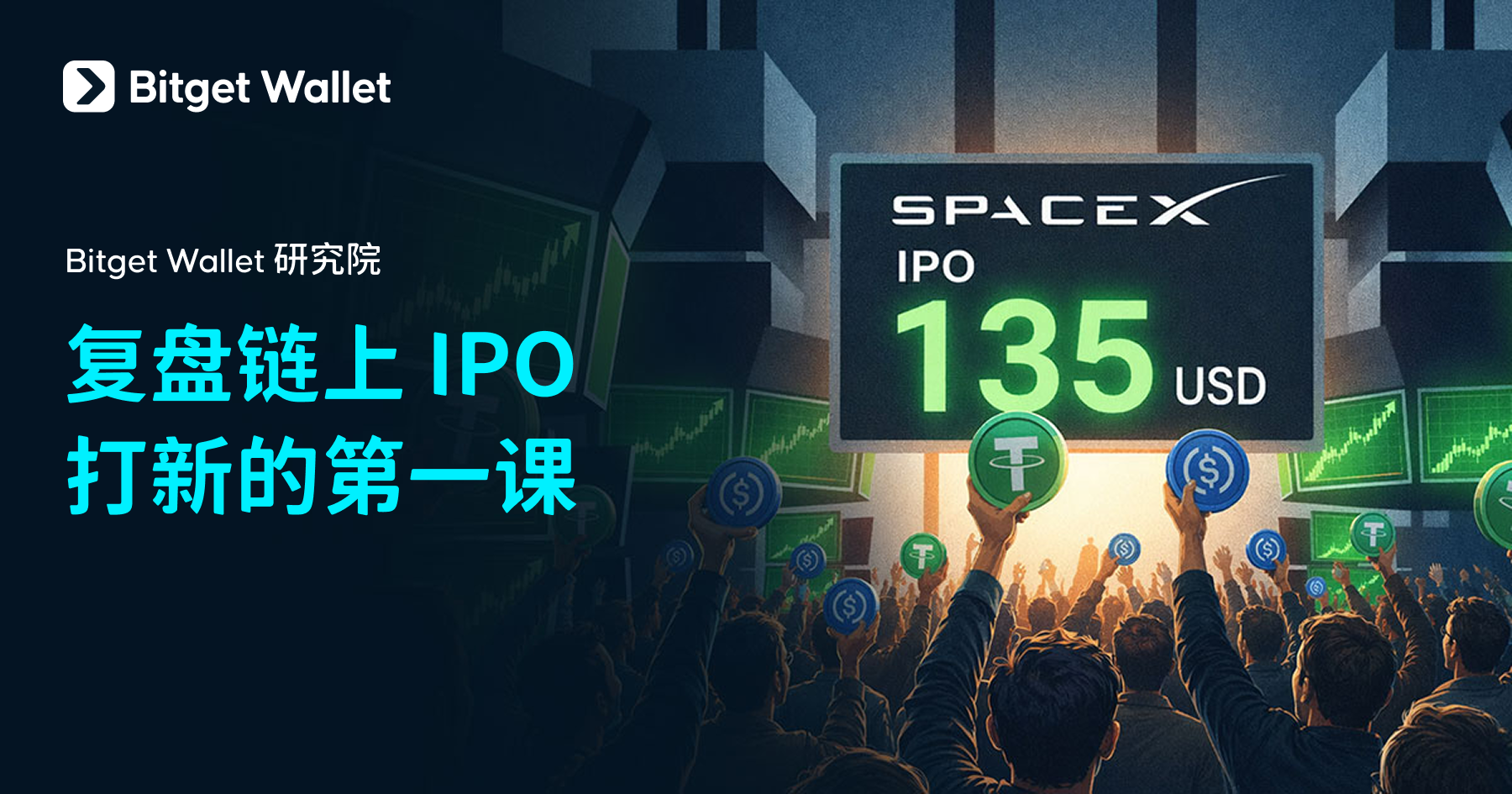
Bitget Wallet researcher Lacie Zhang framed the review of the SpaceX, ticker SPCX, tokenized IPO subscription attempt through an earlier crypto-native story: ConstitutionDAO. In November 2021, a group of strangers gathered more than $40 million within a few days to bid for a first-edition copy of the United States Constitution from 1787. The DAO ultimately lost the Sotheby’s auction to a hedge fund billionaire. It arrived with capital but left without the asset. For many users, that was the first clear demonstration that blockchain rails could rapidly coordinate scattered retail funds from around the world around a scarce real-world asset.
Four and a half years later, a similar distribution impulse appeared in a different venue. On June 12, 2026, SpaceX, trading under the ticker SPCX, listed on Nasdaq. Its opening price was $150, about 11% above the indicated IPO subscription price of $135, and the source described it as the strongest IPO in history. For most users, however, a U.S. stock IPO remains largely inaccessible. Accredited investor requirements, traditional brokerage accounts, and long-standing relationships with underwriters keep most retail participants outside the primary-market allocation process.
Why the SPCX Tokenized Subscription Was Refunded
Several crypto platforms attempted to use tokenization to bring this otherwise restricted IPO exposure on-chain. Bitget Wallet also worked with the tokenized stock platform xStocks to open tokenized subscription access for the SPCX IPO. The individual subscription range was set between $10 and $5,000, reducing the user-side entry requirement to nearly zero and allowing participation through an on-chain interface.
The outcome was not the one participants expected. Because xStocks’ upstream underwriting channel did not obtain the relevant allocation, the underlying shares supporting the tokenized subscriptions could not be delivered on schedule. The attempt ended with refunds. In the review, this failure is presented as the clearest entry point for understanding the real position of on-chain Pre-IPO products: blockchains can distribute access globally, but they do not automatically control the source of supply or the allocation decisions made in traditional finance.
Traditional Underwriters Still Control the Allocation Room
Tokenized IPO subscription is, in essence, the tokenized distribution of IPO allocations that originate from traditional brokerages and underwriting channels. The on-chain layer can change the front end of subscription: users in different locations can participate with stablecoins, without opening a conventional brokerage account. What it cannot change is where the allocation power sits. That power remains with the traditional financial syndicate.
In the case of SpaceX, the joint bookrunners included Goldman Sachs, Morgan Stanley, BofA Securities, Citi, and JPMorgan, among other top investment banks. These institutions organize bookbuilding, collect demand, and ultimately decide how allocations are distributed. The logic of that distribution favors institutions, existing relationships, and long-term clients. Underwriters tend to serve larger orders and investors that can hold positions steadily. The scarcer and hotter an IPO is, the stronger that preference becomes.
SpaceX was oversubscribed by about four times. BlackRock alone placed an order of about $5 billion, leaving extremely limited room for crypto-native channels. The review argues that this is the core mismatch: blockchain has powerful global distribution capacity, but at the decisive allocation point it is operating under rules that belong entirely to another system. Two routes are identified in the source: crypto-friendly institutions can gradually enter traditional underwriting networks through licenses, capital strength, and long-term accumulation; or assets can be issued natively on-chain from the source, bypassing the current IPO allocation structure. Until either route is established, tokenized IPO subscription remains constrained by a supply-side ceiling.
Demand and Execution Were Tested On-Chain
Although delivery failed, the industry-wide attempt was not without signal. On the demand side, more than $800 million in subscription funds gathered within a short period from ordinary users around the world, all directed toward an asset that traditional channels had largely closed to them. Assets such as SpaceX are restricted by geography, qualified investor thresholds, and brokerage account requirements. The on-chain path, by contrast, required only a wallet and stablecoins.
The review also notes a difference after allocation. Traditional IPO participation often comes with anti-flipping constraints. Investors who sell too quickly can face penalties such as commission clawbacks or blacklisting. Tokenized assets typically do not impose a mandatory lockup and can be traded freely once received. For retail users who have long been blocked first by the question of whether they can enter at all, the ability to enter and then move in or out freely is itself a scarce feature.
On the execution side, the event became a real stress test for on-chain infrastructure. Using Bitget Wallet as the example, the review says its self-developed DEX aggregator and multi-chain gas payment system expanded subscriptions to USDC and USDT across five chains. Users could participate with stablecoins on any mainstream chain, without manually bridging or swapping assets, and without being blocked by a lack of native gas tokens. This setup supported more than $13 million of on-chain subscriptions in less than half an hour.
After the failure to deliver was confirmed, full refunds were completed in about four hours. The refund covered principal, fees, and exchange-rate differences, and required no action from users. More importantly, every refund, reconciliation, and status change was recorded on-chain as a publicly verifiable transaction. Compared with traditional brokerage refund processes that rely on internal ledgers and manual coordination, the review presents this as a concrete demonstration of on-chain transparency and execution efficiency.
Tokenized IPO Subscription Versus Pre-IPO Perps
Because tokenized IPO products still cannot change how primary-market supply is created and allocated, the review argues that expectations for this model should be lowered for an extended period. Rather than permissionless and unlimited access, the more realistic form is a stablecoin-based redesign of the traditional IPO participation process. When subscription demand exceeds actual allocation, oversubscription, lotteries, pro-rata allocation, and full refunds will become common outcomes.
Another route is Pre-IPO perpetual contracts, or Perps. The two instruments serve different preferences. Tokenized IPO subscription is closer to a spot structure because it is backed by real underlying assets. It is more suitable for users with lower risk tolerance who do not want leverage or funding-rate erosion. Its trade-off is limited supply and the chance of oversubscription, lottery allocation, or a complete refund. Pre-IPO Perps do not wait for allocation, do not depend on underwriter distribution, and do not require delivery of real shares. They instead trade directly around price expectations for an unlisted asset, offering more flexibility while requiring users to accept leverage and high volatility risk.
The review highlights that Pre-IPO Perps have already shown a degree of price discovery. SPCX perpetual contracts had traded 24/7 on venues including Hyperliquid since May 18, weeks before the formal June 12 listing. Near the listing date, the cross-venue volume-weighted average price was about $155, roughly a 15% premium to the $135 issuance price. The first official listed trade was $150, indicating that the on-chain market had largely converged toward the actual opening price before the stock began trading. Cerebras is offered as another reference point: at listing, Hyperliquid’s Pre-IPO Perp price differed from the $350 opening price by only about 1.3%.
From Losing an Auction to Being Excluded From Allocation
The review closes by returning to the 2021 auction room. ConstitutionDAO lost because its bid was not high enough. The SpaceX tokenized IPO attempt failed because of trust and eligibility: the on-chain channel did not even enter the room where allocations were decided. The reason for failure moved from execution to structure. Mature on-chain infrastructure does not automatically open the off-chain supply side, and these are two separate developments moving at different speeds.
The source compares this mismatch with earlier changes in financial infrastructure, from the emergence of clearinghouses to electronic trading replacing open outcry. New and old systems often coexist for a long time, with repeated friction. Traditional finance will not open IPO allocation doors immediately after one failed subscription attempt, just as Sotheby’s did not change auction rules because ConstitutionDAO appeared. But the friction leaves records: it changes user perception, changes platform capability, and gradually changes how institutions view crypto channels. The key record from this event is that users who took part have already become accustomed to using stablecoins in a wallet to reach an asset that had previously belonged mainly to institutions. When the supply-side access structure changes, the demand side and the infrastructure side will already have completed an important rehearsal.