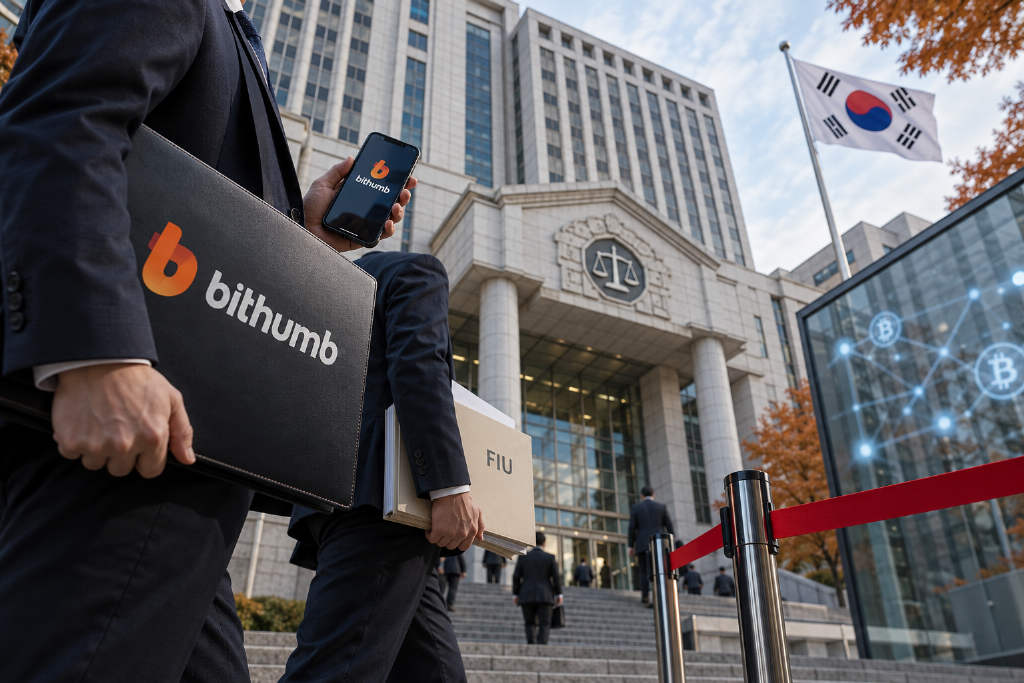
Seoul court opens first hearing in Bithumb lawsuit against South Korea’s FIU

Seoul court opens first hearing in Bithumb lawsuit against South Korea’s FIU

N
News Editor
2026-10-23 05:53:47
The second division of the Seoul Administrative Court held its first hearing on Oct. 22 in an administrative lawsuit between crypto exchange Bithumb and South Korea’s Financial Intelligence Unit, according to Korean media outlet Digital Asset. The FIU said Bithumb conducted 45,772 transfers with 18 unregistered virtual asset operators between Aug. 28, 2022 and Apr. 3, 2025, and imposed sanctions that included a partial business suspension barring new customers from transferring crypto assets to external platforms for six months. In court, Bithumb argued that transfers of KRW 1 million or more were subject to the Travel Rule and that unregistered operators had already been excluded from its list of selectable exchanges, leaving zero improper outbound transfers in that bracket. For transfers below KRW 1 million, the exchange said the Travel Rule did not apply at the time, there was no legal basis to require customers to provide recipient exchange information, and regulators had not clearly defined how blocking should be carried out. Bithumb also challenged the severity of the six-month measure and the FIU’s standards for identifying overseas operators.

According to Korean media outlet Digital Asset, the second division of the Seoul Administrative Court held its first hearing on Oct. 22 in an administrative lawsuit between Bithumb and South Korea’s Financial Intelligence Unit (FIU).

The FIU determined that Bithumb carried out 45,772 transfers with 18 unregistered virtual asset operators between Aug. 28, 2022 and Apr. 3, 2025. Based on that finding, the regulator imposed sanctions, including a partial business suspension that restricts new customers from transferring crypto assets to external platforms for six months.

Bithumb’s arguments in court

Bithumb said transfers of KRW 1 million or more were subject to the Travel Rule, and unregistered operators had already been removed from the list of selectable exchanges. On that basis, the exchange argued that the number of improper outbound transfers in that amount range was zero.

For transfers below KRW 1 million, Bithumb said the Travel Rule did not apply at the time. The company also argued that it had no legal basis to require customers to provide information on the receiving exchange, and that regulators had not clearly specified how blocking measures should be implemented.

Bithumb also told the court that after integrating the Chainalysis API, only about 2% of addresses that could not be identified were later classified as unregistered operators designated by the FIU. The exchange said blocking all such addresses would also affect the remaining 98% of normal transactions and could expose the platform to user claims.

Challenge to the penalty and FIU standards

Bithumb also argued that the six-month sanction was excessive and, in practice, amounted to a ban on acquiring new customers.

The company further questioned the FIU’s standards for identifying overseas operators and the reasonableness of the basis used for the sanctions.

This article was originally published by Bit.Fan. For more cryptocurrency news and market insights, visit www.bit.fan.
100

Disclaimer:

The market information, project data, and third-party content displayed on this platform are for industry information sharing only and do not constitute any form of investment advice or return commitment.

Cryptocurrency trading carries high risks. Users should fully assess their risk tolerance and make independent decisions. All profits, losses, and legal responsibilities are borne by the users themselves.