
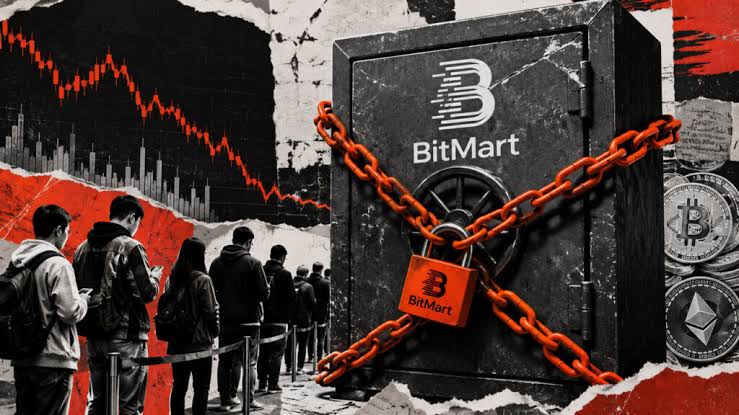
BitMart’s planned shutdown does not create one uniform problem. It puts users, mainland China-based employees, and KOLs in three different legal positions.

By Gao Mengyang
On the surface, an exchange closure looks like a question of whether users can still withdraw funds. For a platform that has long offered spot trading, perpetual contracts, wealth products, staking, and referral commissions, a shutdown usually exposes two other lines of risk as well: one involving staff still working remotely from mainland China, and another involving KOLs and agents that helped the platform acquire users, lead trades, or promote contract products.
That is why BitMart’s exit cannot be understood only through the narrow lens of whether coins in an account can still be moved out. Users need to handle open positions, redeem products, preserve asset records, and assess possible remedies. Mainland employees need to sort out what business lines they worked on, what permissions they held, and whether they had already noticed red flags. KOLs and agents need to revisit their promotional materials, commission structures, and user acquisition methods to see whether those activities were deeply tied to higher-risk business lines on the platform.
On July 26, 2026, BitMart announced that, after reviewing the company’s operating conditions, market environment, and future development direction, it had decided to wind down the trading platform in an orderly manner. According to the notice, the platform began suspending new user registration, digital asset and fiat deposits, and acceptance of new spot orders and new futures openings from July 26. Spot, futures, and other trading services are scheduled to stop on Aug. 26, and the trading platform itself is set to formally cease operations on Jan. 31, 2027.
One exchange closure, three very different sets of issues
These three groups do not stand in the same legal position. Users are usually the parties that most directly bear property losses after a platform shuts down. Employees and KOLs, by contrast, may be examined for whether their role in operations, user acquisition, or contract promotion amounted to substantive assistance to the business in question.
At the same time, neither employees nor KOLs can be judged on a label alone. The issues that need to be reviewed are still the degree of participation, subjective knowledge, method of compensation, and the extent of control, if any, over the platform’s core business.
Users cannot look only at total balance; different products need separate exits
BitMart’s notice says the platform has stopped, or plans to stop, spot trading, futures, copy trading, grid trading, and other automated trading functions. Products including Earn, staking, lending, and Launchpad will be suspended in batches depending on each product’s actual arrangement, with redemption and settlement details to be announced through dedicated notices or in-site messages.
The platform has also made clear that submitting a withdrawal request does not mean review has been completed and does not mean the assets have been sent on-chain. Some requests may be reviewed based on account identity, login device, IP address, withdrawal address, source of funds, trading history, Travel Rule checks, and sanctions screening. In some cases, users may also be asked to provide proof of source of funds or proof of wallet control.
For that reason, when a withdrawal request stays in “Processing” for a long time, the first question is whether a TXID has been generated. If there is no TXID, the assets are usually still in the platform’s internal review or handling stage. If a TXID has been issued, the next step is to verify the on-chain status through the relevant block explorer.
If withdrawals stall, should users pursue cross-border remedies or report the case in China?
After an exchange stops operating, the most common legal question from users is straightforward: customer service is not giving a clear answer, so what route is left to recover assets held in the account?
The article sets out three common paths.
The first is to keep engaging through the platform’s official channels. If users can still log in, submit tickets, and the platform is still processing withdrawals, they should organize their UID, token type, amount, network, withdrawal address, request number, and submission time in one place, then ask the platform in writing to explain the reason for review and what additional documents are required.
Where there is a trusted business contact, platform liaison, or KOL, using an intermediary to confirm review progress and document requests may at times be more efficient than immediately starting an expensive cross-border process. Even so, every exchange should be fully documented, and users should not send any so-called “expedite fee” or “unfreeze fee” to a personal wallet. BitMart has already said there is no paid fast-track or priority withdrawal channel, and staff will not ask for private keys or seed phrases.

The second route is to consider overseas litigation or arbitration based on the user agreement and the account-opening entity. That path requires users to first identify which company they actually contracted with, what law applies, where disputes must be resolved, and whether an award or judgment can be enforced where assets are located. Knowing only the platform name is not enough to identify the proper defendant or arbitration respondent.
The third route is to report the matter to mainland public security authorities. But an exchange shutdown, delayed withdrawals, or falling prices do not by themselves amount to fraud or another criminal offense. Whether there is a basis for a criminal report depends on factors such as fabricated assets, malicious transfer of user funds, backend manipulation, continued fund collection despite knowing repayment was impossible, or other irregular signs such as missing personnel or destruction of evidence.
An eight-agency notice issued in 2026 states that civil acts involving personal investment in virtual currencies and related financial products may be deemed invalid if they violate public order and good morals, with losses borne by the participants themselves. Still, “investors bear their own risk” does not mean a platform may withhold assets already confirmed to belong to users without a basis, nor does it mean clues involving suspected fraud, embezzlement, or transfer of property cannot be investigated according to law.
As a result, there is no absolute hierarchy between cross-border litigation, domestic reporting, and continued negotiation. The proper route depends on the location of assets, the platform entity involved, the evidence available, and how the loss arose.
Why mainland staff may still face risk even if the operator is offshore
Many virtual currency exchanges place their registration and operating entities offshore, while technical, operations, business, customer service, community, or product staff continue to work remotely from within China.
Current regulatory rules already make clear that offshore entities and individuals may not illegally provide virtual currency-related services to parties in mainland China in any form. Mainland entities and individuals that knowingly, or where they should have known, assist such offshore services may be pursued according to law, and criminal liability may follow where the conduct constitutes a crime.
That does not mean every person who once worked for an exchange will necessarily face criminal liability. Investigators would still need to review the employee’s start date, rank, job permissions, actual duties, service targets, salary and bonus structure, and whether the person was involved in contracts, user acquisition, funds, risk control, or settlement.
The difference can be significant. Someone handling ordinary administrative or HR work, or other basic internal functions not aimed at users, is in a different position from someone who directly designed high-leverage contract products, set liquidation rules, ran mainland user communities, handled user funds, or managed agent commission structures.
Based on exchange cases previously handled by the author, liability has never been determined simply by placing an “exchange employee” label on a person. The real questions are what the employee did, what the employee knew, what the employee gained from the work, and what steps were taken after abnormalities were discovered.
On the other hand, if an employee joined only briefly, received only a normal fixed salary, did not take part in promised returns, trading guidance, or fund handling, lacked a full understanding of the project’s overall business model, and stopped the work, raised objections, or resigned after noticing problems, those facts should all be closely reviewed in any assessment of responsibility.
The article cites a prior case handled by the team in which evidence was organized around the person’s entry time, compensation structure, scope of authority, actual participation, and response after finding irregularities. A full defense submission was then made, and the case ended with a favorable non-prosecution result.
Can KOLs be pulled in even if they only shared links and received commissions?
User growth for exchanges, especially in perpetual contracts and copy trading, often relies heavily on KOLs, agents, and community operators. KOLs attract users through referral links, invitation codes, signal groups, and trading courses, while the platform pays commissions based on user trading volume or fees.
When the platform is operating normally, those payments are often framed as promotion fees, channel fees, or commissions. Once the platform’s core business is treated by judicial authorities as suspected criminal conduct, though, the issue changes. The review may focus on whether a KOL was merely a standard advertising partner or had become deeply involved in soliciting users and organizing trading activity.
Risk cannot be judged only by whether a KOL had a platform account or received commissions. The article says the key questions include whether the person heavily promoted high leverage and guaranteed profits, whether specific long, short, and opening guidance was provided, whether a multi-layer agent and downstream rebate structure was set up, whether the person helped users deposit, withdraw, or manage accounts, and whether income mainly came from user trading volume, liquidations, or high fees.

A 2026 regulatory notice has already made clear that internet companies may not provide commercial display, marketing, or paid traffic redirection services for virtual currency-related business. Mainland parties that knowingly, or where they should have known, still assist unlawful offshore services may also face legal pursuit.
For that reason, once an exchange shuts down, KOLs should not rush to delete promotional content, close communities, or coordinate a uniform account with partners. They should preserve cooperation agreements, platform back-end records, promotional copy, user source data, commission calculation methods, and actual payment records in full. Whether commissions may need to be disgorged as illegal income also depends on subjective knowledge and actual degree of participation; it cannot be handled by simply sweeping in all historical income.
Does offering perpetual contracts automatically amount to the crime of operating a casino?
Based on recent case handling, perpetual contracts have become a common entry point for investigations into exchange controllers, senior managers, technical staff, operations personnel, and KOLs under the charge of operating a casino.
In June 2026, a prosecutorial practice article reposted on the website of the Supreme People’s Procuratorate said that criminal characterization of virtual currency perpetual contract platforms should rest on a substantive review of how the platform operates and profits, with careful distinctions made between financial investment, gambling, fraud, and illegal business operations. The review focuses on whether leverage is extreme, whether the platform acts as the house and bets against users, whether it captures user losses by controlling market data and liquidation mechanisms, whether there is a closed loop of staking and payout, and whether the platform has substantive control over trading rules and fund settlement.
That means a platform that merely provides genuine market matching and charges reasonable fees cannot automatically be treated the same as a platform that becomes the counterparty to users, manipulates K-line data, and directly takes user principal through forced liquidation.
That distinction matters for ordinary employees and KOLs as well. Whether they took part in contract rule design, market data access, liquidation algorithms, agent systems, and fund settlement will directly affect how close their conduct sits to the platform’s core alleged criminal model.
The records that matter now go beyond balance screenshots
For users, employees, and KOLs alike, the most important shared step after an exchange shutdown is evidence preservation.
Users should preserve account balances, orders, positions, deposit and withdrawal records, wealth product subscriptions and redemptions, platform notices, customer service tickets, and on-chain TXIDs. Employees should preserve labor contracts, payroll records, job descriptions, work instructions, scope of permissions, resignation records, and communications showing objections raised. KOLs should preserve cooperation agreements, promotional copy, referral links, back-end data, commission statements, and complete communications with the platform.
One point the article stresses is that preserving evidence is not the same as concealing assets, deleting records, or creating new explanatory documents. After a platform stops operating, a sudden wave of deleted chats, transferred commissions, or fabricated contracts may turn otherwise explainable conduct into a new irregular fact pattern.
Lawyer’s observation
Users are focused on whether assets can be recovered, and whether negotiation, cross-border dispute resolution, or criminal reporting is the right path. Mainland employees need to explain what business lines they joined, what permissions they held, and whether they knew the platform was continuing to serve mainland users. KOLs need to show whether they were only ordinary brand partners or had become deeply involved in user trading through trade-leading, commissions, and community operations.
An exchange shutdown does not automatically determine anyone’s legal liability. It does, however, bring business models, fund flows, and division of labor that may have been overlooked into a much clearer view.
For users, the earlier they complete asset checks, position handling, and evidence preservation, the more room they may have later when dealing with stalled withdrawals. For employees and KOLs, the earlier they clarify role boundaries, income sources, and actual degree of participation, the better placed they will be to respond accurately if legal risk later materializes.
Mankun Blockchain Legal Services