

BitMine has built Ethereum staking into its main source of revenue, but that income was not enough to offset losses elsewhere in the business. In its fiscal third quarter ended May 31, 2026, the company posted $46.5 million in revenue, up from $2.1 million a year earlier. About 98% of that total, or $45.7 million, came from staking and node validation as BitMine continued shifting away from Bitcoin mining and toward an Ethereum treasury model.
Even with that jump in revenue, BitMine reported a net loss of $83.6 million for the quarter, compared with a loss of $623,000 in the same period last year.
Option losses erased staking income
The biggest hit came from the company’s Ethereum derivatives strategy. BitMine recorded $92.1 million in losses tied to ETH-related options during the quarter, roughly double the revenue generated by its staking business over the same period.
- Net losses on expired option contracts totaled $78.6 million
- Losses on exercised positions came to $14 million
- Open contracts produced a gain of $534,000
The company had no derivatives trading in the year-earlier period, which makes the change in risk exposure especially clear. Over the first nine months of the fiscal year, cumulative derivative losses reached $133.3 million. That total included $79.3 million in losses on exercised positions and $54.5 million in losses on expired contracts, while open contracts generated just $515,000 in gains.
Over the same nine-month stretch, staking and validation brought in only $56.9 million. The derivatives loss was therefore more than twice the income produced by those operations.
BitMine said its options strategy mainly involves selling put options as part of a broader portfolio management approach. Selling puts can generate premium income and allow the company to add to holdings when prices fall, but the strategy can also produce steep losses if contracts are exercised under unfavorable market conditions. The quarter’s results showed that the attempt to enhance returns through options wiped out the stable income coming from node operations.
Operating expenses also climbed sharply
Administrative and general expenses jumped to $37.3 million from $744,000 a year earlier. Management attributed the increase to digital asset custody and asset-management service fees, higher salaries, and larger compensation for directors in both cash and stock.
BitMine said staking income was enough to cover cost of sales and administrative expenses before changes in crypto asset valuations. Still, after excluding several non-cash items, its adjusted non-GAAP net loss was $70.8 million.
That leaves the company in an awkward position: staking and validation now generate meaningful recurring cash flow, but the broader trading and treasury structure continues to consume those gains.
ETH accumulation was funded by issuing BMNR shares
BitMine financed most of its Ethereum purchases by selling common stock into the public market. In the nine months through May 31, the company sold 340.7 million BMNR shares under its at-the-market program and raised $11.87 billion after issuance costs. During the same period, it spent $11.69 billion buying ETH.
The result was heavy dilution for existing shareholders. Outstanding common shares rose 149% over nine months, increasing from 232.4 million on Aug. 31, 2025 to 579.7 million at the end of May 2026. Share issuance continued after the quarter closed, bringing the total to 603.2 million as of July 9.
Backed by that equity financing, BitMine held 5.42 million ETH as of May 31 at an aggregate cost of $19.05 billion. By the time of writing, the company’s ETH holdings had increased to 5.7 million.
At the end of May, however, those holdings were worth only $10.86 billion, leaving an unrealized loss of about $8.2 billion, or 43%.
That impairment was the main driver of the company’s $9.04 billion in unrealized digital asset losses over the first nine months of the fiscal year. BitMine’s cumulative net loss over the same period reached $9.1 billion. The numbers show the effect of buying Ethereum at a high aggregate cost while transferring much of the price risk to common shareholders through repeated share issuance.
In January, shareholders approved an increase in the company’s authorized common stock from 500 million shares to 50 billion shares. The authorization does not require the company to issue the full amount, but it gives management room to continue selling stock to acquire digital assets and make other investments.
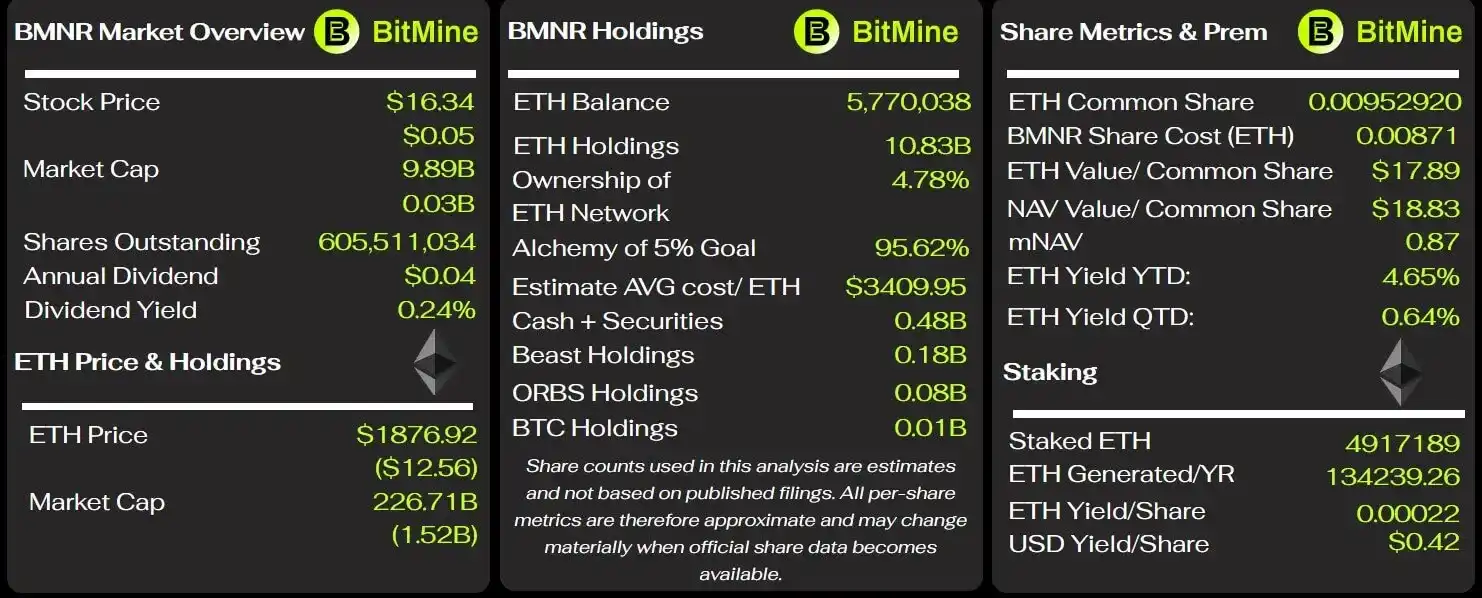
BitMine said its ability to expand ETH holdings depends heavily on access to financing. A drop in Ethereum’s price, weakness in the company’s own stock, or softer investor demand could all raise funding costs and limit its ability to issue securities on favorable terms.
Long-term service contracts are eating into staking economics
BitMine has leaned on staking income to offset volatility in its ETH holdings, but long-term service agreements have created fixed costs that continue to pressure margins. The company signed a 10-year consulting agreement with third-party provider Ethereum Tower and paid $12.8 million under that deal during the quarter, equal to about 28% of total staking revenue for the period. Over the first nine months, the expense reached $37.5 million.
BitMine estimated the annual cost of that agreement at $40 million to $50 million, with fees charged on a tiered basis according to the total value of digital assets under custody.
The contract can be terminated only under limited circumstances. If BitMine ends the agreement without cause, it must pay Ethereum Tower 85% of all estimated service fees for the rest of the contract term.
After acquiring node operator Pier Two, BitMine also entered into a separate 10-year management services agreement. Under that arrangement, Ethereum Tower will receive a 2% equity stake in the MAVAN platform and a monthly revenue share tied to native staking rewards generated by the platform. As of May 31, the company had not yet recorded expenses related to that agreement, meaning those costs were not reflected in the staking segment’s profit profile.
BitMine said most of its ETH is staked through MAVAN and that, over time, staking rewards should be enough to cover custody costs. Looking only at quarter-level operations, staking revenue did cover selling and administrative expenses before crypto valuation changes. But once fixed consulting fees, future revenue sharing, and broader asset-management costs are considered, staking income alone does not fully capture the business’s underlying profitability.
Little traditional debt, but growing reliance on capital markets
As of the end of May, BitMine had a low-leverage balance sheet with $340.3 million in cash, working capital of $433.1 million, and no traditional debt. Total assets stood at $11.63 billion, while total liabilities were just $30.1 million. Most of the asset base consisted of Ethereum and other digital assets.
That balance sheet does not point to an immediate solvency problem, but the company used $287.6 million in cash in operating activities during the first nine months of the fiscal year. BitMine said the outflow was mainly tied to legal, advisory, and investment banking expenses associated with expanding its ETH position.
After the quarter ended, the company issued 3.5 million shares of BMNP, a perpetual preferred stock carrying a 9.5% annual dividend, and raised $273.8 million. The deal added liquidity in the short term, but it also created a recurring dividend burden of $33.25 million per year.
BMNP is classified as equity rather than debt, yet it ranks ahead of common stock in the capital structure. The dividend requirement also places an ongoing claim on cash flow.
Management said existing cash, expected operating cash flow, and its at-the-market equity facility should be enough to support operations for at least the next 12 months. That view depends on financing windows remaining open. If Ethereum stays weak for an extended period, BitMine’s share price falls, or investor demand fades, the company’s cost of capital could rise and financial flexibility could tighten.
A business model split between recurring yield and market risk
The latest report leaves BitMine with two realities at once. On one side, it has established a staking and validation operation capable of generating tens of millions of dollars in quarterly revenue and covering core operating expenses. On the other, large option losses have fully consumed that income, long-term agreements are lifting the cost base, and the expansion of its Ethereum treasury depends on continued share issuance that has already more than doubled the common share count.
BitMine’s long-term economics now rest on whether staking revenue can consistently absorb asset-management costs and derivatives losses, whether the company can keep raising equity capital on workable terms, and whether Ethereum’s price can recover materially.