
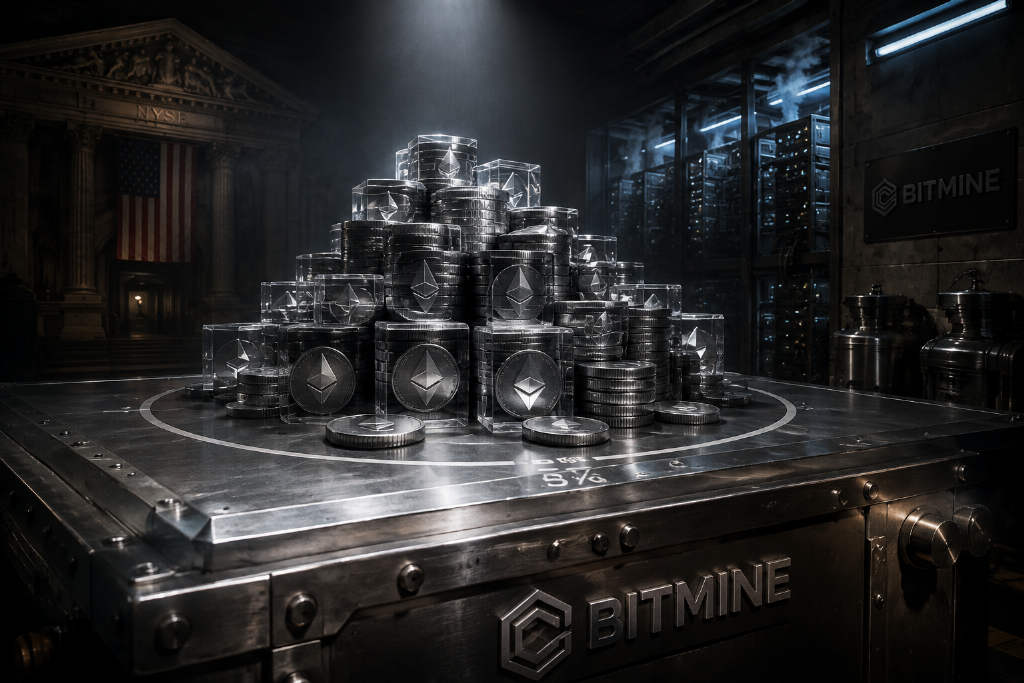
BitMine Immersion Technologies is moving closer to its self-imposed goal of holding 5% of Ethereum’s supply. As of Aug. 24, the New York Stock Exchange-listed company held 5,847,611 ETH worth about $14.3 billion, equal to 4.84% of total ETH supply. That leaves it roughly 187,000 ETH short of the target, which stands at about 6.04 million ETH. At its most recent weekly buying pace of 32,447 ETH, the gap could close in about six weeks.
Chairman Tom Lee has called the plan the "Alchemy of 5%." Since launching its Ethereum treasury strategy on June 30, 2025, BitMine has bought ETH every week without interruption.
From immersion cooling to an ETH treasury strategy
BitMine was previously a small company focused on immersion-cooling equipment for crypto mining. That changed in early 2025 after Tom Lee, co-founder of Fundstrat Global Advisors and one of Wall Street’s best-known crypto bulls, took over and pushed through a sharp strategic shift. The company moved from selling mining-related equipment to accumulating Ethereum.
The buildup happened quickly. In August 2025, BitMine’s holdings reached 1% of ETH supply. A month later, they reached 2%. In September 2025, the company raised $365 million through a share offering priced at $70 per share. By March 2026, its ETH holdings had climbed past 4.66 million coins, and by May they had crossed 5.2 million.
In June 2026, BitMine raised another $274 million by issuing preferred shares with a 9.5% annual dividend under the ticker BMNP, priced at $80 per share. Investors in that financing included ARK Invest, Founders Fund, Pantera Capital, Kraken, and Galaxy Digital.
On June 26, 2026, BitMine was added to the Russell 1000 large-cap index.
ETH is the centerpiece of the balance sheet
BitMine also holds 210 BTC, an $180 million equity stake in MrBeast-owned Beast Industries, an $89 million stake in Eightco Holdings (NASDAQ: ORBS), and about $308 million in cash and marketable securities. The company classifies the Beast and Eightco positions as "moonshots." Its total assets stand at about $14.9 billion.
Still, the company’s core bet is Ethereum. BitMine is on track to become one of the largest single holders of the native token of the world’s second-largest blockchain network.
More than 5 million ETH has already been staked
BitMine is not simply stockpiling ETH. It has put most of that position to work in Ethereum staking.
As of Aug. 23, the company had staked 5,067,309 ETH, about 87% of its total holdings, worth roughly $12.4 billion on the figures cited in the article. BitMine built its own staking platform, MAVAN, initially for internal use, with plans to open it to institutional investors and custodians later on. Based on the company’s disclosed 2.61% seven-day annualized yield, the stake generates about $287 million in annualized revenue.
That number is significant in network context. Ethereum currently has about 42 million ETH staked, or 34% of total supply. BitMine’s 5.07 million staked ETH accounts for about 12% of that total. Lido remains the largest staking service provider with about 8.83 million staked ETH, equal to 20.9% of the staking market. On that comparison, BitMine on its own has reached 57% of Lido’s staking scale.
Tom Lee said BitMine has more staked ETH than any other entity in the world.
Holding 5% of ETH does not give direct control over Ethereum
Owning 5% of ETH would not give BitMine direct control over the Ethereum network. Protocol upgrades are decided through the Ethereum Improvement Proposal process and rough consensus among core developers, not token-weighted voting. ETH ownership does not translate into formal governance power, and Ethereum does not have on-chain governance.
Even so, a 12% share of total network staking is not trivial. Ethereum’s proof-of-stake design depends on broad validator distribution to preserve security and censorship resistance. The community has already debated Lido’s roughly 20% staking share because a high level of concentration in one entity can create systemic risk.
BitMine adds another layer to that discussion because it is a publicly listed company subject to U.S. securities law. The article says that means its staking behavior could be influenced by the Securities and Exchange Commission, the Commodity Futures Trading Commission, or other regulators.
It sketches an extreme scenario: if the U.S. government were to impose some form of sanction or compliance requirement on Ethereum, similar to the Office of Foreign Assets Control sanctions on Tornado Cash, BitMine as a listed company would have to comply. In that case, its 5.07 million staked ETH, representing 12% of Ethereum’s consensus weight, would raise questions well beyond one company’s compliance obligations and into the neutrality of the network itself.
The article argues that this is not only a theoretical issue. In August 2026, Lido publicly disagreed with Ethereum core developers over EIP-8363, a proposal affecting staking rewards. Once a staking participant becomes large enough, it is no longer just a passive stakeholder. It can become a power center in protocol politics.
A bull case and a bear case built around ETH price
The report lays out two sharply different ways to read the BitMine story.
The bullish case starts with valuation. ETH is currently trading well below BitMine’s average purchase price, according to the article. If Ethereum’s fundamentals improve through faster tokenization of real-world assets, rising Layer 2 activity, and stronger inflows into ETH exchange-traded funds, and if ETH recovers to above $4,000, BitMine’s paper losses could turn into profits quickly. The company’s roughly $287 million in annualized staking income also offers a cash-flow cushion. Inclusion in the Russell 1000 could support the stock through passive index-fund buying, while the current discount to net asset value is presented as an additional margin of safety.
The bearish case is just as direct. If ETH’s relative weakness is not temporary but instead reflects a broader repricing of Ethereum’s role in the AI era, then BitMine’s entire investment thesis rests on one idea: ETH should be worth more. If ETH remains stuck in a $2,000 to $3,000 range over the long term, the article says the company’s $9.1 billion in unrealized losses would not go away. At the same time, it would still need to keep paying the 9.5% dividend on its preferred stock, while a staking yield of roughly 2.6% would not be enough to cover that financing cost.
The report also says BitMine has no meaningful source of revenue outside ETH. In that framing, this is a leveraged bet on a single asset rather than an operating company with diversified income streams.
Only about 187,000 ETH left to reach the goal
In a statement on Aug. 24, Tom Lee said ETH rose 30% over the past week, its biggest weekly gain since May 2025, and added that similar weekly moves have historically marked the start of larger advances.
BitMine now needs only about 187,000 more ETH to hit the 5% threshold, equal to roughly $460 million at current prices. For a company that has kept buying every week, the article suggests that line could be crossed before year-end.
If that happens, the crypto industry would face an unusual setup: a NYSE-listed company holding more than 5% of the token supply of the world’s second-largest blockchain, staking about 12% of the network’s consensus weight, and still potentially carrying billions of dollars in unrealized losses on its books.
Whether the "Alchemy of 5%" turns into something valuable, the article concludes, will depend entirely on where ETH goes next.