
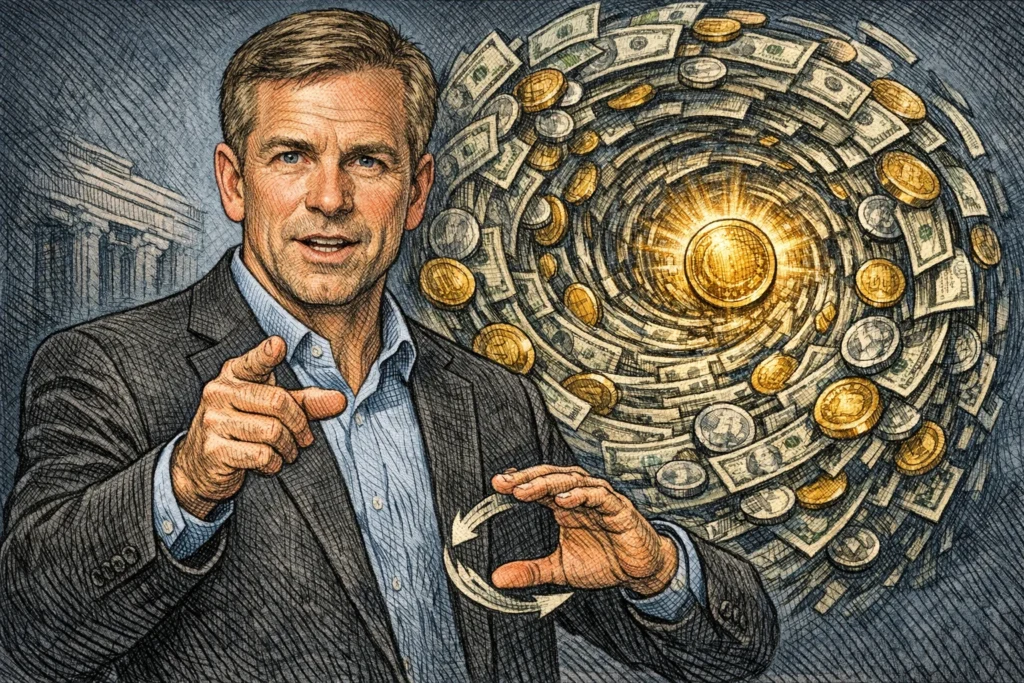
Bitwise Chief Investment Officer Matt Hougan said in an Aug. 13 analysis that DeFi protocols are entering an era of revenue recycling, with a growing number of projects using trading fees to buy back or burn their own tokens.
Hougan said that shift lets token holders benefit more directly from protocol income. He argued that crypto assets outside Bitcoin are becoming a yield-driven market, while investors have not yet fully priced in the change. On that basis, he said many crypto assets remain undervalued and could at least double from current valuations.
Five protocols highlighted by Hougan
Hougan pointed to five major protocols that already use revenue-return mechanisms: Hyperliquid, Uniswap, Aave, Pump.fun and Lighter. The group spans decentralized exchanges, a lending platform and a meme token launch platform.
For Hyperliquid, he said full-year revenue in 2025 topped $800 million, with about 99% used to buy back and burn HYPE. In the second quarter of 2026 alone, the protocol generated $169 million in revenue, and $141 million of that was used for HYPE buybacks.
Uniswap, according to the analysis, turned on protocol fees on Dec. 22, 2025 through the “UNIfication” proposal. UNI holders can apply for protocol revenue by burning UNI.
Aave’s DAO buyback plan purchased more than 205,000 AAVE in its first 10 months. Hougan also cited comments from Aave founder Stani Kulechov on June 25, saying the team was designing an automated, non-discretionary buyback mechanism.
Pump.fun, the Solana-based meme token launch platform, was also listed as using trading fees to buy back or distribute PUMP tokens. Lighter, a Layer 2 decentralized exchange, was described as using a similar fee-return structure.
Kulechov said: 「100% of the revenue from the Aave protocol and the GHO stablecoin will go to the AAVE token, and this has been established in the Aave Will Win proposal.」 The article said governance documents support that direction and show it is still moving forward.
From speculation to cash-flow based valuation
Hougan’s central argument is that DeFi is converting tokens with no cash flow into income-bearing assets. If that trend holds, crypto markets can be valued with more familiar finance frameworks, including revenue multiples and discounted cash flow models, rather than leaning only on speculative sentiment and macro liquidity.
He also laid out two limits. Token holders do not have the kind of legal claim on cash flows that shareholders do, so distribution still depends on community governance. And token economics can be changed by vote, meaning a buyback or revenue-return mechanism in place today could be removed later.
In other words, a protocol can generate income, but the link between that income and token holders still has to be maintained through governance instead of legal protection.
Regulatory easing in the U.S. seen as a catalyst
Hougan said a looser U.S. regulatory climate is a major reason these mechanisms are spreading faster. Over the past several years, many projects intentionally avoided attaching revenue rights to tokens because of concern that the U.S. Securities and Exchange Commission could treat revenue-sharing as a securities feature.
With the regulatory stance turning more permissive after 2025, he said projects no longer need to hide the revenue side of their tokens. In a separate analysis dated Aug. 5, Hougan also said that even if the CLARITY Act does not pass, current regulatory guidance is enough for the crypto industry to keep expanding.
What Hougan expects next
Hougan said similar revenue-return structures could spread broadly across DeFi applications and Layer 1 networks over the next 12 to 24 months. That would leave infrastructure protocols such as Solana and Ethereum exploring ways to route on-chain fees back to native tokens.
He also pointed to institutional adoption as an area to watch. Once DeFi protocols begin producing measurable cash flow, traditional asset management products, including ETFs and structured products, may find it easier to include those assets in portfolios, provided governance remains transparent and predictable.
For token holders, the model points to a shift away from purely speculative instruments and toward hybrid assets that combine cash-flow exposure with speculation. Hougan did not frame that as a short-term price guarantee, but as a change in the way long-term crypto valuations may be assessed.