
Crypto markets have bounced lately. Bitcoin has been trading around $80,000, and Ether at one point stayed above $2,500. BTC, ETH, and SOL are back in the spotlight.
The article ties that recovery to a mix of shifting liquidity expectations, institutional inflows, spot ETF demand, and short covering. But price is only part of the story. It argues that users are changing how they handle money across borders. Digital currencies, in this telling, are no longer sitting off to the side in separate accounts. They are being linked to cross-border remittances, currency exchange, stocks, foreign exchange, wealth management, and global payments. The report’s point is blunt: the market now wants more than a remittance tool or a single trading gateway. It wants one place for transfers, asset allocation, and spending.
Starting with remittances and using USDT as the funding rail
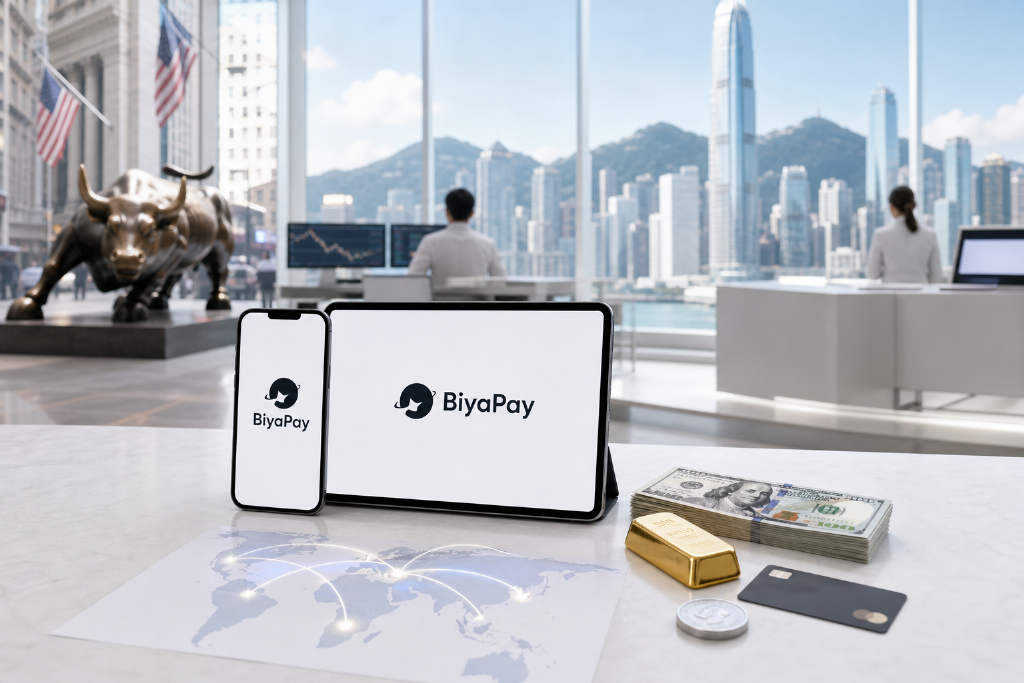
Cross-border remittances and payments were where BiyaPay began. Then demand grew. So did the product list: U.S. and Hong Kong stocks, cryptocurrencies, foreign exchange, commodity futures, and wealth management. The article’s main argument is pretty direct. Payment handles the first leg of money movement. The next issue is what happens after the money lands, and how to manage it better inside one account.
In cross-border finance, remittance and payment are still basic services. Even so, the article says the headaches have been around for years. International students move tuition, rent, and living expenses across countries and accounts. Overseas workers regularly deal with wage settlement, family remittances, and multi-currency exchange. Freelancers and cross-border operators rely on overseas collections, account transfers, and settlement, all of which shape day-to-day business efficiency.
The piece lays out the usual problems in traditional remittance flows: opaque fees, unstable arrival times, intermediary bank charges that are hard to predict, unclear FX spreads, complicated recipient account requirements, and weak continuity between receiving funds and actually using them afterward. BiyaPay’s early decision to start with remittances is framed as an attempt to fix the most basic, highest-frequency money movement needs first.
According to the article, BiyaPay’s remittance business runs on an integrated transfer chain. Users can start with USDT inside the platform, complete digital asset conversion, fiat conversion, and cross-border remittances, and then send the money to overseas accounts, investment accounts, or other payment scenarios depending on what they need.
The report says this payment-first route did more than attract an initial user base. It also gave BiyaPay a base layer of trust around identity verification, account security, risk control, customer service, and fund transfer operations. Later on, those abilities became the base for wider financial services.
As the user base grew and use cases widened, the company found that demand did not end when a remittance cleared. International students may need to switch funds into local currency and use them for online spending. Overseas workers may want to send part of their wages home and put another part into savings or investment. Users holding digital assets such as USDT may need currency conversion, cross-border transfers, or a way into U.S. and Hong Kong equity markets.
In those cases, payment is just the opening move. After the transfer, the money still has to move across accounts, asset classes, and spending scenarios. The article says the user problem shifts from finishing a cross-border remittance to managing cross-border funds inside one account. That, it says, is the real-world reason BiyaPay moved from a payment tool into broader financial services.
From the product logic angle, the article says BiyaPay does not treat remittances as a standalone function. It puts them inside a broader global asset allocation chain. Cross-border transfers handle the regional movement of funds. USDT conversion and fiat remittances handle entry into different currencies and account systems. Then U.S. and Hong Kong equities, digital assets, wealth management, and FX products take over, covering how funds are managed and used after arrival.
Expanding from crypto into equities and other asset classes
The article argues that the product edge of a cross-border financial platform is often set by where the user’s money goes next. Once a transfer is done, users may switch into U.S. dollars or Hong Kong dollars and enter stock or other financial markets, keep funds in USDT and use crypto-related services, or park idle cash in wealth management products.
Many users already hold USDT. But that is not where their needs stop. They want those funds connected to broader global asset markets, including U.S. and Hong Kong stocks. Under more traditional routes, the article says, users usually need offshore or brokerage accounts and then have to work through foreign exchange conversion, deposits, and internal fund transfers in several steps. If they already hold USDT, they must first convert digital assets into fiat and then move the money into a stock account through other channels. Messy stuff. The process runs across multiple platforms and accounts, raising both time costs and operating costs.
BiyaPay’s product expansion is described as following that same money trail. In U.S. and Hong Kong equities, the platform is positioned as a bridge between cross-border funds and traditional securities markets. Users are not just looking at market data. The article says they can reach actual stock markets through related brokerage and clearing services. It also makes a point of separating this from tokenized stocks: real stocks represent ownership rights in traditional securities markets, and orders, clearing, and dividend arrangements follow the rules of the relevant markets and services.
The article says BiyaPay cuts the basic participation cost through mechanisms that include 0-commission U.S. stock trading, then gives users access to real stock-related services in U.S. and Hong Kong markets. Its description of the outcome is simple enough: users can use USDT to buy real U.S. and Hong Kong stocks.
Crypto services push the platform’s asset coverage even wider. As Bitcoin, Ether, and other digital assets become part of asset allocation for some global users, the article says attention is no longer fixed only on market moves. Users also care about asset conversion, fund transfers, fee transparency, and account security. BiyaPay’s crypto services are described as giving users ways to view, trade, and manage more than 200 mainstream digital assets, with those services tied back to cross-border fund use cases.
Foreign exchange and commodity futures answer a different set of global needs. Exchange-rate swings shape the real cost of overseas study, travel, cross-border business, and offshore investing, the article says. Commodity prices are tied to inflation, energy markets, and global economic cycles as well. Covering FX and commodity futures is presented not just as adding two extra product lines, but as giving users a broader framework for watching and managing assets.
Wealth management products are aimed at cases where USDT-denominated funds do not yet have a clear immediate use. Some users keep part of their money idle after remittances, FX conversion, or portfolio adjustments. The article says current flexible wealth management products offer annualized yields of up to 10.22%, giving users more choices across liquidity and return preferences.
U.S. and Hong Kong equities, crypto, FX, wealth management, and commodity futures might look like separate categories. The article doesn’t see them that way. It treats them as one user path: once funds enter an account, they keep moving through conversion, allocation, and management. From cross-border payments and USDT entry rails to equities, FX, crypto, and wealth products, BiyaPay’s expansion is described not as feature stacking, but as a steady build around how user funds actually flow.
From point tool to account-based platform
The article says global financial services are shifting from point solutions to account-based platforms.
BiyaPay’s CEO was quoted as saying, "Financial services in the future will not stay confined to a single market, a single currency, or a single asset class." He also said, "What users need is one account that can connect global stocks, digital assets, and foreign exchange markets, allowing funds to move more freely across different assets, different currencies, and different scenarios."
The report says BiyaPay is trying to become that kind of gateway. Its product matrix now runs from cross-border remittances to U.S. and Hong Kong stocks, from cryptocurrencies to foreign exchange and commodity futures, and then on to wealth management and global payments. In the article’s account, the platform is gradually covering four main links: fund transfers, asset allocation, fund management, and global consumption.
It also says BiyaPay wants to move early as traditional finance and digital finance come together, combining Web2 and Web3 capabilities into what it calls a first gateway for integrated global assets. On the Web2 side, the platform connects mature finance and spending scenarios such as U.S. and Hong Kong stocks, FX, commodity futures, and U-card crypto payment services. On the Web3 side, it uses stablecoins such as USDT, digital asset trading, and on-chain fund transfer capabilities to give users more flexible funding paths.
One account tied to many scenarios sits at the heart of that strategy. Once those services are placed inside a single account structure, the article argues, BiyaPay is no longer selling one isolated function. It is offering a fairly complete route for using funds globally, with the stated aim of breaking barriers between asset classes and letting value move more freely.
The article also points to the tougher demands that come with broader product coverage. The more services a platform offers, the more clearly it needs to spell out service providers, fee structures, market risks, and applicable regions. And as the number of asset classes rises, account security, identity verification, risk management, and customer support need to keep up.
For global users, multilingual service is described as another key part of platform expansion. For cross-border users, localization is not just about translating interface text. It also comes down to whether product rules are easy to understand, whether fees are displayed clearly, whether risk disclosures fit local contexts, and whether users can get effective support when problems come up.
The article ends its factual account by saying BiyaPay is redrawing its own service boundary, moving from a remittance tool toward multi-asset financial services. Payment was the starting point. Not the finish line. As traditional finance and digital finance keep converging, the company wants to become an important bridge between the two and build what it describes as a global one-stop asset allocation platform.