
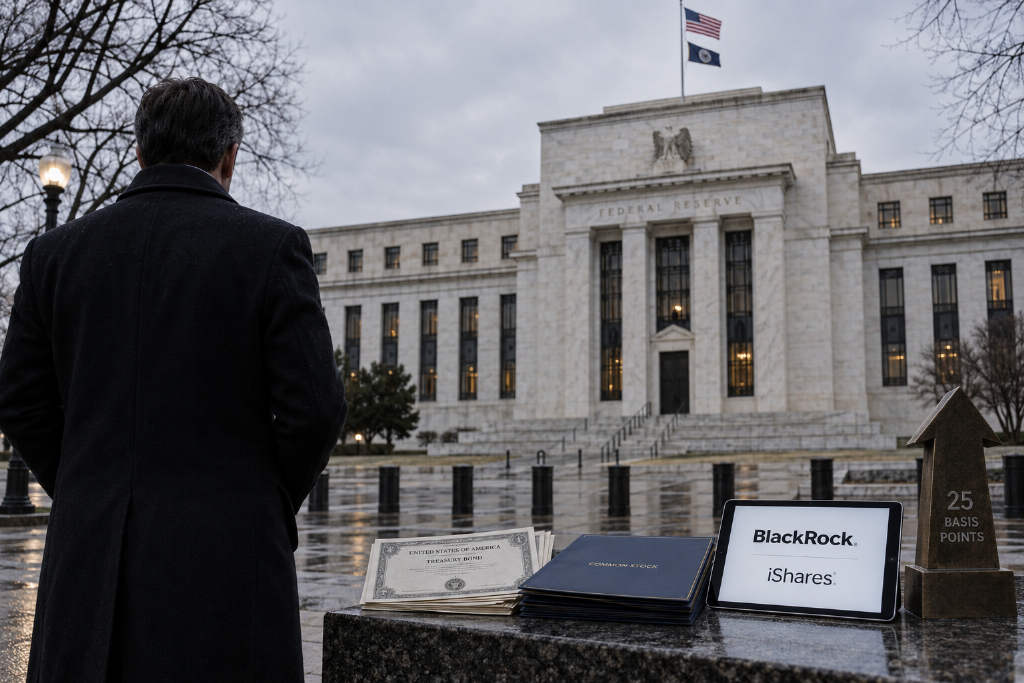
BlackRock says the Federal Reserve’s return to rate hikes should not be read as an automatic signal that both stocks and bonds are headed lower.
At its September meeting, the Fed lifted the target range for the federal funds rate by 25 basis points to 3.75%–4.00%, the first increase since July 2023. In BlackRock’s latest report, Kristy Akullian, head of iShares Investment Strategy for the Americas, said the move was driven by three factors: inflation remains above target, higher energy prices are adding to price pressure again, and the U.S. labor market is still holding up.
That backdrop, in BlackRock’s view, gives the central bank room to keep pushing against inflation without immediately worrying about clear deterioration in growth or employment. For investors, the bigger question is what a renewed higher-rate environment means for portfolios across equities and fixed income.
The first hike has not historically guaranteed losses
Markets often treat rate hikes as a negative. Higher borrowing costs can pressure equity valuations, and rising bond yields can reduce the price of outstanding bonds.
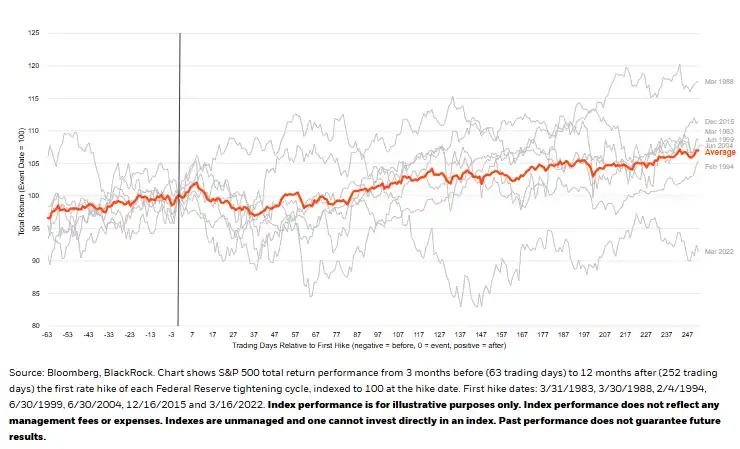
BlackRock argues the historical relationship is not that simple. The firm reviewed seven Fed hiking cycles since 1983 and found that in the 12 months after the first rate increase, U.S. stocks rose an average of 4.7%, U.S. bonds gained 3.07%, and high-yield bonds advanced 4.68%.
That does not mean rate hikes are bullish by themselves. The report’s point is narrower: one hike alone does not determine the direction of asset prices over the next year. The Fed usually raises rates when the economy is still in relatively solid shape. If earnings are still growing and the labor market is not weakening sharply, economic momentum can offset part of the pressure created by higher rates.
BlackRock says investors should focus less on whether a hike is good or bad in isolation and more on why the Fed is tightening and whether the economy can absorb higher rates.
Higher rates also reset the income profile for bonds
On fixed income, BlackRock says one major difference from recent years is that bonds now offer higher income to begin with. Elevated risk-free rates and real yields have made the starting point for fixed-income assets more attractive.
Rising rates can still weigh on the price of existing bonds, but new buyers are able to lock in higher yields. In that sense, a higher-rate environment is not purely negative for bond investors.
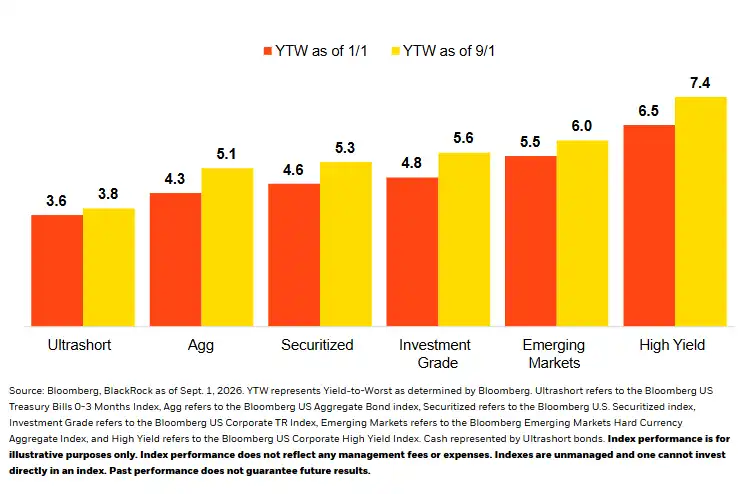
BlackRock says it currently favors higher-quality credit, including investment-grade bonds and better-quality high-yield debt, and it is putting more emphasis on earning coupon income than on making aggressive calls for bond prices to rally.
The report also notes that heavy issuance of Treasuries and corporate bonds could keep upward pressure on long-term yields. Because of that, BlackRock says investors should not simply bet on a rapid drop in long-end rates and should manage duration more actively.
It also points to the level of real yields. BlackRock says the real yield on 30-year U.S. Treasury Inflation-Protected Securities, or TIPS, has moved above 3%. That means long-dated bonds are now offering more meaningful real income even without a large capital gain.
For equities, rate volatility matters more than the level alone
BlackRock remains relatively constructive on U.S. equities. Its reasoning is that corporate earnings are still fairly strong, and history does not show that stocks automatically enter a drawdown after the Fed’s first hike.
According to the firm’s data, the S&P 500 has generally tended to rise over the 12 months following the first hike across the past seven tightening cycles.
There is an important condition attached to that view: rates cannot move around too violently. Markets can adjust to a higher but stable policy-rate environment over time. If investors come to believe policy rates will remain around 4% for a period, that level can gradually be absorbed into valuations and financing assumptions.
The harder scenario is one in which the market keeps repricing the terminal rate. If inflation keeps surprising to the upside and investors repeatedly lift expectations for future policy, long-term Treasury yields can climb quickly and force a fresh reset in equity valuations.
That is why BlackRock is focused less on whether rates are high and more on whether they become suddenly unstable. In this setup, the firm prefers larger companies with stronger earnings quality and dependable dividend payments, while taking a more cautious stance on smaller companies that are more exposed to funding costs.
The stock-bond diversification story is not what it used to be
BlackRock also says the relationship between stocks and bonds has shifted, weakening a cornerstone of traditional portfolio construction.
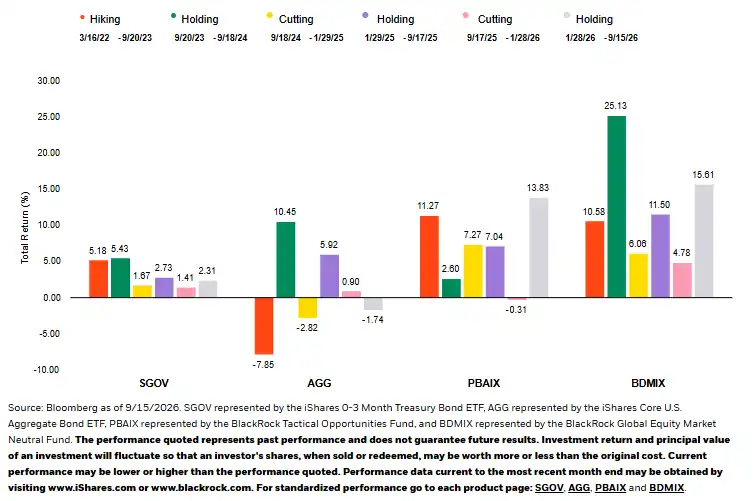
The classic 60/40 allocation became popular in part because equities and bonds often offset each other. When growth weakened, stocks tended to fall, but the Fed could cut rates and lift bond prices, softening the hit to portfolios. BlackRock says that relationship has been less reliable in recent years.
Using data from BlackRock and Morningstar, the report says the correlation between stocks and bonds was about -0.22 from 2010 to 2019. Since 2020, that figure has risen to 0.51. In practical terms, stocks and bonds have been moving up and down together more often.
The reason, the report says, is that the market’s dominant risk has changed. If recession is the main concern, bonds can still benefit when stocks sell off. If inflation is the main concern, the pattern can flip: inflation pushes rates higher, bond prices fall, and higher discount rates also weigh on equity valuations.
For that reason, BlackRock says a traditional stock-plus-bond mix may no longer deliver the same stability it once did, and investors may need other assets or strategies with different return drivers to improve diversification.
What BlackRock says matters next
BlackRock’s base case is that the Fed may raise rates once more in 2026, though it does not expect an especially aggressive tightening cycle from here.
The report says the market should now watch three variables more closely than the simple count of how many hikes may still come.
- First, whether inflation keeps moving higher. If energy prices ease and inflation cools again, pressure on the Fed to keep hiking would decline. If inflation broadens further, markets may need to push rate expectations higher.
- Second, whether the economy and corporate earnings can withstand higher rates. Historically, post-hike equity gains have tended to come when economic growth remained intact. If employment, consumption, and profits all weaken clearly at the same time, the value of that historical pattern would diminish.
- Third, and most important in BlackRock’s telling, the bigger risk may not be high rates themselves but rates becoming highly unstable.
If the economy keeps its resilience and markets can adapt to a higher but steady rate environment, BlackRock says stocks can still rise and bonds can still generate returns through income. If inflation proves sticky and forces markets to repeatedly reprice rates higher, then both sides of the portfolio could come under pressure again.
In Akullian’s framework, the central issue is not only when the Fed moves next. It is whether high rates remain stable, and how long the U.S. economy can continue to absorb them.