
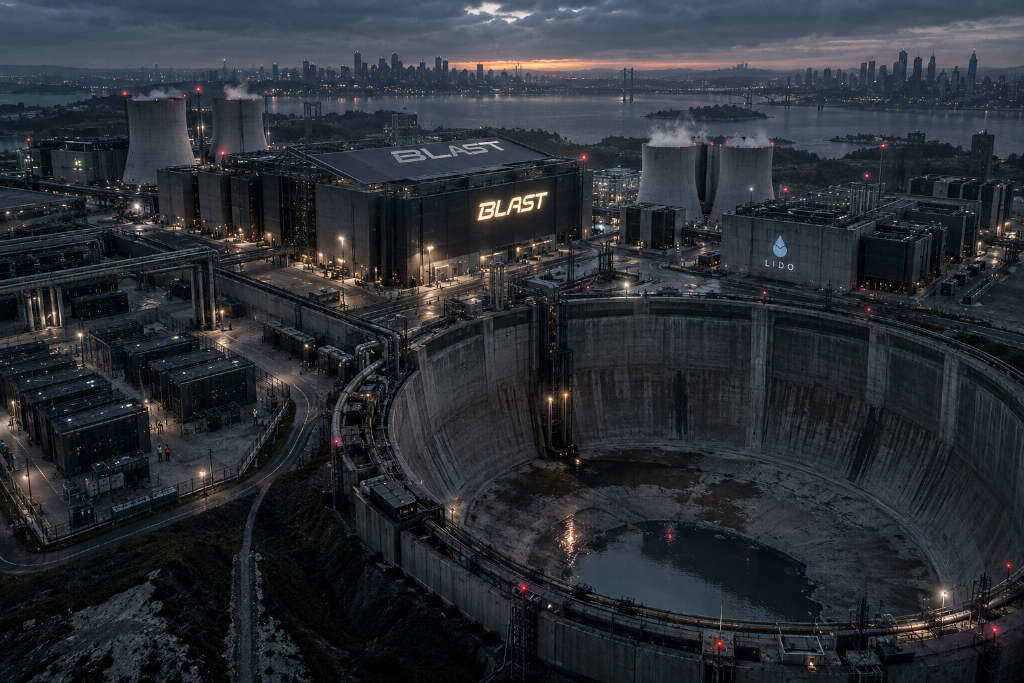
Ethereum Layer 2 network Blast is winding down after deciding that its operating economics no longer work. In a post on X on Oct. 2, the team said revenue from network activity is no longer enough to cover the cost of node maintenance and state synchronization, and that it no longer believes the model can sustain itself.
Withdrawals will happen in two phases
Blast said withdrawals will be handled in two stages. First, the team will unwind assets held in Lido, a process expected to take about a week. During that period, withdrawals will be temporarily disabled. Once the Lido position has been processed, withdrawals will reopen and the original seven-day waiting period will be shortened to 24 hours.
The team said Oct. 26 is the final day to withdraw through Blast’s standard interface. That deadline applies to on-chain assets as well as balances stored in the Blast web app, or PWA. Missing the date does not mean funds are lost, but users would then need to interact directly with the Blast bridge contract deployed on Ethereum mainnet, a route the announcement described as less friendly for ordinary users. The team said it will publish detailed contract withdrawal instructions before the deadline and urged users to move funds early.
BLAST token fell after the shutdown notice
After the announcement, BLAST fell from $0.0004 to $0.00025, according to the article. Its circulating market capitalization now stands at $17.32 million, while fully diluted valuation has fallen to $24.56 million.
From $2.2 billion to $32 million
The scale of Blast’s decline is visible in its on-chain data. The network was created by Pacman, founder of NFT marketplace Blur. In November 2023, the project raised a combined $20 million from Paradigm and Standard Crypto, opened early access by invitation that same month, and launched mainnet in February 2024.
Blast grew quickly on the back of its “native yield” pitch. ETH bridged into the network was staked through Lido, while stablecoins generated yield through MakerDAO’s on-chain U.S. Treasury strategy, according to the article. That setup helped push Blast’s TVL to nearly $2.27 billion shortly after mainnet launch, putting it briefly among the top tier of Layer 2 networks.
That capital base did not last. Citing DefiLlama, the article said Blast’s DeFi TVL had dropped to roughly $32 million by publication time, down about 99% from its peak. The BLAST token had also fallen about 98% from its June 2024 high. Revenue figures were just as weak: the network generated less than $1,500 in the past 24 hours, while stablecoin market capitalization had shrunk to $12.1 million.
Comparison with Arbitrum shows the gap
The contrast looks sharper alongside larger Layer 2 networks. DefiLlama data cited in the piece puts Arbitrum One’s current TVL at about $1.411 billion, more than 40 times Blast’s level. The article added that even after falling by nearly two-thirds from a peak above $4 billion in October 2025, Arbitrum One still ranks as the top Ethereum Layer 2 by TVL.
The revenue gap is wider. The article said Arbitrum DAO recorded $6.19 million in revenue in the first half of 2026, and around $26,000 over the past 24 hours.
The piece argues that the more basic difference is business model. In its reading, Blast depended entirely on activity within its own chain and lacked stronger external ecosystem effects or durable use cases, leaving revenue exposed once liquidity pulled back. The article described Blast as a “giant DeFi yield farm” wrapped in a public-chain narrative, with TVL largely carried in by Lido staking and MakerDAO Treasury yield.
By contrast, it said Arbitrum has been able to capture value from external chains through its Orbit stack and the Arbitrum Expansion Program, or AEP. One example cited was Robinhood Chain, which the article said returned about $3.75 million to the Arbitrum ecosystem in its first two months under a 10% net revenue-sharing arrangement, nearly matching the annual fee total of Arbitrum’s own mainnet.
Signs of withdrawal had appeared earlier
The article says Blast’s contraction had been visible well before the shutdown notice. Pacmoon, once described as the largest meme coin by market value on Blast, announced a move to Solana and rebranded as ARMY. Team members also publicly complained that Blast had not provided enough support for native tokens and their communities.
In May 2026, Blast ecosystem social card game Fantasy Top said it would stop operating. The team said it would return all seed-round investments on a 1:1 basis and disclosed that about 70% of cumulative revenue had been generated in the first month after mainnet launch. The article says that detail now looks like a snapshot of the broader Blast ecosystem.
Team changes also pointed to retrenchment
The article also points to moves by the team itself. In May this year, Blast ended its integration with multisig wallet provider Safe, citing third-party risk and usability concerns, and began building multisig functions directly into Blast Mobile, which had been pitched as a mobile entry point for mainstream users. In hindsight, the article argues, reducing reliance on outside infrastructure looked more like preparation for an orderly exit.
Pacman’s public posting activity also dropped sharply. The article noted that the founder, once highly active on X, has posted only twice this year: one anti-scam warning and one repost of the shutdown announcement. The official BLUR account he founded has also stopped posting this year.
Incentives can attract capital fast, but not keep it there
Blast became one of the emblematic projects of the points-and-airdrop cycle. The article’s conclusion is straightforward: incentives can bring in capital in a very short period of time, but they do not guarantee that capital will stay. After the 2024 airdrop was distributed and the points multiplier lost force, the on-chain economy weakened quickly because it lacked steady transactional demand, while infrastructure expenses and the fixed costs tied to yield generation did not fall with it.
Once the spread from that yield was no longer enough to pay the chain’s bills, shutting down stopped being a strategic choice and became a matter of arithmetic.



