
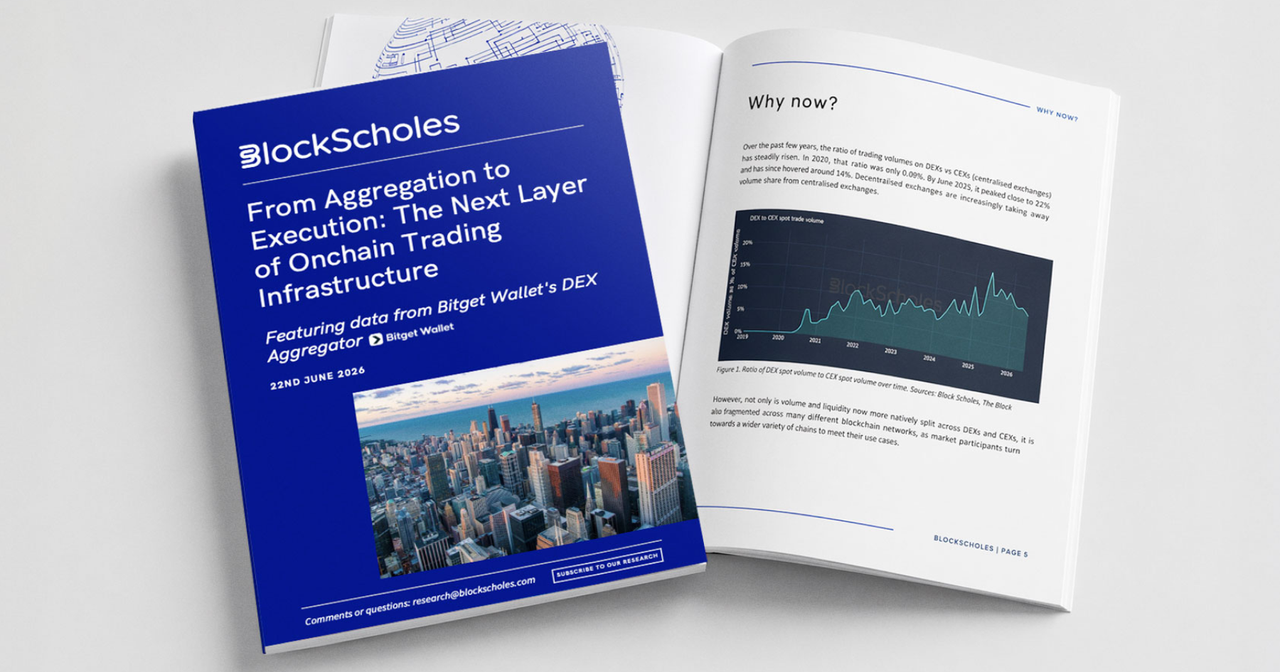
Block Scholes compared four DEX aggregators — Bitget Wallet, KyberSwap, 0x, and Jupiter — and found that pricing differences stay relatively narrow on small orders, but execution costs diverge much more once trade sizes increase. According to the report, orders in the $10,000 to $100,000 range can produce materially different outcomes depending on how each platform routes liquidity, with the total gap reaching thousands of dollars.
The study analyzed thousands of live API quotes across Ethereum pairs including BTC/USDT and ETH/USDT, along with Solana pairs such as SOL/USDC and BONK/USDC. It measured quote quality, slippage control, and execution stability. For orders below $1,000, win rates across the four platforms clustered around 46% to 52%, showing only limited separation. Once order sizes moved into the $10,000 to $100,000 bracket, the winning range expanded to 66% to 78%, where routing differences became much clearer.
Routing logic, not access alone, drives the gap
The report says access to fragmented onchain liquidity is no longer the main differentiator, since most aggregators already connect to multiple sources, account for gas, and split orders by pool depth. The larger distinction comes from the routing logic itself: how an order is divided, which pools are excluded, and how execution is balanced against cost. On large trades, even a small basis-point difference turns into a visible dollar amount.
Block Scholes also pointed to Bitget Wallet’s Sentinel risk filtering layer, which removes abnormal liquidity pools before routing begins. The stated aim is to reduce hidden losses that can appear when a failed order has to be re-quoted and resubmitted at a worse price. That cost may not be obvious in the interface, but it can affect final execution on bigger transactions.
$10 million stablecoin swap showed an 8 bps spread
One PYUSD/USDC test covered trade sizes from $100,000 to $10 million. At sizes below $5 million, the report said three aggregators used the same Spark.fi liquidity pool, leaving only negligible pricing differences. At $10 million, routing choices split. Bitget Wallet and KyberSwap sent the order across two Curve pools, while 0x routed through a single pool. The result was a gap of about 8 bps, or roughly $8,000 at that size.
The report added that large stablecoin-to-stablecoin trades such as USDC/USDT and DAI/USDT tend to show far less variation across platforms. In that segment, pricing tends to reflect market microstructure more than a single aggregator’s execution edge.
Bitget Wallet says its engine spans 100+ DEXs and 20+ chains
The material also cited Bitget Wallet data showing that the platform’s average user trade size grew 5 times in the first five months of 2026, with peak average size above $1,200. Bitget Wallet said its routing engine covers more than 100 DEXs across 20-plus blockchains, and that gas costs are included in route selection. Institutional users and developers can access the system through the Bitget Wallet DEX Aggregator API.
The article further said DEXs now account for about 14% of global crypto spot volume, after reaching a peak of 22% in June 2025, while stablecoin market capitalization has passed $300 billion. With liquidity spread across Ethereum, BNB Chain, Solana, and multiple layer-2 networks, the quality of routing is becoming a more important factor for large onchain trades.