


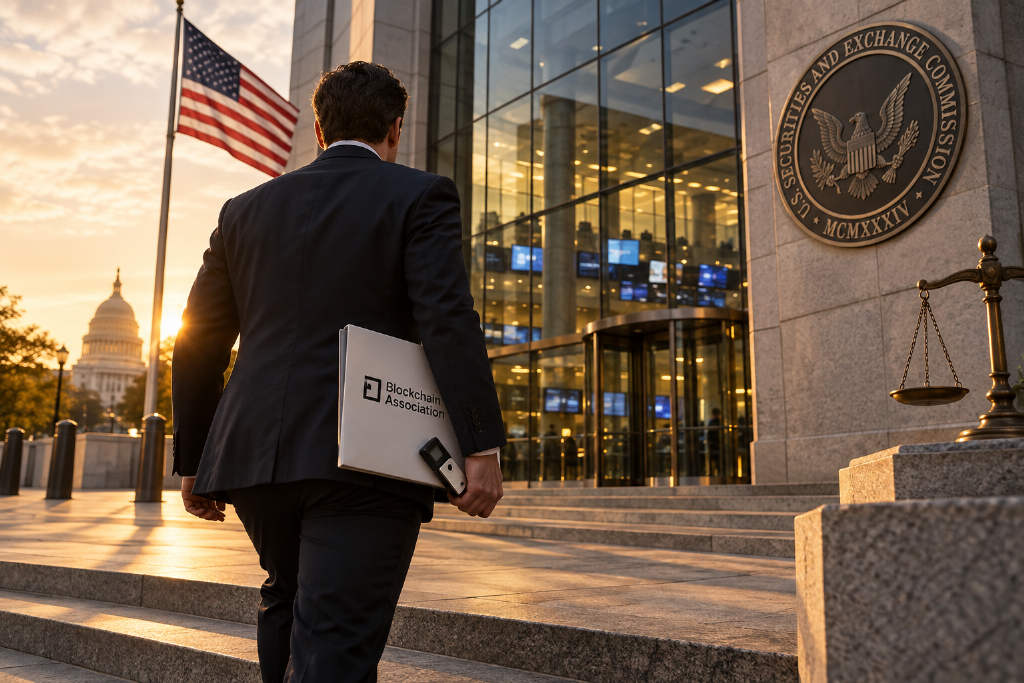
The Blockchain Association has asked the U.S. Securities and Exchange Commission to set clearer rules for crypto assets, including objective standards for decentralization and explicit support for 24/7 trading and self-custody, according to a roundup published by ChainCatcher.
Blockchain Association pushes for broader exemptions and decentralization tests
The Blockchain Association submitted a comment letter on the SEC’s proposed crypto asset framework. It asked the agency to raise the startup exemption cap to $10 million and the fundraising exemption cap to $150 million. The group also said on-chain transparency should be allowed in place of audits and that airdrops should not count toward fundraising totals.
The association proposed a third-party filing safe harbor for existing tokens. It also urged the SEC to define objective standards for when a token is no longer tied to an “investment contract,” citing examples such as open-source code and the absence of unilateral censorship power. The letter also called for stronger federal preemption over state-level rules and backed 24/7 exchange trading and self-custody.
BlackRock and Deutsche Bank CEOs say deficits matter more than an AI bubble
According to Bloomberg, senior finance executives remain split on whether artificial intelligence has entered bubble territory. Ken Griffin had warned earlier that AI investors were almost certainly in a bubble and should prepare for setbacks, adding that major economic transformations often come with bubbles. Recent market concerns have centered on whether heavy upfront AI capital spending will take longer than expected to turn into profits and productivity gains.
Deutsche Bank CEO Christian Sewing said there was no reason to fear a sharp short-term reversal in asset prices. Some companies may stumble, he said, but he does not see a bubble that is already bursting. Sewing distinguished between a bubble and ongoing volatility, and he pointed to geopolitical tensions. He also said AI’s industrial use could become a once-in-a-century opportunity for Germany if the regulatory framework is right.
BlackRock CEO Larry Fink argued for faster construction of AI data centers, warning that delays could threaten economic growth and add to inflation because computing power remains expensive. He had previously said AI faces supply shortages and demand has grown faster than expected. In his view, more data centers and more compute capacity built sooner would lower costs sooner.
Steve Chiavarone, chief investment officer for global equities at Federated Hermes, said investors worried about an AI bubble may ultimately be right, but too early by several years. He said infrastructure still has years of growth ahead before overbuilding becomes the more pressing risk. For now, markets are still distinguishing which companies can get funding and at what rates, which he said is the opposite of a bubble period.
Fink and Sewing both said fiscal deficits are a more urgent concern than an AI bubble, especially as the AI industry competes with governments for investment capital. The U.S. fiscal deficit is nearing $2 trillion, and Treasury yields have climbed to multi-decade highs. Fink said the competition for capital is the most intense he has seen in his career. On rising risk in French government bonds, Sewing said it is not yet a debt crisis, but it is a warning sign for public finances and budget discipline matters.
Anthropic CEO defends safety record while staying at the frontier
Anthropic recently submitted a draft AI safety bill to U.S. lawmakers, drawing criticism from parts of the U.S. AI safety community. The draft sets a high bar for emergency government intervention to halt dangerous models. The risk would need to involve scenarios such as biological weapons, cyberattacks or loss of AI control, and could lead to more than 50 deaths or serious injuries, or more than $1 billion in losses. Some provisions could also limit state-level regulatory authority.
Nathan Calvin, strategy lead at AI safety group Encode AI, later reviewed Anthropic’s decisions over the past year. In February, the company revised what had been a stricter safety policy. Under the earlier approach, Anthropic had said it would pause training or deployment if safety measures failed to keep pace with model capabilities. The new policy no longer requires the company to stop development on its own at higher-risk stages, citing the possibility that rivals could overtake it.
During the same period, Anthropic committed large amounts of compute, built a chip team and assigned Claude a larger role in AI research. On Oct. 21, CEO Dario Amodei posted a long response on X. He acknowledged that the company had made mistakes, but said competing for the most advanced AI capabilities does not conflict with its safety mission. He described the company’s approach as an upward race, arguing that only firms at the technological frontier can push the industry toward higher safety standards.
Amodei listed nine safety decisions that he said came with commercial costs, including keeping Mythos-level models restricted for months and tightly limiting biology-related requests. Anthropic’s updated safety roadmap on Oct. 19 said current policy is aimed mainly at dangerous model deployment, but future policy may need to directly limit the pace of research. The company said it plans to propose such a policy by Jan. 15, 2027, or explain why it has not done so.
Switzerland approves first retail spot Bitcoin ETF
Swiss regulator FINMA has approved the country’s first spot Bitcoin ETF for retail investors, allowing the fund to invest directly in Bitcoin under Swiss investment fund rules. FINMA said Tuesday that the ETF falls under Swiss law as an “other alternative investment fund” with specific risks.
FINMA said Bitcoin’s longer trading history and much higher trading volume than most other cryptocurrencies justify an exception to diversification rules that normally apply to funds. It also outlined safeguards covering custody, operational risk and investor disclosure.
FINMA approved a crypto fund for qualified investors in 2021. Existing Swiss Bitcoin ETPs, by contrast, are debt securities rather than investment funds.
Bybit eyes U.S. entry through partnerships
Bybit plans to work with established local firms when it enters the U.S. market, according to CoinDesk, with CEO Ben Zhou saying the exchange wants to challenge the reach of platforms such as Robinhood. Zhou said partnering is Bybit’s standard approach when entering new regions, and the U.S. could involve firms such as Interactive Brokers.
“At this stage, it is best to work with partners that want to enter crypto and already have a U.S. customer base, such as IB, or similar firms that have not yet entered crypto but have strong U.S. clients,” Zhou said.
Bybit is the world’s second-largest crypto exchange by trading volume and has more than 80 million registered users across more than 180 countries and regions. The company is continuing to secure licenses globally as it rolls out more regulated products.
In Europe, Bybit plans to launch a “super app” as early as the first quarter of next year, covering derivatives and tokenized stocks. Zhou said a partnership route could help the company avoid the lengthy process of applying for money transmitter licenses state by state in the U.S., as Coinbase has done, a process he said can take two to three years. He added that it may make sense to wait for the Clarity Act to pass, or for a clearer understanding of new laws, at which point the SEC could become the unified regulator and a single license might cover the federal level.
Zhou also said the U.S. market is highly competitive and increasingly saturated, with Coinbase firmly established and Robinhood becoming more important. The U.K., by contrast, remains less concentrated and less fully developed, though entry costs are high and comparable to an EU MiCA license. He said he met earlier this year with the U.K. Financial Conduct Authority and related bodies in the House of Lords, and that Bybit is looking for office space in London but has not chosen a location.
Vault12 says SEC token safe harbor still leaves uncertainty
Crypto wallet backup company Vault12 told the SEC that the agency’s proposed token safe harbor does not do enough to remove listing concerns for centralized exchanges. Trading venues, it said, still worry that the SEC could later challenge a token’s legal status.
Vault12 raised $17.45 million from 38 investors in 2018 through a simple agreement for future tokens. Its Vault Guardian Token, or VGT, has still not listed on any centralized exchange. The company said it has either fulfilled or formally abandoned all commitments in its white paper, yet exchanges it approached still wanted assurance that the SEC would not later say VGT remains tied to the original investment contract.
The SEC’s Regulation Crypto Assets proposal, introduced in August, would create exemptions for token fundraising and allow eligible projects to sever the link between a token and its original investment contract through a safe harbor. Vault12 proposed adding a 60-day objection period. If the SEC does not object within that window, a qualifying filing should become final and binding on the agency, except in cases involving fraud or material misstatements.
GENIUS Act timeline and compliance choices for stablecoin firms
The GENIUS Act took effect on July 18, 2025. Its general applicability date is typically 18 months after enactment, or 120 days after the main federal payment stablecoin regulator issues final implementation rules, whichever comes first. The U.S. Treasury expects the general effective date to be Jan. 18, 2027. Some issuance and sales restrictions would take effect on July 18, 2028.
The Office of the Comptroller of the Currency released its main implementation proposal in February 2026. The Federal Reserve proposed rules on Sept. 24, 2026, covering regulated issuers, reserves, capital, risk management, custody and application procedures. An interim final rule that took effect on Sept. 30, 2026 established forms and procedures for certifying state regulatory regimes.
Stablecoin issuers need to assess approval requirements, prudential supervision, reserve rules and redemption obligations. Distributors and intermediaries need to analyze duties tied to conversion, transfers, custody and related financial services. Companies that hold stablecoins also need to review redemption channels, reserve arrangements, custody, freezing risk and counterparty exposure. Businesses that accept stablecoin payments need to distinguish between receiving payment for their own goods or services and transferring funds on behalf of others.
Prospective issuers can choose among an approved subsidiary of an insured depository institution, a federally qualified issuer or a state-qualified issuer. State-qualified issuers with no more than $10 billion in outstanding issuance may choose state supervision if they meet the conditions. Payment stablecoin reserves must cover outstanding tokens at at least one-to-one. Firms also need to map fund flows, customer rights, compliance responsibilities and product yield arrangements. Issuers may not pay interest or yield solely for holding, using or retaining payment stablecoins.
French authorities propose liability for some DeFi-related losses
France’s finance ministry, AMF, central bank and ACPR jointly proposed amendments to the EU’s Markets in Crypto-Assets framework. The proposal would require crypto platforms to bear responsibility for some customer losses when they actively provide access to DeFi protocols without reviewing those protocols or while ignoring known security risks.
France wants platforms to review protocols before offering access and to keep monitoring vulnerabilities and suspicious activity. It also supports certification for protocols and smart contracts. The requirements would apply in full to significant crypto-asset service providers, while smaller platforms would face scaled obligations.
France also proposed shifting oversight of significant CASPs from national regulators to the European Securities and Markets Authority, and lowering the current threshold of 15 million average daily active users. It further suggested revisiting the asset-referenced token category and adjusting the e-money token framework to cover multi-currency stablecoins.
Reuters survey points to a December Fed hike
A Reuters survey showed a shift in expectations for the Federal Reserve. Expectations for an October hike cooled, but economists surveyed now uniformly expect another rate increase in December.
In the Oct. 16-20 survey, 94 economists said the Fed would keep the federal funds rate in a 3.75% to 4.00% range at its Oct. 27-28 meeting.
That view matched market pricing and came just days before the U.S. midterm elections in November. Expectations for December changed sharply. In last month’s survey, fewer than half of economists expected a December hike. In the latest survey, all 100 respondents said the Fed would raise rates again then.
Delphi Digital says speculation is the decade’s defining theme
Jason Pagoulatos, a macro and markets author at Delphi Digital, published a report on Oct. 20, 2026 titled “The House Always Wins: Why Speculation Is the Theme of the Decade.” He argued that speculation has long had two engines: a constructive engine and a lottery-like engine. Technological change opens the first, while fiscal and political pressure opens the second. Historically, famous bubbles were often driven by one or the other. Today, he wrote, both are running at high speed, fed by the same technologies.
From that, he framed speculation itself as an investable theme and argued for owning the venues where bets are cleared rather than the bets themselves. The report cited a U.S. federal deficit of $1.8 trillion in fiscal 2025, about 5.8% of GDP, with net interest near $1 trillion a year and already above defense spending. It also cited Harvard’s Joint Center for Housing Studies, which said the 2024 national median single-family home price was 5.0 times median household income, and the National Association of Realtors, which said first-time buyers accounted for 21% of transactions and had a median age of 40.
The American Gaming Association’s data showed legal sports betting handle rising from $6.6 billion in 2018 to $166.9 billion in 2025. Microsoft, Alphabet, Amazon and Meta spent about $416 billion in capital expenditures in 2025, with combined 2026 guidance of roughly $720 billion to $745 billion, excluding Oracle. On the venue side, Robinhood generated $156 million in event contract revenue in the second quarter of 2026, above stock revenue of $129 million and crypto revenue of $100 million in the same period.
Hyperliquid generated about $972 million in fees in 2025 on roughly $3 trillion in volume. Kalshi reportedly raised funding at a valuation of about $40 billion, and Polymarket returned to the U.S. in late 2025. Pagoulatos also wrote that the most likely mistake is to own inventory of the crowd and call it a casino. The report said it was for educational and general information purposes only, not investment advice. The author may hold BTC, HYPE, HOOD and LIT, and Delphi Ventures may invest in assets or protocols discussed in the report.
DefiLlama and Trueo launch protocol revenue and exploit markets
On-chain data platform DefiLlama said it has partnered with prediction market platform Trueo to launch new markets settled using DefiLlama data. The markets cover protocol revenue and exploit probabilities.
Revenue markets include Hyperliquid, Pump, Aero, Uniswap, Collector Crypt and Papertrade. Exploit markets cover DeFi hacks and the probability of specific protocols being exploited, including whether Aave or Morpho suffers an exploit this month, as well as weekly and monthly markets on the size of the largest hack event.
Other on-chain metric markets include Robinhood Chain’s RWA market capitalization and DEX volume, and whether Solana or Base will have the higher TVL by this weekend.
Four Pillars says Robinhood Chain is still intact
Four Pillars researcher 100y wrote on Oct. 20 that Robinhood Chain is not dead, pushing back on outside criticism. He said the ecosystem remains resilient and is preparing for another growth phase. The chain launched on July 1, 2026 and is positioned as an on-chain financial network centered on tokenized stocks. The note said Robinhood’s crypto revenue share fell from 27.2% in the first quarter of 2025 to 12.6% in the first quarter of 2026.
According to The Rollup, the chain generated about $8.27 million in network fees on Sept. 4 alone, compared with roughly $100 million in Robinhood’s total crypto revenue for the second quarter of 2026. After market conditions weakened and meme activity cooled, fees fell more than 99% from the peak, to around $30,000 to $40,000 a day in mid-October, less than 1% of the high.
100y attributed the fee spike to congestion in September. The chain uses the Arbitrum stack, and the base fee index rises when usage exceeds target throughput. At the time of writing, TVL was about $1.1 billion. The Steakhouse USDG Vault, curated by Steakhouse Financial and supplying USDG to Morpho, accounted for about half of that at roughly $540 million and was still growing, with about 75,000 deposit wallets.
Stocks and ETFs made up more than half of issued RWA tokens, with about $150 million in outstanding value. Spot trading volume was about $3.27 billion on Sept. 4 and $3.24 billion on Oct. 7, and daily volume afterward still held at roughly $600 million to $700 million. Robinhood has also made strategic investments in perpetuals platform Lighter and Arcus. According to 100y, the next growth phase depends on treasury and stock token scale, meme trading, perpetual activity after the points period, and more builders and new on-chain financial primitives.
Grayscale says compute demand remains intact despite stock pullback
Grayscale head of research Zach Pandl wrote in “The Stack,” published on Oct. 20, 2026, that AI compute infrastructure stocks have fallen recently because investors are worried about higher borrowing costs while those companies still need large amounts of financing.
An index that includes AI cloud providers CoreWeave and Nebius has fallen about 27% since late September, based on Bloomberg and Grayscale Investments data using the Indxx High Performance Computing Index through Oct. 19, 2026. Pandl said most of these companies are early-stage and capital intensive, and some neocloud firms are spending several times current revenue on capex.
The top five holdings in the index had capex-to-sales ratios above 230% over the past 12 months as of Oct. 19, 2026. Pandl said that even as share prices pull back, compute demand and pricing remain in place, and demand is rising rather than falling. He also said lower token prices and increased use of AI agents could drive more inference demand, supporting further growth in compute demand. If demand rises and compute prices stay high, those companies could benefit.
He also pointed to slower GPU depreciation, overlap between AI compute and Bitcoin mining, and the possibility of a higher Bitcoin price. In his view, higher borrowing costs have weighed on compute infrastructure stocks, but the underlying trend of rising compute demand still holds, and the pullback should be seen as an opportunity to add exposure to the energized compute layer.
Anchorage and Securitize link stablecoin issuance to tokenized markets
Anchorage Digital, the first federally regulated crypto bank in the U.S., said it has partnered with tokenization platform Securitize. The arrangement will let Securitize directly mint and redeem stablecoins issued by Anchorage Digital Bank, N.A., without going through intermediaries.
Anchorage Digital Bank will also handle custody and settlement, allowing institutions trading tokenized assets on Securitize to use the same counterparty and custody standards on the dollar side as on the securities side. Securitize says it is the world’s largest tokenization platform by assets under management and provides regulated infrastructure for tokenized funds from Apollo, BlackRock, BNY, Hamilton Lane, KKR and VanEck. Assets on the platform exceed $4 billion.
Anchorage Digital Bank’s stablecoin issuance ecosystem includes USDtb, issued with Ethena Labs, and USA₮, developed with Tether. According to an independently attested reserve report from Anchorage Digital Bank, about 99% of USDtb’s roughly $530 million in reserves as of Aug. 31, 2026 were held in BlackRock’s BUIDL fund tokenized by Securitize.
Co-founder and CEO Nathan McCauley said Anchorage Digital Bank was designed for stablecoin issuance at scale under federal regulation, and that regulated issuance is key to bringing tokenization to institutional scale. Securitize chairman and CEO Carlos Domingo said the partnership gives the company direct access to digital dollars issued under federal regulation and custodied by the same institution.
BitGo launches BitGo Labs with an AI-crypto focus
BitGo said it has created a new research and innovation unit called BitGo Labs to design, launch and test what it described as the next breakthrough applications in digital assets. The company said the unit will focus on use cases that only crypto can enable, such as rates and yields unavailable in traditional systems, and will use AI to build in months rather than years. Its initial focus is the intersection of AI and crypto.
BitGo said the AI economy still needs crypto financial infrastructure for micropayments, instant settlement and asset security. At launch, the unit introduced several projects, including consumer app Gokubu, which uses AI-driven card optimization to improve user spending. The app is already live and can assign users personalized AI financial assistants to help them get better rewards and transaction value.
BitGo said BitGo Labs will also publish research reports, protocol prototypes and reference implementations, and work with developers, academics and institutions across the crypto and AI communities. CEO Mike Belshe had previously said in an interview that AI agents are likely to use stablecoins as their native currency and that humans will retain control over AI longer than some people predict.
Those remarks were a response to comments from Maelstrom CIO Arthur Hayes, who had argued that stablecoins and similar digital currencies cannot serve as native money for AI agents because they cannot be directly converted into compute.
Evernorth, HoneyB and other corporate updates
Digital asset treasury company Evernorth Holdings and SPAC Armada Acquisition Corp. II said the SEC has declared effective the S-4 registration statement tied to their proposed business combination.
The registration statement covers up to 11,499,992 shares of Class A common stock that may be issued and sold upon warrant exercise. At an exercise price of $11.5 per share, that implies about $132.2 million. Under the arrangement, Armada shareholders of record as of Aug. 20, 2026 were scheduled to vote on the transaction at a special meeting on Sept. 30, 2026.
If approved and subject to customary closing conditions, the combined company is expected to list on Nasdaq under the ticker XRPN. The transaction is expected to close in late third quarter or early fourth quarter of 2026. Founder and CEO Asheesh Birla said the effectiveness of the registration statement is an important milestone. Evernorth is positioning itself as a digital asset treasury company built to create institutional XRP exposure and plans to deploy capital into the XRP ecosystem through strategies aimed at increasing XRP per share. Its investors include Arrington Capital, SBI Group, Ripple, Pantera Capital, Kraken and GSR.
Separately, Nectar Group, the developer of Bitcoin yield platform HoneyB, raised $5 million in seed funding led by Portal Ventures, with participation from Peer Venture Partners, Anchorage Digital Ventures, an unnamed family office and angel investors. Co-founder and CEO Josh Gordon said the round used a SAFE plus one-to-one token warrant structure and valued the company at $30 million post-money. No investor received a board seat or advisory role.
HoneyB is designed to help Bitcoin holders earn yield on their positions. In its first strategy, users borrow stablecoins against Bitcoin collateral and invest the proceeds in yield strategies tied to U.S. Treasuries, fixed income, credit, gold, volatility and options. Bitcoin collateral can be held through on-chain smart contracts or through a three-party arrangement involving borrower, lender and custodian. Anchorage Digital and BitGo provide services for custody clients, and HoneyB has deployed infrastructure on Ethereum, Sui, Solana and Arch Network.
Gordon said the underlying investment products target annualized returns of about 10%, while HoneyB aims to deliver roughly 2% to 4% annualized returns on users’ Bitcoin after borrowing costs and fees. The first strategy will use a fund from Simplify Asset Management, which manages about $13.5 billion in assets. Alphaledger will manage and tokenize the fund, and Amber Capital SPC will serve as issuer.
HoneyB plans to launch in the fourth quarter of 2026. Its first product will target institutional investors outside the U.S., followed by plans for a U.S. institutional product and a retail product expected in the first quarter of 2027. Nectar was founded in October last year and has more than 12 employees.
Bessent, Western Union and OpenStocks
U.S. Treasury Secretary Scott Bessent said in a post that the GENIUS Act is a watershed for American finance and further cements the U.S. as a global crypto center. He said that just as President Lincoln’s National Currency Act of 1863 created a national framework for bank-issued money, the GENIUS Act creates a federal framework for payment stablecoins in the digital era. Bessent added that the OCC’s final rule advances implementation of the law and provides a clear, practical foundation for private-sector innovation, competition and U.S. leadership in digital assets.
Western Union has selected stablecoin payments infrastructure provider Noah to supply the on-chain banking network behind its Receiver Redirect service. The service lets recipients of Western Union transfers receive funds in the USDPT stablecoin across more than 60 currencies and over 200 countries and territories. The goal is to cut cross-border transfer times from days to hours and reduce fees. The global remittance market is worth about $905 billion a year. USDPT is issued by Anchorage Digital Bank on Solana.
Senders can initiate transfers through Western Union’s network of more than 500,000 agent locations worldwide. Recipients receive USDPT into a Western Union wallet and can hold the stablecoin indefinitely using Stablecard, launched in August 2026. Noah will provide treasury management and licensing for prefunding, conversion and distribution of USDPT to recipients while ensuring compliance with local rules. Noah raised $38 million in seed funding on Oct. 7, 2026 and obtained both a MiCA crypto-asset service provider license and a payment institution license on Oct. 15.
OpenStocks has launched on BNB Chain with tokenized economic exposure products tied to four private companies: Anthropic, Figure AI, Neuralink and Anduril. The products are BEP-20 tokens on BNB Chain mainnet, support 24/7 trading, have no minimum trade size and settle on-chain in seconds. The model is self-custodial, with users trading through their own BNB Chain wallets. OpenStocks does not act as custodian.
The platform said the tokens provide only economic exposure to private share prices and are not equity. They do not grant ownership, voting, dividend or information rights, and OpenStocks is not affiliated with the companies. Token prices are set by on-chain DEX liquidity pools, with PancakeSwap Infinity as the main venue, and trade against USDT. The platform is not open to U.S. persons, U.S. citizens or other ineligible individuals, and Singapore is listed as a prohibited jurisdiction.
ETF flows and Binance tokenized securities updates
According to SoSoValue, spot Ether ETFs recorded net outflows of $26.1343 million yesterday, extending the streak to five straight days of net outflows. Fidelity’s FETH led daily inflows with $3.6318 million and has accumulated $2.342 billion in historical net inflows. Grayscale’s mini trust ETH followed with $3.2522 million in daily inflows and $2.011 billion in cumulative inflows. BlackRock’s ETHA saw the largest daily outflow at $33.0183 million and has accumulated $12.365 billion in historical net inflows.
As of publication, total net assets across spot Ether ETFs stood at $14.975 billion. The ETF net asset ratio, measured against Ether’s total market capitalization, was 5.01%, and cumulative historical net inflows had reached $12.81 billion.
Spot Bitcoin ETFs posted total net inflows of $23.1624 million yesterday. BlackRock’s IBIT led with $29.865 million in daily inflows and has accumulated $66.263 billion in historical net inflows. Fidelity’s FBTC followed with $3.5845 million and cumulative inflows of $10.375 billion. Bitwise’s BITB had the largest daily outflow at $10.287 million and has accumulated $2.037 billion in historical net inflows.
As of publication, total net assets across spot Bitcoin ETFs stood at $106.284 billion. The ETF net asset ratio, measured against Bitcoin’s total market capitalization, was 6.38%, and cumulative historical net inflows had reached $57.428 billion.
Binance said that at 20:00 on Oct. 21, 2026 it would add five bStocks tokenized securities as eligible collateral in cross margin, unified account mode and unified account pro. The additions are RoboStrategy Inc (BOTB), Berkshire Hathaway (BRKBB), KraneShares STAR Market 50 ETF (KSTRB), Direxion Daily 20 Year Treasury Bull 3X ETF (TMFB) and Vistra Corp (VSTB). Eligible users will be able to use those bStocks tokens as margin collateral.
Binance also said it would list trading pairs for the same bStocks products at 20:00 on Oct. 21. Users will receive zero-fee conversion into BTC, USDT or other tokens during the first hour after listing, and maker fees will be zero through 07:59 on Nov. 1.
Elice, Hylo, NGRAVE and OpenAI
According to Korea Economic Daily on Oct. 21, AI infrastructure company Elice Group, which provides AI cloud services as well as education and office software, rebounded sharply on its second day of trading on KOSDAQ. As of 9:15 a.m. local time, Elice was trading at KRW 79,900, up KRW 18,400 or 29.92% from the previous session.
The prior close was KRW 61,600, down KRW 28,900 or 31.93% from the IPO price of KRW 90,500. The report said that even after hitting the daily limit, the stock was still below the offering price. Bloomberg reported on Oct. 20 that Elice fell about 32% on its first trading day, making it a case study in weakening confidence around so-called new cloud companies and putting it at the center of debate over AI valuations and whether those valuations can be justified.
Reuters said the sharp drop revived concerns about the sustainability of heavy AI infrastructure spending and the time needed to earn a return on that investment. CNBC reported that the effect had spread to U.S. data center-related stocks. The IPO raised $150 million, and the company plans to use the proceeds for modular data centers and related infrastructure.
Hylo, a leverage and yield infrastructure protocol in the Solana ecosystem, said it raised $1 million in strategic funding led by Solana Ventures, with participation from Colosseum. Hylo said this was Solana Ventures’ second investment in the project and Colosseum’s third.
Hardware wallet maker NGRAVE disclosed that attackers hijacked a third-party notification service used by its LIQUID companion app and sent fake security alerts to users. The incident led to thefts totaling about $2.56 million from around 70 wallet addresses across four blockchains. Losses included about $1.77 million in Bitcoin, about $454,000 in XRP, about $316,000 in Ether-based assets and about $18,000 in Stellar.
The attackers lured users to a spoofed website and prompted them to enter a 24-word recovery phrase or Perfect Key, then used automated scripts to drain assets within minutes. NGRAVE said its ZERO hardware wallet and private keys were not directly compromised. Victims handed over recovery credentials during the phishing attack.
Unauthorized access may have begun on Oct. 11. After obtaining one access key, the attackers gained a broader key and sent fake notifications on Oct. 17. NGRAVE said it detected the anomaly about one minute after the notifications appeared, but the first wallet was emptied six minutes later. The notification system was shut down that night.
The company’s CEO said NGRAVE had failed to meet the most basic security duties expected of a crypto security company. The firm said it has replaced affected keys and added dual approval, domain restrictions and an emergency shutdown mechanism. It also told affected users to create new wallets and contact support. Some device information, wallet activity, IP addresses and approximate location data may have been exposed.
OpenAI said it has acquired San Francisco startup Orchestra Bio, whose AI agents help pharmaceutical companies track drug development projects. Orchestra’s team and platform will be folded into Rosalind, OpenAI’s life sciences product line for biologists and chemists. Financial terms were not disclosed.
Orchestra was founded in the fall of 2022. Its seed investors included Andreessen Horowitz, Definition Capital, Insight Partners and 8VC, and it has raised about $20 million in total. OpenAI said a new drug can take as long as 15 years from initial concept to U.S. approval, can cost more than $2.6 billion per approved drug, and that fewer than 10% of candidates entering human trials ultimately reach market.
Orchestra’s AI agents can automatically monitor tasks and flag problems, analyze how setbacks such as failed production batches affect an entire development program, summarize relevant information and compare response options, with scientists and project leads making the final decisions. The acquisition follows Anthropic’s roughly $400 million acquisition of Coefficient Bio in April and reflects growing competition among AI labs for drug-development workflows.
OpenAI launched GPT-Rosalind in April, a model built for biology and drug discovery, available only to vetted U.S. enterprise customers such as Amgen and Moderna. Its companion product, Rosalind Workbench, connects the model to scientific tools and data.
Meme token rankings and reading list
According to GMGN market data as of 08:00 on Oct. 22, the top five trending ETH meme tokens over the past 24 hours were ZC, DACITY, CTM, cirBTC and CLAUS. On Solana, they were Kimchi, CYBER, Pokémon, PHP and Dacity. On Base, they were XDP, AXIS, CTR, ELSA and AIPOP. On BSC, they were BNCB, pPOLY, .ai, .ai and AID.
ChainCatcher also highlighted several related reads, including pieces on Polymarket CEO Shayne Coplan, an interview with Robinhood senior vice president Johann Kerbrat, a CICC note on whether AI demand can withstand supply constraints, discussion around DeepSeek’s open-source inference framework, comments from Jensen Huang at GTC Berlin, and a SpaceX call in which Elon Musk discussed ARR targets and a committee exploring a possible Tesla combination.