
This article was originally published by Bit.Fan. For more cryptocurrency news and market insights, visit www.bit.fan.
Blockchain Capital: Stablecoin cross-border payments work differently than you think
N
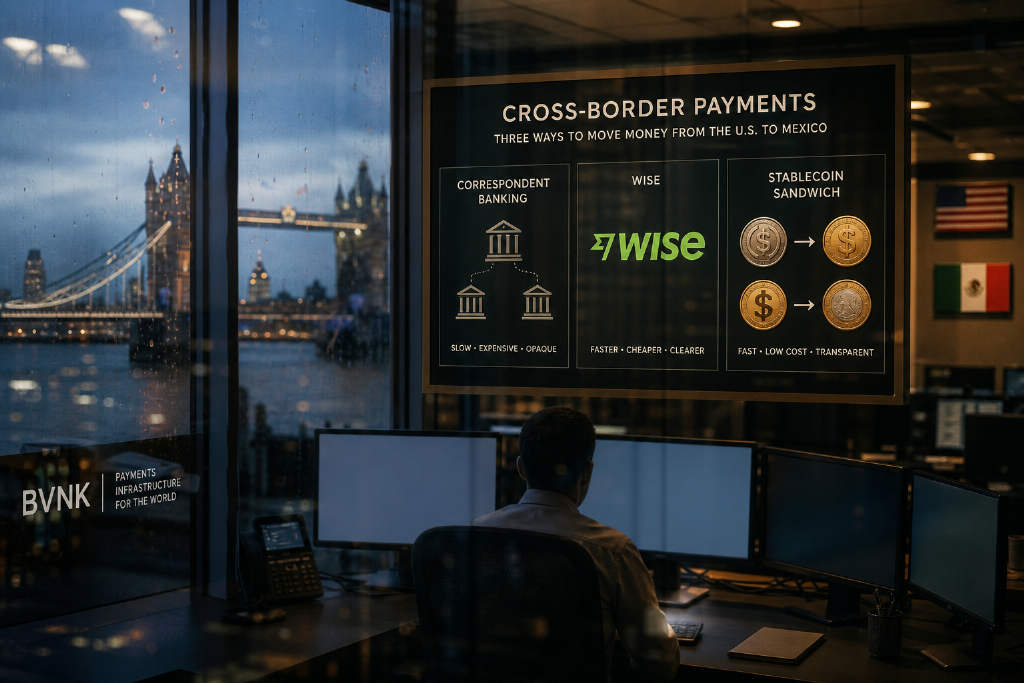
News EditorBlockchain Capital investor Jonah Burian argues that stablecoins are a strong tool for sending money to people who already want to hold stablecoins, but the harder problem is cross-currency payments. In his view, the biggest gains from stablecoins are not simple speed or cost cuts. They come from opening up payment rails to more competition, splitting apart the bundled network that fintech firms once controlled, and making it easier for local on- and off-ramp providers to compete on each leg of a transfer. Burian compares three models: the traditional correspondent banking system, Wise-style fintech routing, and the “stablecoin sandwich” of fiat to stablecoin to fiat. The chain leg can be nearly free and instant, but the fiat conversion on the edges still matters. He also points out that Wise has already built a low-cost model without stablecoins, with cross-border fees around 0.5% in FY26 and 0.50% in Q1 FY27, while the World Bank puts the average cost of digital remittance providers at about 3.5%. The core question, he writes, is not whether stablecoins move money faster onchain, but what kind of market structure they create around the transfer.
Blockchain Capital investor Jonah Burian says stablecoins are a great tool only in a narrower case: when the recipient already wants to hold a stablecoin.
In that setup, transfers can be near-instant and close to free. The harder problem is cross-currency payments, where one side pays in dollars and the other side ultimately needs Mexican pesos, or another local currency.
That is where the stablecoin pitch gets more complicated. Burian argues that many crypto advocates present stablecoins as a major breakthrough for cross-border payments, but fintech companies have already shown they can move money quickly and cheaply without them.
To explain the difference, he walks through the old correspondent-banking model. If Alice in the U.S. wants to send pesos to Bob in Mexico, her bank usually cannot settle directly with Bob’s bank. It relies on a larger correspondent bank, which may also keep peso balances at another local bank in Mexico. Each layer takes a cut. SWIFT messages add another fee. The result is slow and expensive. Burian cites World Bank data showing that consumer cross-border transfers sent through banks cost close to 15% on average when fees and FX spreads are combined, and that transfers often take one to five business days.
He then compares that with Wise. The model began in 2011, when two friends in London had opposite needs: one earned euros but lived in the U.K. and needed pounds, while the other earned pounds but had an euro mortgage in Estonia. Rather than send money across borders, they simply paid each other locally. That idea became Wise.
The key insight is netting. If one customer is converting dollars into pesos while another is converting pesos back into dollars, the fintech can offset those flows internally and avoid moving money across borders in both directions. Only when a currency pool gets badly out of balance does the company need to fall back on the traditional financial system.
Burian says Wise also charges transparent fees and uses the real market mid-rate instead of hiding revenue in the spread. He notes that Wise’s FY26 cross-border take rate fell to about 0.5%, with Q1 FY27 at 0.50%. The World Bank’s average for fully digital remittance providers is around 3.5%.
Stablecoins, by contrast, create what Burian calls a “stablecoin sandwich”: fiat to stablecoin to fiat. Alice can convert $100 into 100 USDC, send it over blockchain rails in seconds for less than a cent, and Bob can cash out through a local off-ramp into pesos.
That middle leg is cheap. But the edge legs are not automatically cheap. Bob still wants pesos, not USDC, and local cash-out providers can still charge meaningful FX spreads. Burian’s point is that blockchain reduces the transport layer, but it does not erase the cost of converting between fiat currencies.
Where stablecoins do matter, he argues, is market structure. Building a global payment network like Wise is hard, which is why only a handful of firms have done it well. Stablecoins lower the barrier to entry. A new payment company no longer needs to build a worldwide banking network from scratch. It only needs a strong on-ramp on one side, a strong off-ramp on the other, and stablecoins in the middle.
That breaks apart the old bundled fintech stack. Instead of one company controlling the full corridor and capturing the spread across the entire transfer, local off-ramp providers can compete leg by leg. In smaller, long-tail corridors that big global networks often ignore, that may matter even more.
Burian points to Yellow Card as an example. The company focuses on stablecoin payments and fiat conversion across several African countries and is also a Blockchain Capital portfolio company.
He also notes the counterargument. There are now many stablecoin orchestration platforms, and the largest players are moving back toward vertical integration. The market could consolidate again. But open payment rails are hard to monopolize. If one middleman takes too much in FX spread, another local provider can step in with a lower price. That competition, Burian argues, is the real promise of stablecoins: not just faster transfers, but cheaper transfers over time.
50
Disclaimer:
The market information, project data, and third-party content displayed on this platform are for industry information sharing only and do not constitute any form of investment advice or return commitment.
Cryptocurrency trading carries high risks. Users should fully assess their risk tolerance and make independent decisions. All profits, losses, and legal responsibilities are borne by the users themselves.