
Corning’s latest quarter did not change the core debate around the company. It shifted the focus to valuation. The company reported 65% growth in enterprise optical communications revenue in the second quarter, and overall revenue came in above expectations. But its third-quarter revenue guidance midpoint of $4.95 billion landed below market forecasts, and the stock dropped 19% in one day.
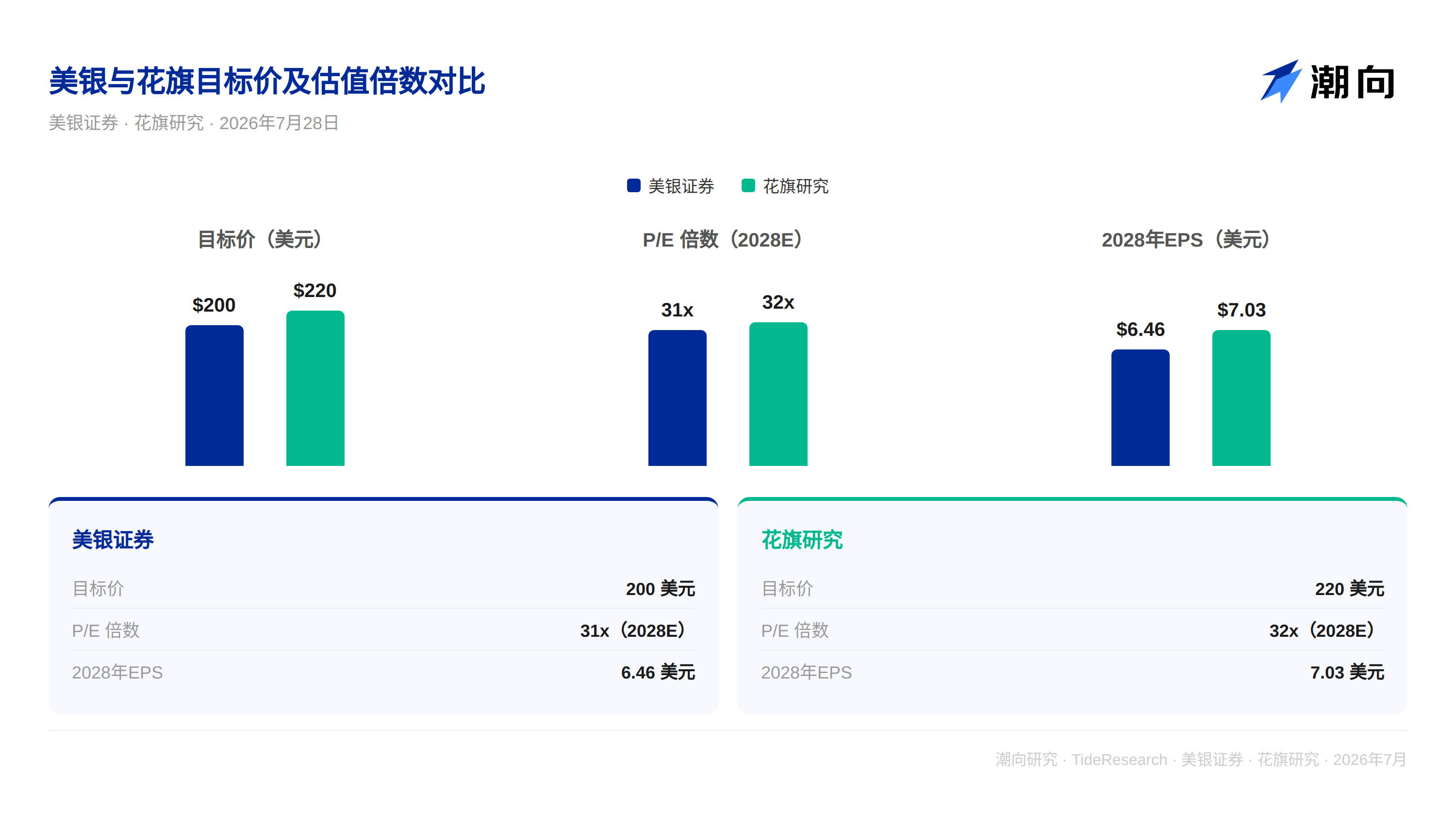
Bank of America Securities cut its price target on Corning to $200 from $243 and kept a Buy rating. Citi Research lowered its target to $220 from $240 and also maintained Buy. In the view summarized in the source article, the two firms were aligned on the main point: the market is deflating a valuation premium, not calling the business model into question. The disagreement is about magnitude, not direction.
Growth is slowing, but the AI demand case remains in place
Based on the broker research cited in the article, Corning’s enterprise optical communications revenue rose 65% in the second quarter, while generative AI-related sales nearly doubled from the prior quarter. Across the broader optical communications segment, year-over-year growth was still 32%.
BofA’s estimate is that the current growth wave reflects scale-out demand, while two additional demand layers — scale-up and co-packaged optics, or CPO — have not started yet.
Citi framed the business in a different way but reached a similar conclusion on quality. It said Corning’s optical communications profits come from higher-value connectivity solutions rather than bare fiber sold by the meter, which in its view means the technical moat is still intact.
The market’s problem was the deceleration embedded in guidance. The midpoint of third-quarter revenue outlook implies year-over-year growth easing from 17% to 16%. In optical communications, growth slows from 81% to 32%, marking a third straight quarter of deceleration. The source article described that as a timing issue rather than a directional change.
That repricing came after a major run-up in the stock. Corning had climbed to $271.78, a 52-week high, and the market had assigned it more than 60x expected 2026 earnings, versus a five-year average of 22x. The business narrative around AI, according to both firms, still stands. What no longer holds is the earlier price level.
Citi also pointed to a structural shift in the business mix. Long-term supply agreements are becoming a stabilizing force in optical communications, it said, with prepayments, capacity reservations, and take-or-pay terms extending order visibility well beyond where it used to be.
Same bullish stance, different math on durability and multiples
The split between the two banks shows up in how they model the staying power of AI infrastructure spending.
BofA reduced its valuation multiple to 31x from 37x and trimmed its 2028 earnings-per-share forecast to $6.46 from $6.50, a cut of just $0.04. Its explanation was straightforward: the lower multiple reflects investor concern over how long the data center buildout can continue. Even at 31x, the stock still screens rich against a historical median of 15x, though less stretched than before.

Citi, by contrast, expects Corning to reach $7.03 in 2028 EPS, a more optimistic earnings view than BofA’s. It lowered its multiple to 32x from 35x, implying EV/EBITDA of about 27x. Citi also said a $2 billion annualized revenue run rate should be reached one quarter earlier than expected, while management’s 19% revenue CAGR target for 2026 through 2030 remains intact. In Citi’s model, profits grow faster than revenue and free cash flow keeps expanding.
The two targets are only $20 apart. The real gap is in the assumptions behind them: BofA is more conservative on the multiple, while Citi is more constructive on earnings power. Each firm is using a different framework to judge how long AI infrastructure capex can hold up, and that leads to a different answer.
Both firms say the selloff hit valuation, not the underlying business
Neither research house turned bearish after the drop.
BofA expects enterprise optical communications revenue to keep growing sequentially in the third quarter. It also sees profits recovering after a solar factory shutdown ends, with operating margin expanding 184 basis points year over year to 20.9%.
Citi expects solar profitability to rebound in the third quarter as the shutdown impact clears. The article says management remains confident in the solar business, with a target of more than $3 billion in revenue and margins above the industry average.
On consumer electronics, management’s view as cited in the source is that current weakness is manageable and can be offset by higher content per device and new product introductions.
Taken together, the long-term thesis on Corning has not changed in the broker notes summarized by the article. What has changed is the market’s framework, from paying for explosive expectations to demanding evidence of durable growth. The source article notes that BofA’s $200 target and Citi’s $220 target imply 67% and 83% upside to the current share price, respectively. But those gains would still require the market to support valuation above 30x. For now, the company’s task is not to add a new story. It is to rebuild confidence through the next several quarters of results.
Source note
The original article says it is a compilation and interpretation by Chaoxiang Research of third-party broker reports from Bank of America Securities and Citi Research, both dated July 28, 2026, together with public market information. It also states that the ratings, target prices, earnings forecasts, and related judgments cited in the piece are the views of analysts at those institutions, do not represent Chaoxiang Research’s own position, and should not be treated as investment advice or a basis for buying or selling securities.