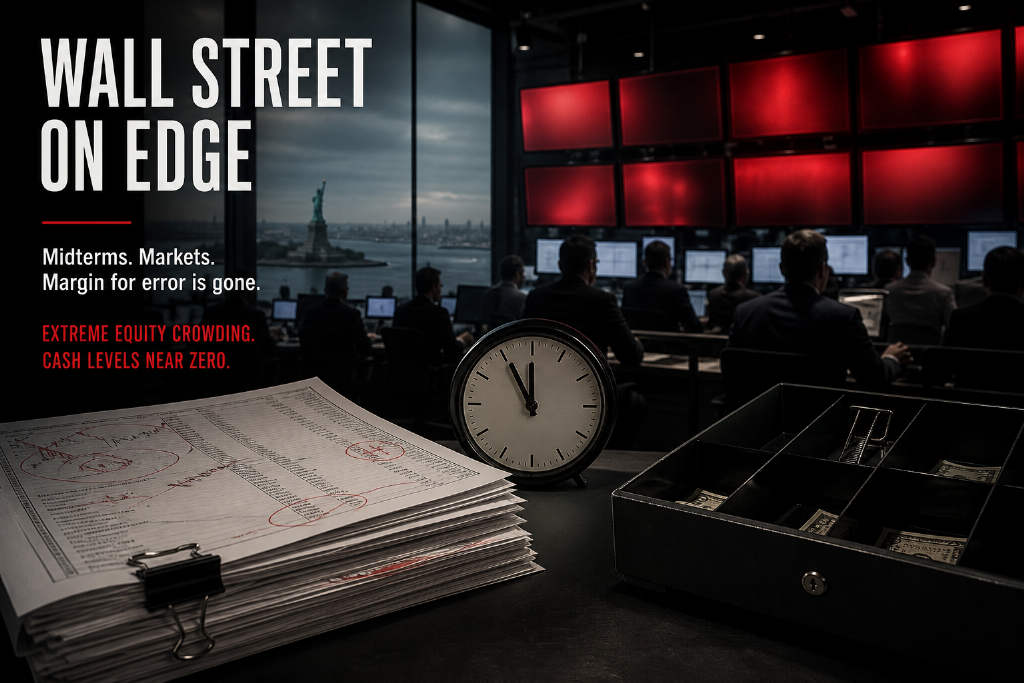
BofA survey shows crowded equity positioning as midterm-election window points to sharper volatility

BofA survey shows crowded equity positioning as midterm-election window points to sharper volatility

N
News Editor
2026-08-18 12:16:50
Bank of America’s latest global fund manager survey showed equity allocations rising to their highest level in nearly five years, with consensus positioning described as increasingly crowded. A net 56% of respondents said they were overweight stocks, the highest reading since November 2021, while cash levels fell to a record low of 3.5%. Michael Hartnett, BofA’s chief investment strategist, said markets are now priced for a tightly aligned set of expectations: no macroeconomic landing, no Federal Reserve rate hike, no pullback in AI capital spending, no Democratic landslide, and no short sellers left. In his view, current positioning favors rotation or reduction within risk assets rather than adding more overall exposure. The survey also found that 72% of respondents expect the Fed to stay on hold before the November midterm elections, while 71% do not expect hyperscale cloud companies to cut AI capital expenditure this year. At the same time, AI was identified as the biggest tail risk, and spending by hyperscale cloud firms was seen as the most likely source of a credit event. Separately, BTIG chief market technician Jonathan Krinsky warned that Aug. 18 to Oct. 11 has historically been one of the most difficult stretches for markets in U.S. midterm election years.

Bank of America’s latest global fund manager survey, cited by BlockBeats on Aug. 18, showed global money managers lifting stock allocations to their highest level in nearly five years, a sign that positioning has become heavily crowded. A net 56% of respondents were overweight equities, the highest since November 2021, while cash holdings dropped to a record low of 3.5%.

Michael Hartnett, BofA’s chief investment strategist, said the market is now built around an unusually uniform set of expectations: no macroeconomic landing, no Federal Reserve rate hike, no reduction in AI capital spending, no Democratic landslide, and no shorts. He said current positioning is better suited to reducing or rotating exposure within risk assets rather than increasing total portfolio risk.

The survey found that 72% of respondents expect the Fed not to raise rates before the November midterm elections. Another 71% said they do not expect hyperscale cloud companies to cut AI capital expenditure this year. Even so, AI has been identified as the biggest tail risk, while capital spending by hyperscale cloud companies is viewed as the most likely trigger for a credit event.

Separately, BTIG chief market technician Jonathan Krinsky warned that the period from Aug. 18 to Oct. 11 is usually one of the toughest phases for markets during U.S. midterm election years. Historical data showed that since 1990, with 2006 the only exception, the S&P 500 has posted at least a 7% decline at some point between August and October in every midterm election year.

The S&P 500 is already up more than 13% this year and remains near record highs. At the same time, yields on 10-year and 30-year U.S. Treasuries have risen above 4.7% and 5.2%, respectively. Higher energy prices and rising financing costs could add pressure to equities. Krinsky said investors may want to cut exposure or hedge during this historically high-risk window.

This article was originally published by Bit.Fan. For more cryptocurrency news and market insights, visit www.bit.fan.
30

Disclaimer:

The market information, project data, and third-party content displayed on this platform are for industry information sharing only and do not constitute any form of investment advice or return commitment.

Cryptocurrency trading carries high risks. Users should fully assess their risk tolerance and make independent decisions. All profits, losses, and legal responsibilities are borne by the users themselves.