
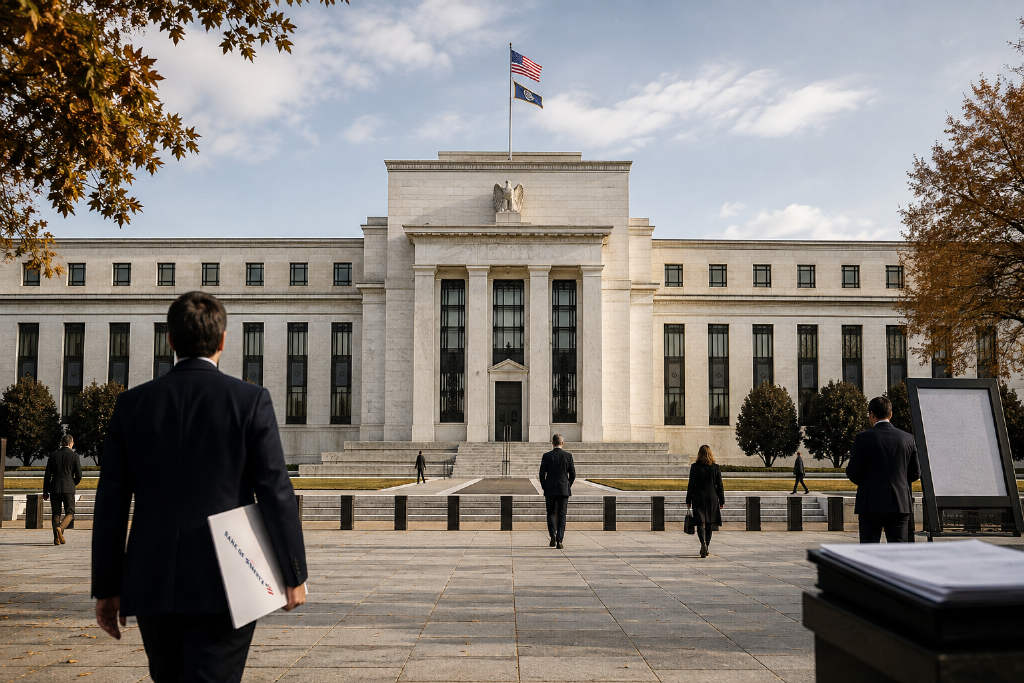
Bank of America said in its latest global economics weekly that Federal Reserve officials are sending signals so divided that markets are struggling to identify a clear policy direction. Fed Chair Warsh’s hawkish remarks at Jackson Hole revived bets on a September rate hike, while Governor Christopher Waller pointed in the opposite direction during the same week. BofA described the setup as a communication paradox.
The bank said Warsh used a comparison between former Vice Chair Donald Kohn and former Chair Ben Bernanke to frame the debate, asking: “Is today a Kohn day or a Bernanke day?” In BofA’s reading, the Bernanke approach is milder and more preemptive, while the Kohn approach leaves the hard move for later and tightens rapidly if inflation gets out of control.
In a global weekly dated Sept. 4, BofA Securities said Warsh’s remarks effectively signaled that the default path has shifted toward a Kohn-style track. He did not formally commit to a rate increase, but he gave markets more directional guidance than his own communication philosophy would normally suggest.
Why BofA calls this a Fed communication paradox
BofA’s argument is not simply that one official sounded hawkish and another sounded dovish. The bank said the real divide lies in how they communicate policy. In its view, Warsh had to offer more explicit forward guidance to repair credibility damage from the July press conference, while Waller did not face the same constraint and could describe a more state-dependent policy rule with greater precision.
BofA said Warsh was effectively telling markets that the Fed may already have waited too long, so investors should be prepared for a Kohn path. Waller, by contrast, was outlining a conditional roadmap: if conditions remain favorable, the Fed follows a Bernanke path; if conditions deteriorate, it shifts to a Kohn path.
One message tried to tell markets which scenario is more likely. The other explained how the Fed would switch between two routes. BofA said that difference comes down to how much credibility pressure each policymaker is carrying. As chair, Warsh has to repair the fallout from July’s communication misstep. As a governor, Waller has more freedom to describe conditionality.
The result, according to BofA, is a tension at the center of current Fed messaging. Warsh, in trying to restore credibility, ended up giving more forward guidance. Waller, in stressing conditionality, ended up giving markets less concrete information about the rate path.
$40 trillion in U.S. debt is not the main yield story
BofA said the U.S. Treasury market crossing $40 trillion should be treated as a balance-sheet milestone rather than the direct catalyst for the recent rise in long-end yields. Markets, the bank said, are less sensitive to the absolute debt level than to changes in deficit expectations and the pace of Treasury issuance.
What matters more is interest expense. BofA said federal net interest costs have already moved above defense and Medicare and now account for 3.5% of GDP. That, in the bank’s view, is the more important warning signal behind long-term yields.
Because current market rates are well above the weighted average rate on outstanding debt, interest costs are likely to keep rising as existing obligations roll over. BofA said the debt-rate-debt feedback loop should not be read as an immediate shock, but as a slow and cumulative process that becomes more meaningful over time.
In its scenario work, the bank modeled interest-rate increases of 1, 2, and 3 basis points for every 1 percentage-point rise in the debt-to-GDP ratio. The early impact is modest, BofA said, but the long-run paths diverge clearly.
BofA’s ECB base case: a 25-basis-point move in September
The report also laid out BofA’s expectations for the European Central Bank. The bank said it expects the ECB to raise rates by 25 basis points in September, taking the deposit rate to 2.50%.
Using assumptions from mid-August, BofA said inflation forecasts do not change much, which leaves room for a third hike this year without amounting to a commitment. Its base case is that a September increase would mark the end of this tightening cycle, with the ECB turning to cuts in 2027.
Energy prices remain the largest uncertainty. BofA said that if energy prices through Sept. 1 are used, the synthetic 2027 energy price would be nearly 5% above the June baseline. If the ECB’s alternative scenario shows 2027 inflation and terminal core inflation 10 basis points above the June baseline, markets would likely treat that as a sign of higher odds for a December hike.
Even so, BofA said a cumulative 75 basis points of tightening would still be a high bar and would require energy prices to keep rising.
Bank of England seen on hold before a 2027 cut
For the U.K., BofA raised its 2026 growth forecast slightly to 1.2%, citing stronger-than-expected activity in the first half. It lowered its 2027 growth forecast to 1.2% because of elevated energy prices and policy uncertainty ahead of the autumn budget.
The bank said inflation is now expected to peak at 3.5% in November, above its previous forecast. On rates, BofA expects the Bank of England to stay on hold through 2026 and then cut by 25 basis points in November 2027, taking the policy rate to 3.50%.
BofA added that uncertainty around the energy shock means hike risk remains in play. It described the November, December, and February meetings as “live” and said markets are pricing the next three hikes too hawkishly.
Philippines deficit outlook and divergence in Central and Eastern Europe
In emerging markets, BofA said the Philippines’ 2026 fiscal deficit could widen to 6.1% of GDP, above the government’s earlier 5.5% estimate. The bank attributed that to slower revenue growth, which it sees at 6% versus the government’s 8%, and weaker GDP growth of 2.5% versus the official 3.5% to 4.5% range.
Interest payments are taking up a growing share of the budget, BofA said, and are expected to reach 15% in 2026, the highest level since 2014.
In Central and Eastern Europe, the bank said the gas-price shock is a real risk and that markets may be overpricing the extent of future rate increases. Pass-through from gas prices to consumer prices is slow and uneven, with a lag of six to 12 months and major country-by-country differences.
BofA said the Czech Republic is the most exposed to wholesale gas prices, followed by Poland. Hungary and Romania are more insulated because of administered pricing. Its forecast is for the Czech central bank to deliver at most one more hike, a 25-basis-point move in November, while Poland’s central bank stays on hold.
The broader picture in BofA’s report is a world in which the U.S. is still caught in a communication problem, debt dynamics are deteriorating gradually, Europe is near the end of its tightening phase, the U.K. is waiting to see how the energy shock feeds through, and divergence across emerging markets is becoming harder to ignore.