
Bank of America chief investment strategist Michael Hartnett used his latest Flow Show report to lay out a two-track market call: cautious in the near term, still bullish from a longer-term allocation standpoint. His tactical view is to step away from risk assets. His strategic view remains long equities and short bonds, based on the argument that U.S. policymakers will not allow a full-blown market collapse and now treat the stock market as a systemically important asset that is too big to fail.
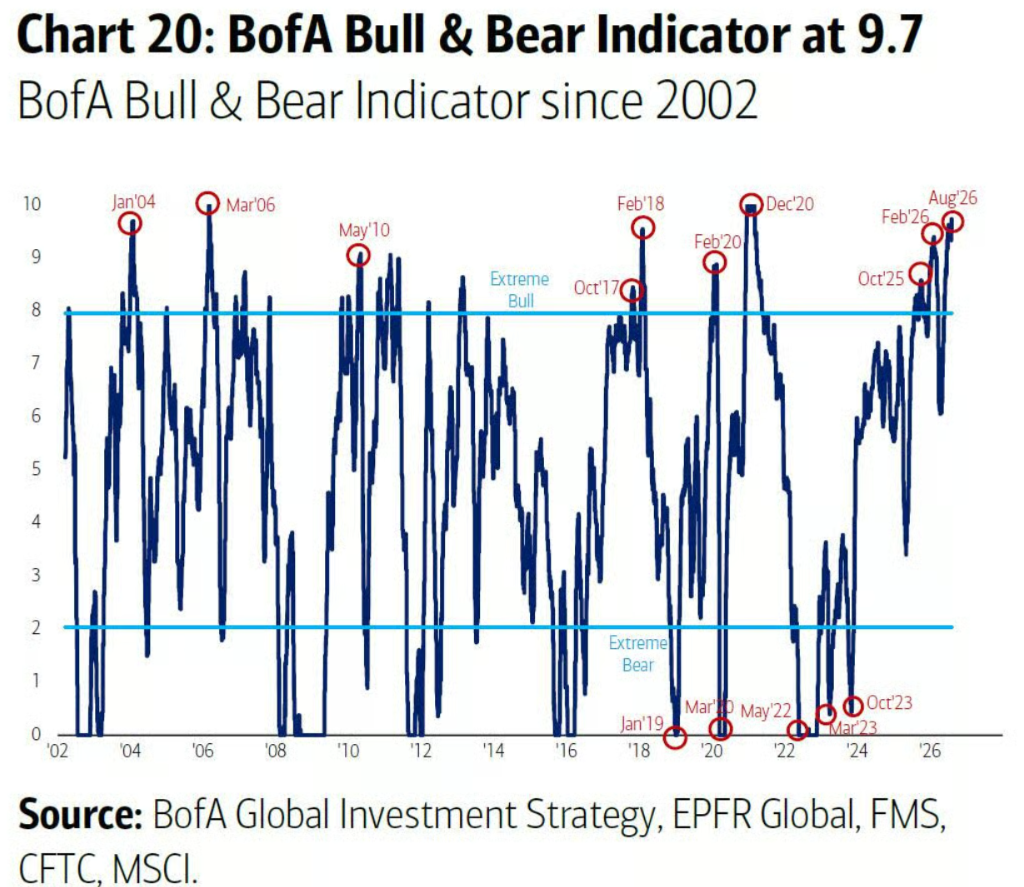
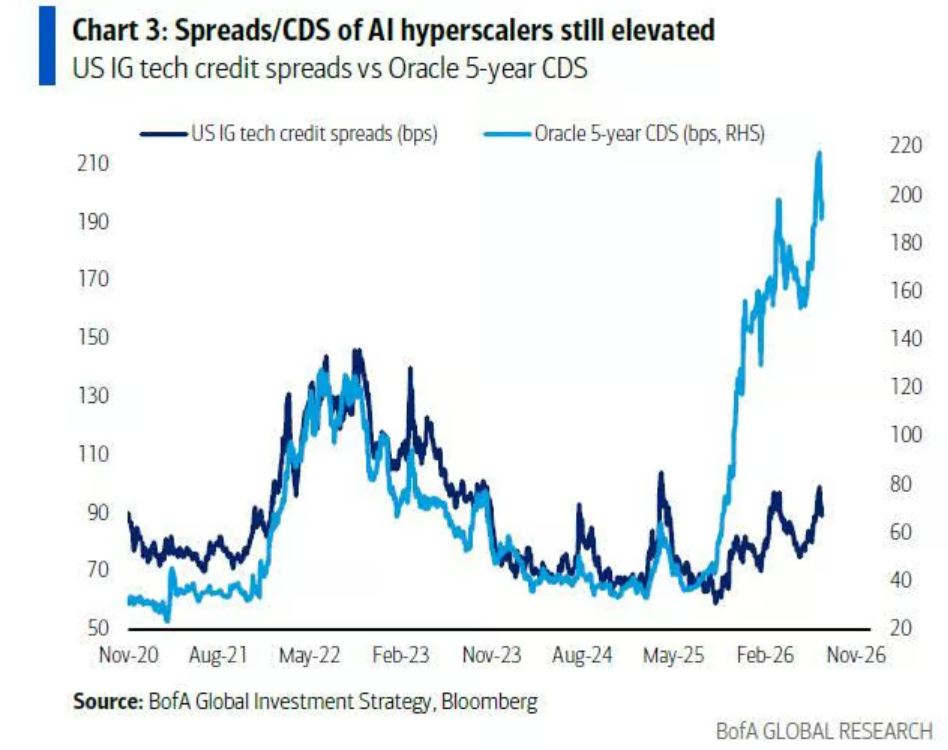
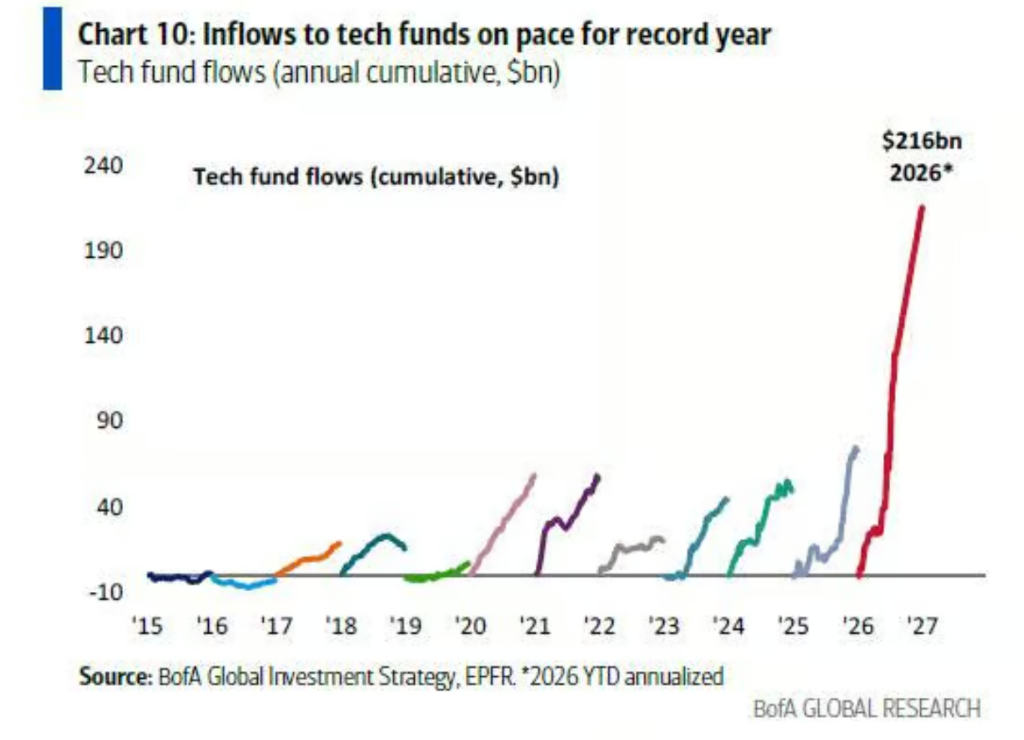
His latest update comes as BofA’s bull-and-bear indicator climbed from 9.4 to 9.7, the highest reading since the meme-stock bubble in early 2021. Hartnett said the move reflects extremely optimistic sentiment. He also warned that credit markets are sending clearer bearish signals, with widening credit spreads and CDS for AI hyperscale data center operators, while tech funds posted their first net outflow in six weeks.
Bull-and-bear indicator hits 9.7 as sentiment stretches higher
Hartnett said BofA’s bull-and-bear indicator has risen to 9.7, its highest level in nearly five years. He tied the move to heavy inflows into high-yield bonds, tighter spreads in global high-yield debt and AT1 risk debt, and improving breadth across global equity indexes.
He said that when the indicator reached similar extremes in 2018, 2020 and 2021, market sentiment later swung from extreme optimism to extreme pessimism within a year. He did not say history must repeat, but he said the pattern deserves attention.
Fund flows for the week showed net inflows across almost every major asset class:
- $53.7 billion into cash
- $32.9 billion into stocks
- $23.1 billion into bonds
- $0.9 billion into gold
- $0.6 billion into crypto
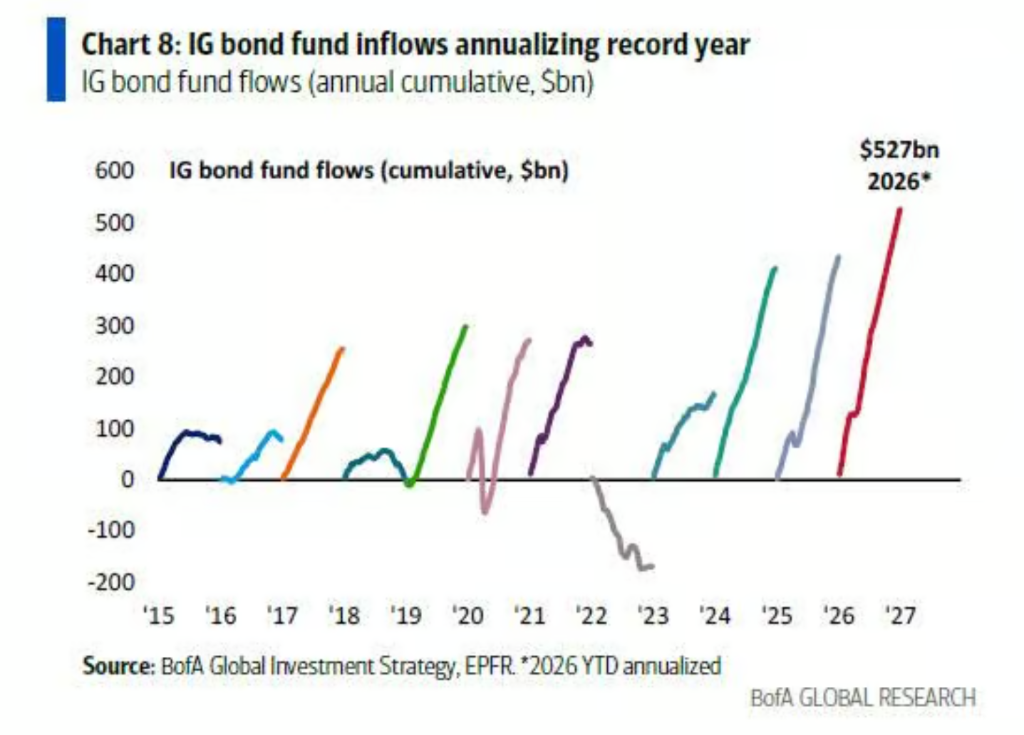
Within that, annualized inflows into U.S. equities reached a record $652 billion, while annualized inflows into investment-grade bonds hit a record $527 billion.
Tactical stance: rotate and retreat rather than add risk
On near-term positioning, Hartnett said he remains in the “summer retreat/rotation rather than adding” camp. He advised investors to move out of risk assets and into defensive holdings, duration-sensitive assets and the U.S. dollar. The report cited staples as a defensive trade, and named REITs, small caps and biotech as duration assets.
His reasoning is that those groups are better able to withstand tighter financial conditions. They are also less exposed than cyclicals such as banks, industrials and semiconductors if the market’s current consensus starts to break down. That consensus, as Hartnett framed it, assumes no macro hard landing, no new Federal Reserve rate hikes, no cut to AI capital spending and no Democratic sweep in the midterm elections.
He had earlier set out two macro thresholds around the July nonfarm payrolls report. If payroll growth came in above 125,000 and the unemployment rate stayed below 4.1%, Federal Reserve chair candidate Kevin Warsh could return to a hawkish stance at the Aug. 28 Jackson Hole meeting. If payroll growth fell below 50,000 and unemployment rose above 4.3%, that would favor duration assets and defensive positioning.
The data that eventually came out sent mixed signals. Payrolls missed expectations by a wide margin, but the unemployment rate fell to 4.1%, offsetting part of the negative impact. At the same time, the labor force shrank by 264,000.
Strategic view: long stocks, short bonds stays in place
Despite the tactical caution, Hartnett did not change his core strategic allocation of long stocks and short bonds. He argued that policymakers have made it clear they will not tolerate a major equity drawdown.
He linked that view to the U.S. economy’s dependence on the wealth effect. U.S. household stock holdings have increased by $7 trillion so far this year, after rising by $9 trillion in 2024 and another $9 trillion in 2025. He also pointed to the boom in AI data center capital spending as another pillar supporting the current setup.
Hartnett said last week’s coordinated intervention in the foreign-exchange market, which he described as an effort to end a “poor man’s LTCM” deleveraging event, reinforced his case. In his reading, the U.S. government will step in when tighter financial conditions threaten to end the boom and the bubble. He added that the Trump administration and Treasury Secretary Scott Bessent still have yield-curve control available as a policy tool.
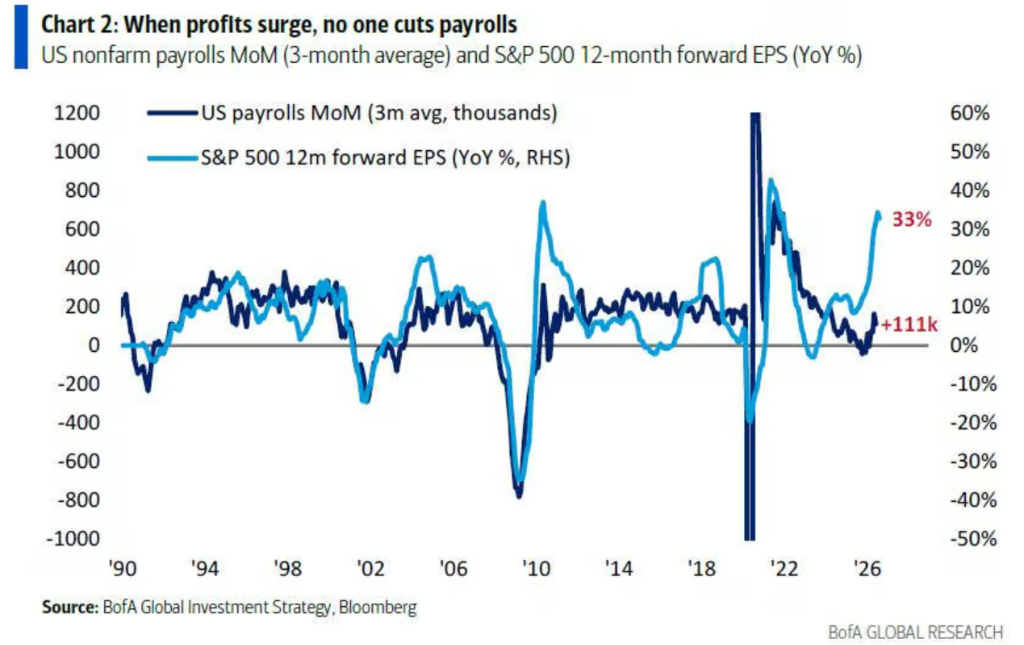
On earnings, Hartnett said EPS remains the core driver of the bull market. Twelve-month forward EPS estimates have been revised up by 33%, helped in part by roughly $35 billion in tariff refunds over the past three months. He said that partly offset about $75 billion in tariff pressure between May and July 2025.
What could end the rally
Hartnett was explicit about the conditions that could bring the current bull market to an end. He said a self-protective bond selloff marked by rising yields and a falling dollar could force a sharp fiscal-policy turn and push asset allocation away from stocks and into bonds. That, in his view, would end the current stretch of prosperity.
Asked for the market’s canary-in-the-coal-mine signal, he gave a direct answer: rising yields and falling bank stocks.
He also returned to credit markets, where he said spreads and CDS for AI hyperscale data center operators are still widening as large-scale share buybacks and cash flow fade. Hartnett said the threat that cheap Chinese computing power could end the AI capex boom would only be removed if MAGS quarterly EPS comes in above $70.
Gold as a hedge against politics and election-cycle tail risk
At the end of the report, Hartnett widened the frame to politics and the broader macro picture. He said political populism in the 2020s has driven fiscal expansion, lifting U.S. nominal GDP from $20 trillion to $32 trillion over the past six years, a 63% increase, while U.S. national debt is close to breaking above $40 trillion.
He described the coming midterm election as a contest between “populist capitalism,” which seeks to reduce deficits through growth, and another political route that would use a wealth tax to reduce deficits.
In market terms, Hartnett said it would be positive if Republicans hold their Senate majority. He said going long consumer stocks is the best way to position for a Trump shift toward affordability issues, while going long gold is an effective hedge against the tail risk that a “K-shaped” voter structure triggers simultaneous declines in yields, the dollar and stocks before year-end.