

Odaily author Qin Xiaofeng (@QinXiaofeng 888) reviewed the growing pressure around the Bank of Japan’s June policy decision. According to Nikkei, the BoJ is set to raise its short-term policy rate from 0.75% to 1.0% at the monetary policy meeting on June 15-16. If implemented, that would mark Japan’s highest policy rate level since 1995. Market pricing has already moved sharply in that direction: on PolyMarket, the probability of a 25bp rate increase has risen from 25% in early April to 98%.
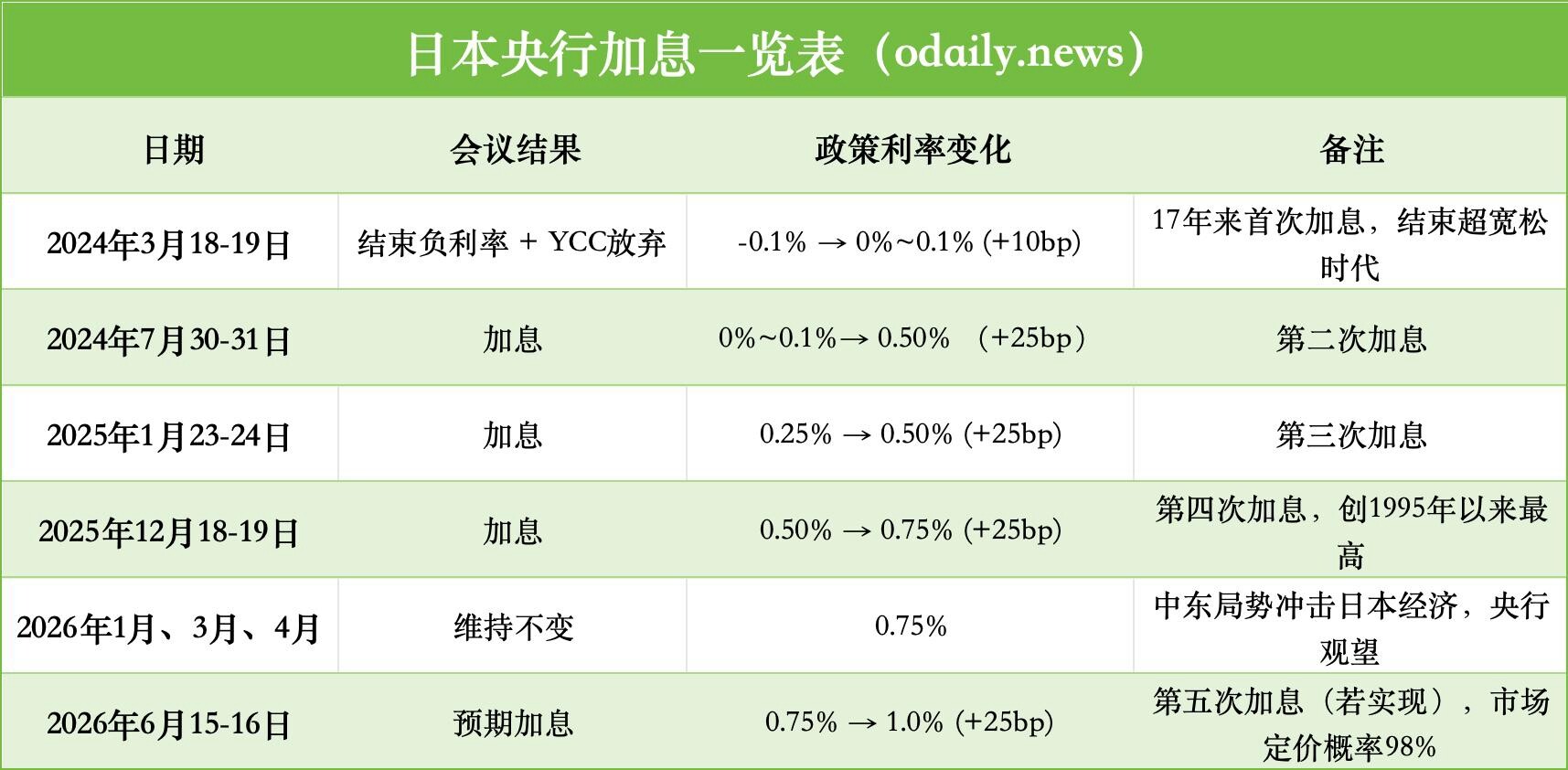
From the end of negative rates to the 1.0% threshold
The issue for global risk assets is not limited to the rate decision itself. Japan’s ultra-loose monetary policy has long supported yen-funded carry trades. Investors borrowed yen at near-zero interest rates and deployed the money into higher-yielding assets such as US equities, technology shares, emerging markets and crypto assets. Once the BoJ raises rates, yen funding costs increase. If the yen strengthens at the same time, investors holding overseas assets face larger foreign-exchange losses and may have to sell assets, buy back yen and repay loans.
The BoJ’s hawkish shift has been building over the past two years. In March 2024, it ended 17 years of negative interest rates, raising the policy rate from -0.1% to a range of 0% to 0.1%. That was the first hike of the current cycle. In July 2024, the BoJ raised rates again by 15bp to 0.25% and announced gradual balance-sheet reduction. In January and December 2025, it raised rates by 25bp each time, taking the policy rate to 0.75%. The first three meetings of 2026 left rates unchanged. After roughly half a year on hold, the renewed push to tighten is driven mainly by two forces: energy shocks and imported inflation, and the weakness of the yen.

On the energy side, oil-price volatility tied to Middle East conflict in the first half of the year has pushed up import costs for Japan, a country highly dependent on imported energy. Japan’s Corporate Goods Price Index rose 6.3% year on year in May, the fastest pace since 2023. Petroleum products climbed 9.6%, while utilities rose 8.5%. The BoJ expects core CPI in fiscal 2026 to reach 2.5% to 3.0%, well above its established 2% target.
The exchange-rate channel is just as important. USD/JPY has been hovering near the 158-160 area, close to an extreme historical weak zone for the yen. The sharp depreciation has directly reduced the import purchasing power of Japanese companies and raised the cost of imported energy, raw materials and other commodities. Japan’s Ministry of Finance has intervened in the foreign-exchange market several times, but the effect has been limited and difficult to sustain.

BoJ Governor Kazuo Ueda shifted clearly toward an anti-inflation narrative in a June 3 speech, stressing that if upside price risks outweigh downside economic risks, the costs and benefits of another rate increase must be discussed. Reuters, citing three people familiar with the matter, reported that unless the Middle East conflict escalates sharply, the BoJ will raise rates in June and may slow the pace of bond-balance-sheet reduction to keep markets stable. Bloomberg and ING maintained similar views, and expect the BoJ to raise rates by a total of 50bp in 2026. Taken together, the shift shows Japan moving from its role as the world’s last lender toward a more normalized central bank, directly challenging global assets that rely on cheap yen financing.
How yen carry-trade unwinding transmits stress
The transmission path is straightforward. A BoJ hike raises yen funding costs. A stronger yen pushes USD/JPY lower and increases foreign-exchange losses for leveraged investors. That forces deleveraging. Deleveraging leads to large-scale sales of risk assets. Lower asset prices trigger more stop-loss orders, which then intensify liquidation pressure. This feedback loop is the central reason why a Japanese rate move can matter far beyond Japan’s domestic bond and currency markets.

History offers a direct warning. On July 31, 2024, the BoJ raised rates by 15bp to 0.25% and announced gradual balance-sheet reduction. Combined with weak US employment data, the move triggered severe turbulence across global markets. South Korea’s KOSPI and KOSDAQ both plunged and triggered circuit breakers. Japanese equities collapsed, with the Nikkei 225 falling 12.4% in a single day and losing more than 20% over one week, its worst performance since 1987. Global equities fell in tandem, US stocks and technology shares corrected, and the VIX fear index surged.
Crypto assets were also hit hard during that episode. Bitcoin and ETH fell by more than 30% in just one week, while leveraged liquidations jumped. According to Morgan Stanley’s estimate, even though a large portion of positions has been gradually unwound since 2024, about $500 billion in outstanding yen-funded positions remains in the market. Morgan Stanley warned that if the yen appreciates quickly, chain liquidations could be triggered during thinner-liquidity periods, with particularly severe effects on highly leveraged assets. J.P. Morgan global market strategist Dubravko Lakos-Bujas and FX strategist Meera Chandan also pointed out that policy divergence between the BoJ and the Federal Reserve will increase the instability of carry-trade unwinding and lead to a repricing of global risk assets.

AI technology shares face liquidity and cost pressure
The AI-driven technology boom was the main theme for US equities in the first half of 2026. Nvidia, Broadcom and other chip stocks, along with hyperscale cloud-service providers, led the Nasdaq to repeated record highs. But in June, the market began to rotate and correct. On June 5, US equities suffered their sharpest single-day pullback of 2026 so far. The Nasdaq dropped 4.18%, its largest one-day decline since April 2025. The S&P 500 fell 2.64%, ending a nine-week winning streak. The Dow declined 1.35%, and the Philadelphia Semiconductor Index fell by more than 10%. Nvidia, Broadcom, Micron, Marvell and other core AI names led the losses.
The correction reflected several factors, including geopolitical tension and uncertainty around Federal Reserve policy. But BoJ-related liquidity pressure is also part of the equation. High-valuation growth stocks are directly exposed to tighter liquidity conditions. AI companies require massive capital expenditure and rely heavily on cheap financing. If yen carry trades unwind, global risk-seeking flows into high-beta technology stocks decline. Semiconductor leaders such as Nvidia and Broadcom, as well as hyperscalers such as Meta and Microsoft, are highly sensitive to valuation changes and therefore vulnerable to selling pressure.

Investing.com noted that high-valuation growth sectors are the most sensitive to changes in global liquidity. Once carry-trade unwinding begins, rapid deleveraging often follows. At the same time, higher energy prices caused by Middle East conflict raise data-center electricity and cooling costs. Together with BoJ rate hikes, this creates a stagflation-style macro environment and tests the sustainability of AI business models. BitMex founder Arthur Hayes warned in his latest article, Reality Test: ‘Energy reality is testing the market’s current dream state.’ He also argued that high oil prices not only lift operating costs, but also slow the growth of enterprise token usage, putting further pressure on AI-related revenue expectations.
Another pressure comes from supply and politics. SpaceX, Anthropic, OpenAI and other large companies plan to list intensively in the second half of 2026. Their valuations can reach hundreds of times sales, and lock-up expirations would bring significant supply pressure. At the same time, Donald Trump turning against AI for the midterm elections would add regulatory uncertainty.

Crypto carries the highest-beta burden
Crypto assets sit at the high-beta end of the global risk-asset spectrum, which makes them especially exposed to the same liquidity squeeze. On one side, higher Japanese rates raise global leverage costs and force the liquidation of leveraged crypto positions. On the other side, crypto is competing with AI for liquidity. AI capital expenditure has already absorbed large amounts of market capital, while crypto has lagged. BoJ tightening further reduces marginal liquidity available to the sector.
Yahoo Finance analyst Lockridge Okoth said the 98% probability of a rate hike is linked to the next liquidity shock for Bitcoin. Investing.com also noted that yen appreciation and BTC weakness are often highly synchronized, serving as a typical signal of rising global risk aversion. The renewed concern over BoJ tightening is therefore not an isolated event. It is a sign of marginal global liquidity tightening, occurring at the same time as Middle East geopolitical conflict pushes up oil prices, AI capital spending consumes liquidity, and Federal Reserve policy remains uncertain. For investors, the short-term pressure is concentrated in highly leveraged and high-valuation areas, especially AI technology stocks and crypto assets, where volatility and drawdown pressure are elevated and leverage risk needs to be controlled.