
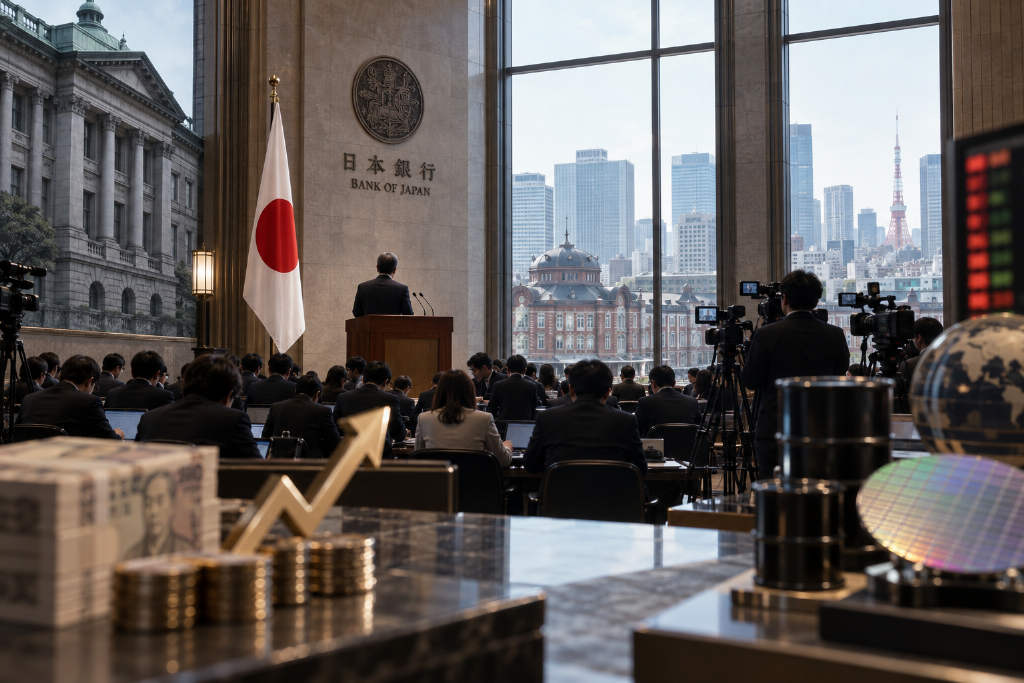
Bank of Japan Governor Kazuo Ueda said Friday that the central bank sees upside risks to underlying inflation above its 2% target, as companies show stronger willingness to raise wages and pricing behavior turns more active. Speaking at a press conference on Sept. 18, Ueda said the BOJ will continue to raise rates in line with economic and price developments, with stabilizing the price trend around 2% remaining the core policy objective.
Ueda said strong demand linked to artificial intelligence, a recent rebound in crude oil prices, and the yen’s continued weakness have together kept producer prices elevated, helping sustain inflation. He said the BOJ needs to act preemptively to contain inflation and avoid a situation in which prices overshoot the target to a degree that would require rapid rate hikes, as seen in the U.S. and Europe several years ago.
No preset path for the pace of hikes
On the pace of tightening, Ueda said the BOJ has no fixed plan for how quickly it will raise rates. Policy decisions will be made after full discussion at each meeting, with the bank weighing both the timing and pace of any adjustment.
When asked whether the BOJ could raise rates by 50 basis points or move at consecutive meetings, Ueda said the central bank would not rule out any specific policy option before a policy board meeting. The pace and size of future hikes will depend on price developments, he said, adding that moving slowly is not always a good thing.
After the remarks, USD/JPY briefly fell about 50 pips and moved back below the 157 level before rebounding. The pair was later up 1% on the day.
Ueda also said it is difficult to judge whether financial conditions are excessively accommodative, and pledged to closely monitor the cumulative impact of rate hikes on the financial environment.
Benchmark rate raised to 1.25%
A Wall Street Insight article said the BOJ raised its benchmark rate by 25 basis points to 1.25%, the highest level since 1995. It was also the sixth rate hike since the central bank exited its negative interest rate policy in March 2024. The speed of the latest tightening marks the fastest since 1990.
The decision was not unanimous. Of the nine board members, two reflationist members appointed by Japanese Prime Minister Sanae Takaichi — Toichiro Asada and Ayano Sato — dissented and argued for keeping policy unchanged, showing that divisions remain inside the BOJ over further tightening.
Chidu Narayanan, Wells Fargo’s chief Asia-Pacific strategist, said the outcome was “not hawkish enough for the market, and should push USD/JPY higher while sending short-end yen yields lower.” He added that although two members voted against the move, they were also the two most dovish members on the policy board, which does not support market expectations for a rapid series of BOJ rate hikes.
Inflation nears target, wage talks matter
On inflation, Ueda delivered a clearer warning. He said the underlying price trend is continuing to approach the 2% policy target, and that inflation could move above target as wage growth and corporate pricing behavior both turn more positive.
He said the BOJ needs to prevent prices from drifting away from target and damaging the economy, with keeping inflation around 2% now a key policy consideration. Ueda also said Japan’s spring wage negotiations are an important factor shaping the price trend.
Middle East, AI demand and the yen are key variables
Ueda identified three external variables that could influence the future path of rates: the situation in the Middle East, expanding AI-related demand, and the direction of the yen. He said those factors have left Japan’s producer prices at elevated levels, while the recent rise in oil prices has added to inflation pressure.
The report said analysts see uncertainty around those external drivers as a two-sided factor. They could either accelerate the BOJ’s rate-hike path or give policymakers reason to stay cautious, depending on how those risks evolve.
Neutral and terminal rates remain hard to pin down
Ueda said the BOJ has entered a different phase of policy implementation. The latest rate increase was driven by the need to guard against upside price risks, and future decisions will continue to be made after full discussion at each meeting.
He said the immediate priority is to keep prices stable around 2%, while the appropriate neutral rate is difficult to predict and the terminal rate is also hard to determine.
Economy on a moderate recovery path
Ueda struck a cautiously optimistic tone on Japan’s economy. He said the economy is on a moderate recovery path and, despite some lingering weak spots, is expected to continue growing at a moderate pace.
On the policy stance, Ueda said Japan’s financial conditions remain accommodative, and that the easy monetary environment is expected to continue supporting the economy.