
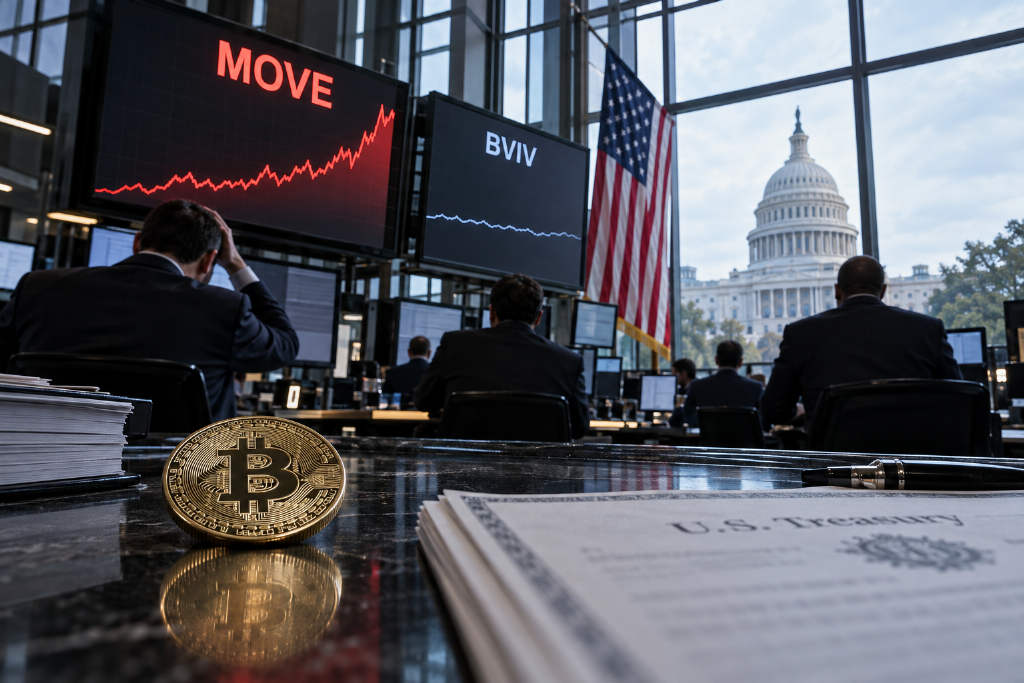
Bond traders are bracing for bigger rate swings. Bitcoin options traders, at least for now, are not.
The MOVE Index, which tracks expected volatility in the U.S. Treasury market, rose to 104.58 from 78.56 on Sept. 22, a gain of about 33% in two trading days and the highest level since March. Volmex’s 30-day Bitcoin implied volatility index, BVIV, was still around 37, only slightly above its yearly low near 35.
That has created an unusual split across markets: bond traders are buying volatility protection, while the Bitcoin options market is still pricing in limited price swings over the next month.
MOVE posts a two-day surge
MOVE is often described as the Treasury market’s version of the VIX. It reflects expected interest-rate volatility implied by U.S. government bond options.
The latest figures show the index rose 21.5% on Sept. 23 and another 9.57% on Sept. 24, for a cumulative two-day increase of about 33%.
- Sept. 22: 78.56
- Sept. 23: 95.45
- Sept. 24: 104.58
The 104.58 reading is the highest since March, though still well below the extreme level of about 199 seen earlier in the year.
The jump came as long-dated sovereign yields moved higher. U.S. Treasury data showed the 10-year yield rising from 4.96% on Sept. 22 to 5.18% on Sept. 24, while the 30-year yield increased from 5.29% to 5.47%. The 10-year yield also touched about 5.2% intraday.
Higher oil prices and rising energy costs have revived concern over sticky inflation and the possibility that major central banks may need to keep policy tighter for longer.
Bitcoin implied volatility stays subdued
Bitcoin options have not shown the same demand for hedging.
BVIV measures annualized implied volatility in Bitcoin options over roughly the next 30 days. It is currently around 37, versus a yearly low near 35. In simple terms, the options market is still pricing in movement in BTC over the next month, but not an extreme one.
As of Sept. 26, Bitcoin was trading near $84,000. Even with Treasury yields above 5% and bond volatility rising quickly, the price of hedging in Bitcoin options remains near the low end of this year’s range.
Correlation data shows the split
The divergence is clearer in the correlation numbers.
Market data showed the 20-trading-day correlation between MOVE and BVIV had fallen to about -0.37. In other words, Treasury volatility has been rising while Bitcoin implied volatility has not moved up with it.
MOVE’s correlation with the equity VIX also dropped to about -0.06, the first mildly negative reading since April 2024. That suggests the current stress is concentrated in rates rather than clearly spilling over into equities or Bitcoin options.
Why Bitcoin has stayed calm
One reason cited in the report is that higher yields do not automatically mean Bitcoin must fall.
A rapid rise in long-term yields usually lifts the risk-free rate and tightens financial conditions, which in theory is negative for risk assets such as stocks and cryptocurrencies. Even so, BTC’s response to rate shocks has become less sensitive than in the past. Historical data does not show a stable, consistent inverse relationship between Treasury yields and Bitcoin returns.
Bitcoin has also just gone through about $15.9 billion in quarterly options expiry. That cleared out or rolled over a large amount of existing options positioning and hedging demand, leaving short-dated implied volatility at relatively low levels.
Current pricing looks more like bond traders are worried that rates could move sharply, while Bitcoin traders do not yet see that volatility as something that must turn into a major BTC move.
What the market is watching next
U.S. Treasuries are not just another asset class. They are one of the core pricing benchmarks and collateral bases in global finance. If MOVE stays above 100 and the 10-year yield remains near 5% for an extended period, funding conditions for banks, funds and leveraged trades could tighten further.
If that happens, whether Bitcoin volatility can remain in the 35 to 40 range will become an important signal.
The bond market is already paying more for volatility insurance, while stock and crypto markets have not raised hedging costs in the same way. That divergence does not necessarily mean Bitcoin must catch down. What it does show is that the rates market and risk-asset markets are assigning very different prices to macro risk right now.
If MOVE falls back quickly, this may prove to be a short-lived repricing in bonds. If Treasury volatility stays elevated while BTC implied volatility remains near yearly lows, the gap between the two will draw more attention.