
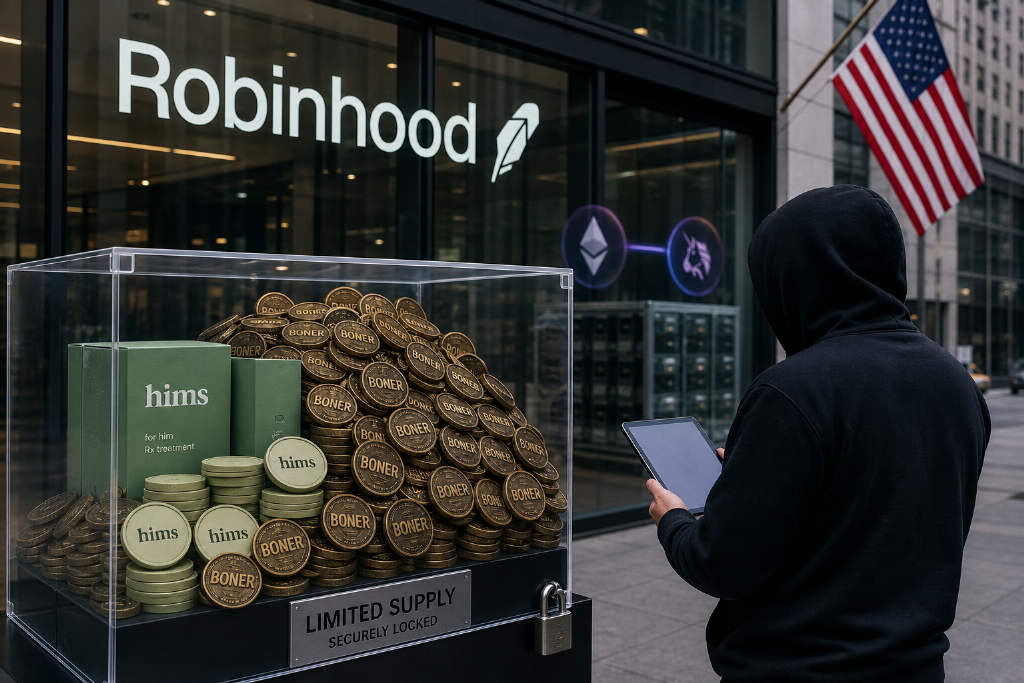
A memecoin built around the short-interest story in Hims & Hers Health absorbed more than half of the company’s tokenized float on Robinhood Chain, and the squeeze in available supply sent the wrapper to roughly 4.5 times the price of the actual stock over the weekend.
Robinhood’s tokenized equities sit on a float small enough for a single memecoin launch to corner, while ordinary holders have no direct way to expand supply. Robinhood spent the summer pitching its Layer 2 chain as infrastructure for real-world assets, but many of the tokenized stocks on the network are now serving as collateral in memecoin pairs. Over the weekend, those meme pairs started determining the wrapper’s price.
According to DEX Screener, BONER traded at $0.04125 at 17:06 UTC on Monday, up 1,054% over 24 hours, with a market capitalization of $41.3 million and $19.8 million in volume across its pools. Its main market pairs BONER against HIMS, the Robinhood Chain token referencing Hims & Hers stock. That pool went live on Aug. 20. BONER closed Aug. 27 at $0.000138, putting the move since then at roughly 300x.
How the structure works
The mechanics break down into seven parts.
First, Robinhood does not issue the tokenized stock directly. Robinhood Assets (Jersey) Limited, a Jersey subsidiary, buys the real share, places it with a U.S. custody partner, and issues one token against it. Robinhood’s Stock Tokens page states that 「every single Stock Token in circulation is backed 1:1 by the corresponding underlying equity.」
Second, only one firm can create or destroy those tokens. The Stock Tokens documentation says 「only Authorised Participants (at issuance, the only Authorised Participant is BBVI) may subscribe for Stock Tokens directly from RHJ after KYB onboarding.」 The developer guide makes the same point: 「Direct mint/burn is available only to Authorized Participants / market makers and requires KYB onboarding.」 A trader who wants more tokenized HIMS cannot mint it independently.
Third, that keeps onchain float extremely small. Hims & Hers had about 233 million shares outstanding in its latest 10-Q, while Robinhood Chain showed 58,714 tokenized HIMS shares as of 17:12 UTC Monday. That works out to roughly one tokenized share for every 4,000 real shares.
Fourth, two launchpads, Bankr and long.xyz, let users create memecoins that trade against stock tokens instead of stablecoins. Buying the memecoin means paying in the stock token.
Fifth, in an automated market maker, assets paid in remain in the pool. Every BONER purchase moved tokenized HIMS out of circulation and into the BONER/HIMS pool. After 10 days of buying, half the float had been pulled there.
Sixth, the remaining HIMS in ordinary HIMS/stablecoin pools became thin, and thin pools can move sharply on small orders. Over the weekend, with the New York Stock Exchange closed and no live stock price available for arbitrage, a few thousand dollars of buying pushed the token to $132.64. That print came on just $39,000 of volume in the hour.
Seventh, two developments closed the gap. The NYSE reopened, and BBVI minted new tokens into the premium. By midday Monday in New York, the token had moved back near the stock price.
More than half the float in one pool
The HIMS token contract on Robinhood Chain showed a total supply of 58,714 tokens at 17:12 UTC Monday. Of that amount, 48,477 tokens, or 83%, sat inside Uniswap v4’s pool manager contract, which custodies liquidity for every v4 pool on the chain. Uniswap deployed v2, v3, v4 and UniswapX on Robinhood Chain on July 2, the day after the chain launched.
DEX Screener attributes 31,198 of those tokens to the BONER/HIMS pool alone, equal to 53% of all issued HIMS tokens. Another 1,424 tokens were spread across eight other memecoin pools. That left 20,303 HIMS tokens in the HIMS/stablecoin and HIMS/ETH pools where price discovery is supposed to take place.
The float is also small in absolute terms. At the stock’s Monday afternoon price of $29.41, all 58,714 tokenized shares were worth about $1.73 million. BONER’s market capitalization was 24 times larger. CoinGecko data showed HIMS itself turned over $13.5 million in 24 hours, close to eight times the value of the entire float.
The $132.64 weekend print
Price data from the HIMS/USDG pool shows the dislocation emerging on Sunday evening. In the hour ending 21:00 UTC on Aug. 30, the token printed a high of $114.24. In the hour ending 22:00, it reached $132.64. In the hour ending 23:00, it printed $115.04. In the first hour of Monday UTC, it dropped to $59.28.
Hourly volume behind those three prints was $206,000, $39,000 and $327.
By 16:00 UTC Monday, noon in New York with U.S. markets open, the pool was quoting $30.10 on $1.27 million of hourly volume, against $29.65 on CoinGecko and $29.41 for the equity.
Ondo’s tokenized HIMS offers a control case. Ondo Finance issues its own wrapper for the same stock, with about 1.04 million tokens outstanding and a $30.8 million market capitalization, around 18 times the float of Robinhood Chain’s HIMS token. It traded at $29.44 through the same period and tracked the stock throughout.
Only BBVI can expand supply
Supply grows when BBVI chooses to grow it, and on Monday it was doing exactly that. Onchain data showed the HIMS total supply rising from 54,641 tokens shortly after noon ET to 58,714 by 1:12 p.m., meaning roughly 4,000 new tokenized shares were issued into the premium in less than an hour.
Most of that new supply landed in stablecoin pools rather than memecoin pools, which pulled the price back toward $29.
Robinhood describes the instruments as 「tokenised debt securities」 that provide 「economic exposure to underlying securities like US shares and ETFs, but does not grant investors any legal or beneficial rights in, or against the issuer of, those underlying securities.」 They are not registered under U.S. securities law and are unavailable to residents of the U.S., Canada, the U.K. and Switzerland.
In January, three divisions of the U.S. Securities and Exchange Commission said in a joint statement that 「the format in which a security is issued or the methods by which holders are recorded … does not affect application of the federal securities laws,」 adding that holders of third-party wrappers 「may be exposed to risks with respect to the third party, such as bankruptcy, to which a holder of the underlying security would not necessarily be exposed.」
The short-squeeze pitch runs into basic math
The project’s premise is a short squeeze, and Hims & Hers is an obvious candidate for that framing. The telehealth company sells generic erectile-dysfunction and weight-loss prescriptions through subscriptions, reported $753 million in second-quarter revenue, and said it had close to 3 million subscribers. It is also one of the most heavily shorted mid-cap names on the NYSE, with about a quarter of its outstanding shares sold short.
But the project’s own disclaimer undercuts the squeeze narrative. On boner.fyi, a section titled 「The Flippening」 counts vaulted shares against the short position and then concedes that a liquidity pool of this size 「cannot, on its own, cause a short squeeze. The monument knows this. The monument does not care.」
The numbers support that disclaimer. The site displays 62,215,733 shares sold short, matching FINRA’s figure for the Jul. 31 settlement date. FINRA publishes consolidated short-interest data twice a month. Its most recent published data showed that position fell 5.7% to 58,674,597 shares at the Aug. 14 settlement, with 4.49 days to cover. Every tokenized HIMS share in existence amounts to 0.1% of that short position.
The equity itself barely reacted. HIMS traded at $29.41 Monday afternoon, up 2% from Friday’s $28.84 close, with a market capitalization near $6.9 billion and a session range of $28.64 to $29.79. BONER’s market capitalization equals about 0.6% of the company’s.
Not an isolated case on Robinhood Chain
BONER is the largest example in a category that now spans the chain. According to GeckoTerminal, Robinhood Chain’s most active memecoin pools are paired against tokenized stocks rather than stablecoins: SAYLORMOON, themed around Strategy, trades against tokenized MSTR with $2.8 million in 24-hour volume; TSLA/SHRUB did $3.8 million; amc/CINEMA reached $5.7 million; and SPY/BUDDY handled $3.7 million.
SAYLORMOON alone holds 26% of the tokenized MSTR supply onchain, while memecoin pools collectively hold about 11% of tokenized TSLA.
Nine memecoins now trade in HIMS-quoted pools. Four of those pools opened on Monday: PENIS at 03:35 UTC, TRBNR at 08:54, VIAGRA at 09:33 and HIMGAJRIA at 15:06. Uniswap runs its own launchpad on the chain alongside Bankr and long.xyz.
RWA infrastructure and memecoin demand are colliding
Robinhood Chain is Robinhood’s Ethereum Layer 2, built on Arbitrum technology and live since July 1. DefiLlama data showed total value locked on the chain reached $727.4 million on Monday, up from $619.6 million on Aug. 26.
The chain generated $2.66 million in 24-hour application revenue, ahead of Ethereum and Hyperliquid, with 88% of that total coming from the Telegram trading bot GMGN, the launchpad Pons and Uniswap.
The Defiant reported in July that Robinhood Chain had overtaken Solana’s tokenized-stock venues in DEX volume, driven by memecoins launched against stock-token liquidity, while tokenized securities on the chain remained below $13 million and broader chain metrics were climbing.
At launch, Robinhood CEO Vlad Tenev said the chain 「exists to make real world assets programmable, globally portable, and always available.」 A week later, he added that 「while we're building robinhood chain to be the best chain for RWA … it works great for memes too.」
Over the weekend, both claims were true at the same time, and the second one was setting the price of the first.