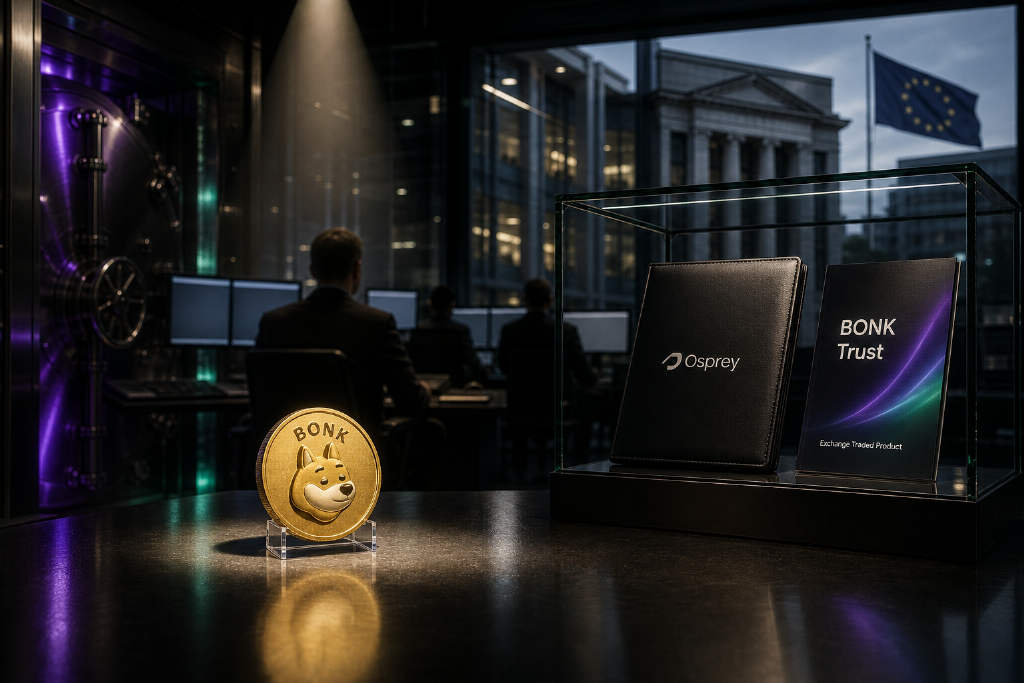
BONK is starting to illustrate a different route for a meme asset. Rather than being discussed only as a symbol of community culture and internet consensus, it is increasingly being framed as a crypto-native asset that is gaining links to trust structures, exchange-traded products, trading access, custody, and other parts of traditional financial infrastructure.
Over the past few years, BONK has expanded from a meme asset inside the Solana ecosystem into a broader network spanning trading, payments, gaming, social use cases, and developer tools. As BONK-related financial products have appeared, the connection between BONK and traditional financial markets has become easier to trace.
That changes the terms of the discussion. The question is no longer limited to BONK’s meme culture. A bigger issue is how BONK’s financialization is taking shape, and how far that process still is from what could be called genuine institutional adoption.
Financialization does not mean BONK has become a security
The article draws a clear distinction at the outset. BONK’s financialization does not mean the token itself has been securitized, nor does it mean BONK has become a stock or a traditional fund.
What the term refers to more precisely is the gradual buildout of financial infrastructure around BONK. For a blockchain-native asset to move into more mature financial markets, a number of pieces usually need to be in place: liquidity, custody, pricing, trading venues, exposure vehicles, and compliant product structures.
In the past, users mainly got BONK exposure through crypto-native exchanges and on-chain protocols. As third-party financial institutions started rolling out BONK-linked trusts and exchange-traded products, BONK began to appear in wrappers that traditional financial markets can more readily understand and use.
This is not a case of a meme token turning into equity. It is a case of BONK being packaged, connected, and brought into a wider set of established market rails. That is where the article places the real significance of BONK’s financialization.
From on-chain token to products that institutions can access
The path between BONK and institutional markets is already taking a recognizable product form.
One example highlighted in the piece is Osprey Funds’ Osprey BONK Trust, or OBNK. The trust structure gives investors BONK exposure and trades on OTCQX. For traditional investors, that means they may gain market exposure tied to BONK’s price performance without directly managing an on-chain wallet, holding private keys, or trading on-chain themselves.
The importance of that development does not rest only on one product. It lies in the format it creates. The underlying asset remains BONK, a crypto-native token, while the point of entry starts to look more familiar to traditional finance.
A similar change has also appeared in Europe. Bitcoin Capital previously launched a single-asset BONK ETP that trades on SIX Swiss Exchange. The article notes that ETPs differ in a visible way from traditional ETFs in product structure. Even so, from a market-access perspective, they serve a similar function: they wrap an on-chain asset in a form that exchange investors already know how to use.
That is why the article argues that discussions around a “BONK ETP/ETF” need to be precise. BONK-linked products currently in the market cannot simply be grouped together as ETFs. ETP is a broader category, and its underlying structure, legal form, asset segregation approach, and investor-protection arrangements can differ from those of an ETF.
Still, from the standpoint of BONK’s institutional adoption, the logic behind both is similar. Each lowers the barrier for traditional investors seeking exposure to BONK.
Institutional adoption requires more than buying tokens
The piece also argues that institutional adoption of a crypto asset is not as simple as a fund deciding to buy the token.
For traditional financial institutions, a digital asset usually needs more than demand. It also needs supporting systems for custody, trading, valuation, disclosure, product issuance, and risk management before it can fit into a broader investment framework. That is why BONK’s institutional adoption deserves separate attention.
Seen from that angle, institutional uptake does not necessarily begin with large funds buying substantial amounts of BONK directly on-chain. A more practical first step is the creation of investment products and infrastructure around BONK that meet the requirements of traditional financial systems.
The emergence of trust products and ETPs provides exactly that bridge. On one side sits BONK as an on-chain asset. On the other are securities accounts, exchanges, and investment systems used in traditional markets.
The article describes BONK’s institutional path as a bridge moving through several layers:
- On-chain asset
- Financial product
- Traditional trading market
- Broader investor base
That is a different route from growth driven mainly by meme narrative alone.
BONK’s market boundary is widening beyond native crypto liquidity
The article also says this shift did not happen all at once.
Inside crypto-native markets, BONK already has trading activity, liquidity, and ecosystem use cases in place. As more third-party products are built around the token, the market is gradually adding new channels for price discovery and portfolio allocation.
That points to a change in BONK’s market boundary. In the past, its main user base sat largely within crypto communities and the Solana ecosystem. Financial products create another point of contact: investors who are comfortable with brokerage accounts, exchange-traded products, and financial assets, but may have no interest in using an on-chain wallet directly.
For a meme-origin asset, that shift in user mix matters. Financial markets do not just add trading venues. They also change how traditional investors can approach crypto-native assets in the first place.
In that sense, one of the core values of BONK’s financialization is not that it changes the asset itself. It changes the way the market can understand, trade, and allocate that asset.
Bonk, Inc. and BONK are not the same asset
The article also flags a point that can easily cause confusion once BONK starts appearing in broader financial-market discussions.
Bonk, Inc. is an independent listed company. Its stock is not the same thing as the BONK token, and owning the stock does not mean an investor directly owns BONK.
For that reason, the article says three layers need to be kept separate when discussing BONK’s links to traditional markets:
- BONK Token: a crypto-native community asset in the Solana ecosystem
- BONK Trust / ETP: financial products built around BONK that offer related market exposure
- Bonk, Inc.: an independent listed company whose shares are conventional securities-market assets
There may be commercial or ecosystem-level connections among the three, but they should not be treated as a single financial asset.
The distinction also reflects a broader trend in BONK’s financialization. The asset itself, the exposure products tied to it, and the companies built around it are beginning to form separate market layers.
From meme culture to financial infrastructure
Looking back, the article presents BONK’s development path as a representative one.
Meme culture answers why users pay attention. Community networks answer why users participate. Ecosystem products answer what users can do. Financial infrastructure answers whether the asset can be connected to a broader market.
In that framing, BONK’s financialization is not a rejection of its meme identity. It is built on top of the community base and ecosystem network that came first. Meme culture provides recognition. Solana provides the asset foundation. Community and ecosystem activity provide network effects. Financial products widen the market entry point.
From BONK Trust to BONK ETP and then to more financial infrastructure built around BONK, these developments may not be enough to declare that BONK has fully completed its institutional transition. But they do indicate one thing clearly: BONK is moving from a crypto-native meme asset toward an asset that traditional financial infrastructure can understand, package, and access.
That may be the next phase of BONK’s financialization worth watching most closely.
[Disclaimer] Markets carry risk, and investment decisions require caution. This article does not constitute investment advice. Readers should assess whether any opinions, views, or conclusions in the article fit their own circumstances. Investment decisions made on that basis are the reader’s responsibility.