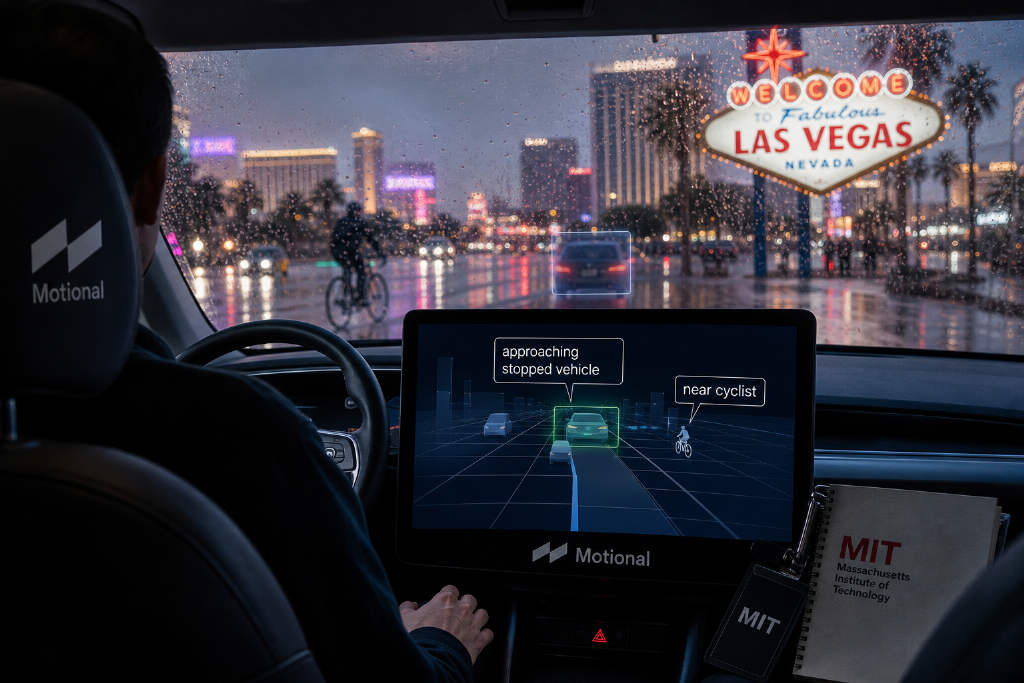
Autonomous driving company Motional and researchers at the Massachusetts Institute of Technology have introduced an explainable AI system called Concept Whitening Network, or CW-Net, designed to show how a self-driving car reaches its decisions in real time. The project targets one of the sector’s hardest problems: the black-box nature of deep learning models used in vehicle planning and perception.
According to the report, CW-Net converts internal neural network computations into human-readable concepts such as "approaching a stopped vehicle" or "moving close to a cyclist." Those signals are displayed on the dashboard so the car’s reasoning can be inspected as events unfold rather than reconstructed later.
The research team has already deployed the system on public roads around Las Vegas as well as on private test tracks. In testing, CW-Net exposed several notable findings. It showed that an experimental planning system was hallucinating a stopped vehicle ahead because of problems in its training data. It also revealed that braking was actually triggered by a safety backup system, not by the deep-learning planner itself.
Motional CEO Laura Major said end-to-end deep learning systems may reach 80-95% accuracy, but that level alone is still not enough to earn trust from cities and customers.
Techub News reported that autonomous driving company Motional and researchers from the Massachusetts Institute of Technology have developed a system called Concept Whitening Network, or CW-Net, that allows self-driving cars to explain their decision logic in real time. The work is aimed at the "black box" problem in autonomous driving AI.
The system translates internal neural network computations into human-readable concepts, including signals such as "approaching a stopped vehicle" or "moving close to a cyclist." Those concepts are shown on the dashboard, giving operators a way to trace how the vehicle arrived at a decision.
Road and test-track deployment
The research team has already deployed the system on public roads around Las Vegas and at private testing grounds.
During testing, CW-Net surfaced several key findings. It showed that an experimental planning system hallucinated a stopped vehicle ahead because of issues in the training data. It also found that the vehicle’s braking was triggered by a safety backup system rather than the deep learning planner.
Laura Major on trust and accuracy
Motional CEO Laura Major said a purely end-to-end deep learning approach may achieve 80-95% accuracy, but that still falls short of winning the trust of cities and customers.
This article was originally published by Bit.Fan. For more cryptocurrency news and market insights, visit www.bit.fan. Disclaimer:
The market information, project data, and third-party content displayed on this platform are for industry information sharing only and do not constitute any form of investment advice or return commitment.
Cryptocurrency trading carries high risks. Users should fully assess their risk tolerance and make independent decisions. All profits, losses, and legal responsibilities are borne by the users themselves.