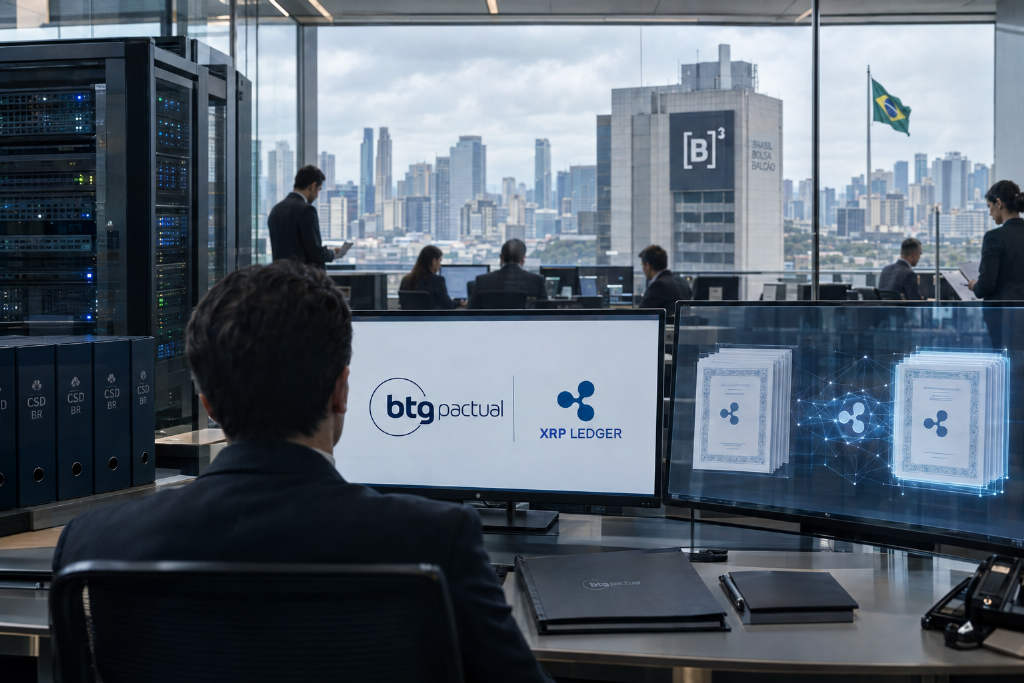
CSD BR, the regulated operator responsible for registration, securities depository, and settlement systems in Brazil’s financial market, has started mirroring ownership records for units of selected investment funds managed by BTG Pactual onto the public XRP Ledger. The move does not shift the official books to blockchain. CSD BR said its existing database remains the authoritative record for registration, custody, and settlement, while the fund units are represented on XRPL in tokenized form.
The company manages more than 22 trillion Brazilian reais in registered assets, roughly $4 trillion. The blockchain copy is designed to let approved banks and institutions verify ownership changes in real time instead of relying on after-the-fact reconciliation, while keeping identity screening and regulatory controls in place. Although token transfers on XRPL can be read publicly, CSD BR still controls who is allowed to hold and transfer the tokens.
The tokens use the XRP Ledger’s multi-purpose token standard, which allows issuers to restrict participants and, when required by regulators or courts, freeze assets or reverse transactions. Participants must still pass identity and anti-money laundering checks. After gaining experience with the mirroring system, CSD BR and Ripple plan to test direct issuance on XRPL and trading among approved participants, with possible assets including Brazilian real estate receivables and agricultural receivables.
ChainCatcher reported that CSD BR, the regulated operator responsible for registration, securities depository, and settlement systems in Brazil’s financial market, has begun mirroring ownership records for units of selected investment funds under BTG Pactual onto the public XRP Ledger.
CSD BR manages more than 22 trillion Brazilian reais in registered assets, or about $4 trillion. Its existing database remains the official record for registration, custody, and settlement. The assets themselves have not been moved onto the XRP Ledger, and the fund units are instead shown on XRPL in tokenized form.
Real-time verification without replacing the official record
The blockchain copy is intended to let approved banks and institutions verify ownership changes in real time, replacing after-the-fact reconciliation and cutting slow, costly matching processes, while keeping identity checks and regulatory controls in place.
Anyone can read token movements on XRPL, but CSD BR still controls who is allowed to hold and transfer those tokens. The tokens use the XRP Ledger’s multi-purpose token standard. Under that framework, issuers can restrict participants and, when required by regulators or courts, freeze assets or reverse transactions. Participants must still complete identity and anti-money laundering checks.
Project starts with live fund records
The project starts with real fund records rather than test assets or a closed network, setting it apart from earlier pilots. CSD BR was founded in 2018 and is authorized by Brazil’s central bank and securities regulator.
After becoming familiar with the mirroring system, CSD BR and Ripple plan to test issuing assets directly on the XRP Ledger and allow approved participants to trade them. Potential assets include Brazilian real estate receivables and agricultural receivables.
This article was originally published by Bit.Fan. For more cryptocurrency news and market insights, visit www.bit.fan. Disclaimer:
The market information, project data, and third-party content displayed on this platform are for industry information sharing only and do not constitute any form of investment advice or return commitment.
Cryptocurrency trading carries high risks. Users should fully assess their risk tolerance and make independent decisions. All profits, losses, and legal responsibilities are borne by the users themselves.