
The bottleneck in tokenized equities is no longer just issuance. Once a stock token exists, it still needs continuous pricing, deep enough liquidity and a credible route back to the underlying asset. Earlier versions of tokenized stocks often stopped at simple mapping: a token lived on-chain, but trading still depended on Wall Street hours. After the underlying market closed, market depth and price anchors weakened.
That changed in scale in July 2026. According to Binance Research, tokenized-stock trading volume reached $18.2 billion for the month, 4.4 times June’s level and higher than the combined total of the prior six months. DEX volume came in at $12.8 billion and CEX volume at $5.4 billion. More of the trading was taking place in wallets and smart contracts, indicating that tokenized stocks were beginning to form a circulation network outside traditional brokerage accounts.
July tokenized-stock volume was about 2.3% of SPY volume over the same period, up from 0.4% in June. That ratio expanded by nearly 5.8 times in one month, suggesting that crypto-native platforms and on-chain venues were taking on a larger share of demand for U.S. equity exposure.
bStocks became one of the main drivers of the July surge
Binance’s bStocks was one of the most active products in that expansion. The product went live on June 11 and had reached $10.4 billion in cumulative volume by Aug. 23, with more than 70% of that total coming from on-chain markets. In July alone, bStocks generated $7.4 billion in DEX volume, accounting for 85% of all tokenized-stock DEX trading that month.
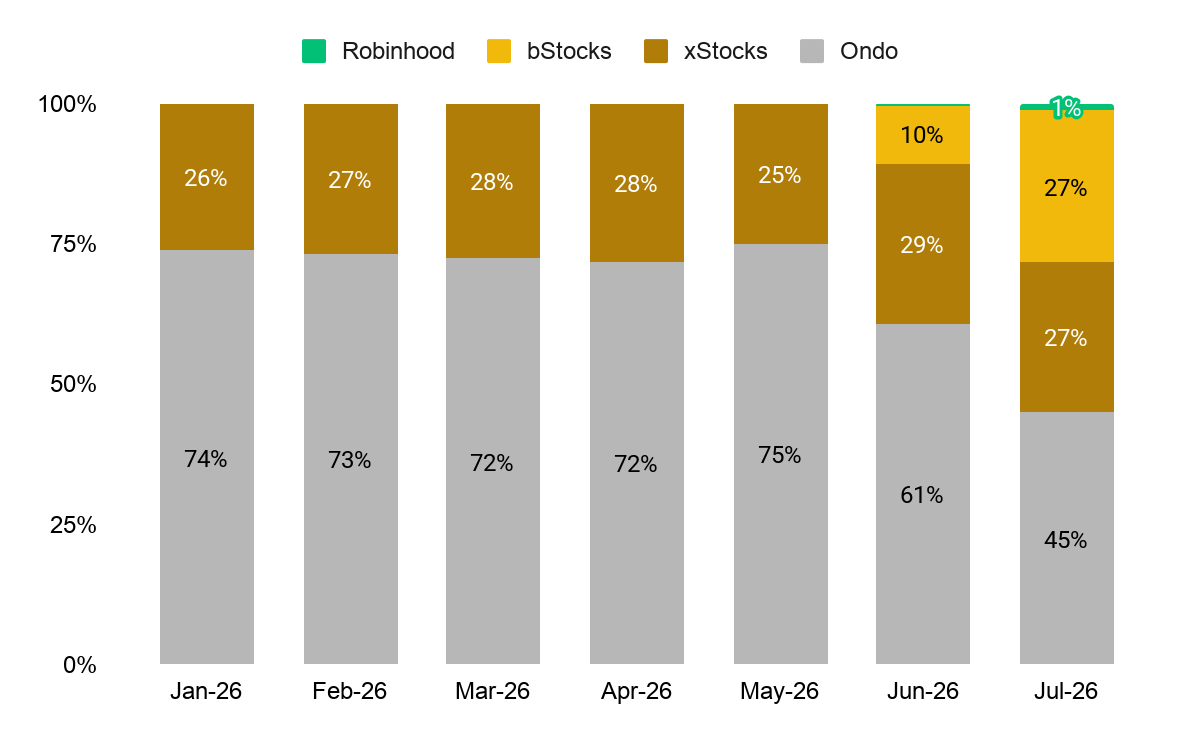
Binance Research estimated that bStocks’ market capitalization climbed above $500 million on July 29, equal to roughly 27% of the global tokenized-stock market. Its share of global tokenized-stock market value rose from 10% in June to 27% in July.
By Aug. 3, Token Terminal put the asset value of bStocks at about $624 million, above xStocks at roughly $579 million. That moved bStocks into second place among tokenized-equity issuance projects tracked by the platform, behind Ondo Finance. Less than two months after launch, it had already accumulated hundreds of millions of dollars in assets and billions in turnover.
How the structure works
bStocks is issued by BTech Holdings Limited, which is registered in Abu Dhabi Global Market, or ADGM. Legally, the product is a certificate representing the relevant financial instrument. Holders get the economic exposure of the underlying U.S. stock or ETF, but they are not directly registered as shareholders of the listed company.
At issuance, a special purpose vehicle holds the underlying stock through regulated brokerage and custody arrangements, then mints BEP-20 tokens on BNB Smart Chain on a 1:1 basis. Product documents say the underlying assets are held in segregated custody and reconciled daily, while proof of reserves is published on-chain. Corporate actions such as dividends and stock splits are passed through by adjusting token quantities.
Eligible Binance users can hold a traditional stock position and convert supported shares into bStocks at a 1:1 ratio, or trade bStocks directly in the spot market. Once withdrawn to BNB Smart Chain, the tokens can move into self-custody wallets, decentralized exchanges and supported DeFi protocols. Conversions are subject to regional and user-eligibility limits, and on-chain transfers incur network fees. That creates a path for a single piece of U.S. equity exposure to move across a stock account, Binance’s order book and an on-chain wallet.
A large share of activity happened while U.S. stocks were closed
After the Friday close in New York, company filings, geopolitical developments and macro policy do not stop. Yet the main liquidity in listed shares contracts with the end of U.S. trading hours and disappears over the weekend. New information is then forced to wait until Monday’s open, often showing up as a gap from Friday’s close. In the past, most price discovery during that period was limited to news, research notes and OTC indications, leaving ordinary investors without an easily executable market.
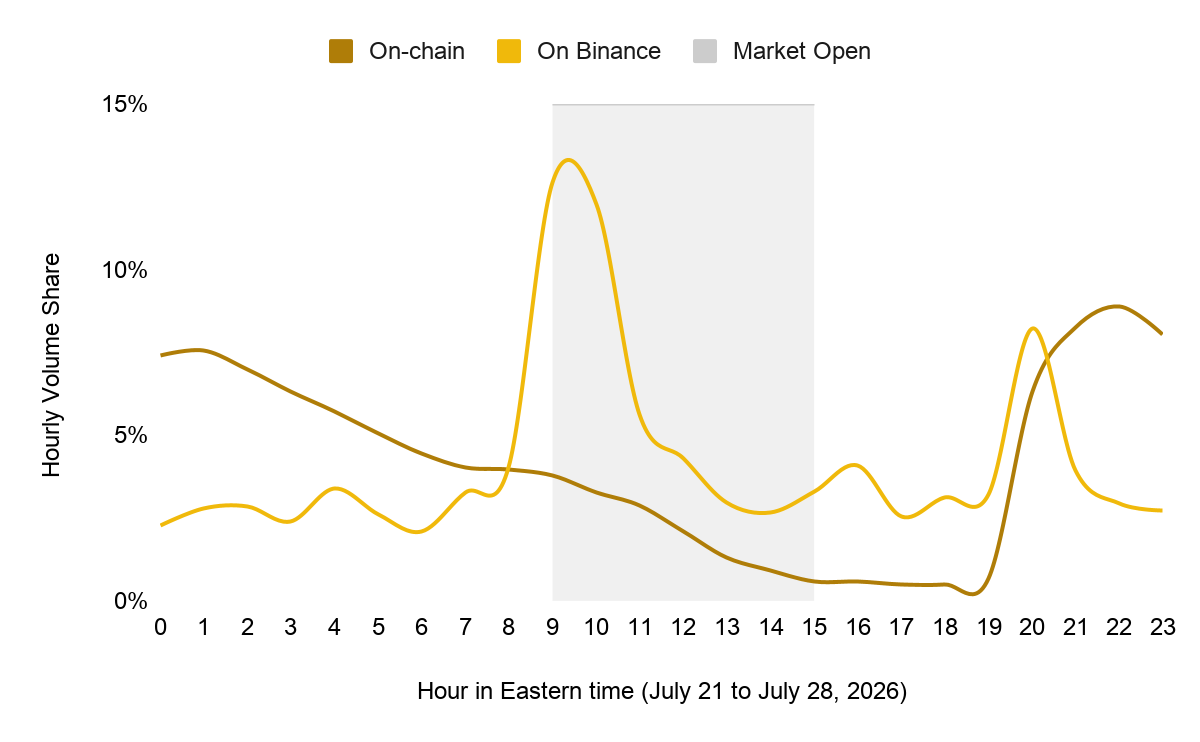
Data cited in the report shows that 62% of bStocks trading on Binance in July 2026 took place while the U.S. equity market was closed. From the June 11 launch through July 28, cumulative closed-market volume reached $1.5 billion. In the week ending July 28, 92% of on-chain bStocks trading and 59% of Binance trading happened during U.S. market closure.
Trading on Binance clustered around the U.S. pre-market and the open, while on-chain activity began to peak from 8 p.m. Eastern Time and stayed active through Asian trading hours. For users in Hong Kong and Singapore, the report said, U.S. equity exposure shifted from a late-night market to something that could also be managed during the daytime.
From June 14 to Aug. 2, Binance accounted for an average of 69% of combined trading across bStocks, xStocks and Ondo Global Markets during U.S. market hours. Its share rose to 82% during market closure and 94.4% on weekends. Once converted, bStocks could trade directly on Binance’s order book and on BNB Smart Chain. The conversion mechanism adjusts token supply with demand, allowing matching to continue on order books and smart contracts after Nasdaq is closed.
During conversion windows, a traditional stock position can be turned into bStocks at a 1:1 ratio, adding supply to the token market. bStocks can also move back in the opposite direction into a stock position. If a premium or discount appears in the order book, conversion passes trading demand through to token supply, allowing weekend liquidity to adjust as spreads move.
The same data set showed Ondo taking 27% of volume across the three platforms during U.S. market hours, falling to 15.2% during closed hours and 3.7% on weekends. Binance’s share moved the other way. The farther trading moved from Wall Street hours, the easier it was for products with their own order book and on-chain liquidity to concentrate volume.
Weekend prices reflected 92% of Monday’s opening gap on a median basis
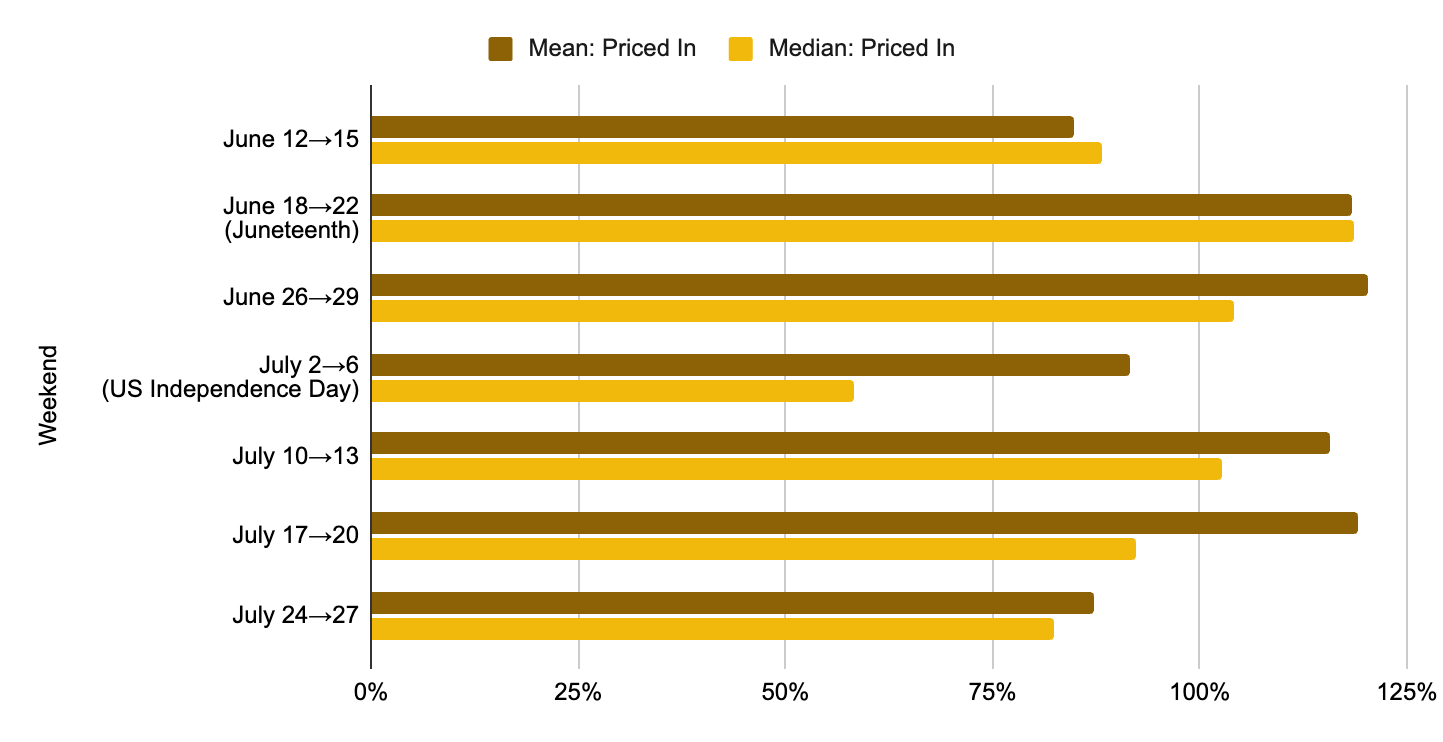
As of July 28, bStocks had gone through seven full weekends. Across that sample, its prices reflected a median 92% of the subsequent Monday opening gap, with an average residual deviation of only 0.19% at the open.
When the underlying stock’s gap was smaller than 0.5%, bStocks got the direction right 81% of the time. For gaps between 0.5% and 1%, directional accuracy rose to 90%. For gaps between 1% and 3%, it reached 97%. In 41 observations where the gap exceeded 3%, the direction matched every time, and the median share of the move reflected in advance reached 99.6%. The bigger the move, the clearer the weekend signal became.
The article’s framing is straightforward: after Wall Street closes, bStocks absorbs new information through actual orders. When the listed share begins trading again, the opening price catches up in the direction bStocks has already traveled. Larger news shocks produced clearer weekend price signals.
How the spread closes once both markets are open
If bStocks rises over the weekend while the listed share is still anchored at Friday’s close, a temporary spread opens between the two. Because bStocks and Binance stock positions support two-way 1:1 conversion, that spread can narrow through real transactions.
When the U.S. market reopens, traders can watch both the listed stock and bStocks. If a divergence appears, trading against the spread adds supply to the higher-priced side and boosts demand on the lower-priced side. Eligible users can also convert stock positions and bStocks within Binance, so the result of that trading feeds through into token supply. Wider spreads attract more trading, and the added supply and demand help compress the difference, reconnecting on-chain pricing with the traditional market.
The article gives a simple example. If a stock closes Friday at $100 and positive company news lifts the corresponding bStocks price to $103 over the weekend, then bStocks has already produced a fresh reference point before Monday’s open. When the stock resumes trading, its opening price moves closer to $103, shrinking the gap. If a difference remains after the open, reverse trades and asset conversion continue to adjust supply and demand. The 92% figure observed over seven weekends represents the portion of that price move completed before the Monday opening bell.
Paired trading volume approached $1.25 billion by the end of July
As of July 31, 4,777 user accounts had executed opposite-direction trades in bStocks and the corresponding traditional stock within a short time window. The paired trading volume tied to that activity was close to $1.25 billion.
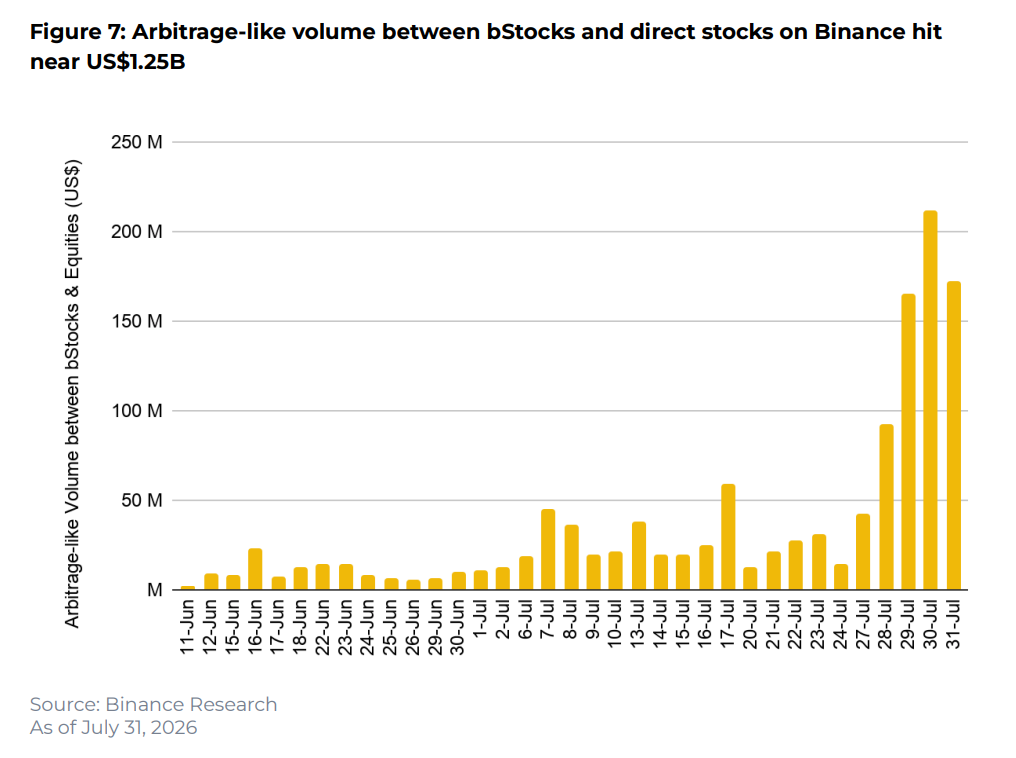
Among them, 4,076 users completed only one matched trade, for a combined total of about $10 million, with a median matching interval of less than one minute. Another 518 systematic participants repeated the strategy on an ongoing basis and contributed about $1.23 billion, or 98.8% of all matched volume, with a median execution interval of two minutes. Together they generated about $1.7 million in gross spread profit.
The article says Binance is currently almost the only exchange that allows ordinary users to switch between tokenized shares and stock positions at will. In that setup, what had largely been a low-risk institutional arbitrage path becomes available to retail users, while larger price correction flows are handled by a smaller set of accounts with systematic trading capacity.
The report compares that mechanism with the primary market for traditional ETFs. There, Authorized Participants, or APs, connect ETF shares with the underlying basket of securities. Only APs approved by the fund can directly use the creation and redemption process. APs and market makers are distinct roles, even though some firms perform both. Ordinary investors can buy and sell ETF shares, but they cannot deliver a basket of stocks to the fund in exchange for new shares.
By contrast, the article says bStock and Binance provide an internal arbitrage path that places stock trading and bStocks conversion inside one account. Eligible retail users can therefore take part in a similar spread-correction process without AP status. They can complete 1:1 conversion between supported stock positions and bStocks, with zero conversion fees and near-instant processing. In the article’s telling, the product design lowers account, system and operational barriers, bringing an opportunity once confined to institutional back-office workflows into a trading channel that retail users can access directly.
Once converted into on-chain tokens, bStocks can continue circulating across DEXs and DeFi protocols on BNB Smart Chain. Prices formed over the weekend keep trading on Binance and on-chain, and when U.S. stocks reopen, cross-market trading pushes the spread tighter again. One asset is therefore connected across a centralized order book, the underlying share and the on-chain market.
Penetration rose roughly 30 times in six weeks, while Gen Z accounts were mostly net buyers
By July 28, combined bStocks volume on Binance and on-chain markets was equal to 0.3% of the trading volume in the corresponding underlying stocks and ETFs. Six weeks earlier, that figure was just 0.01%, implying growth of about 30 times. It still remained far below the volume in listed shares, but when all tokenized-stock volume is compared with SPY, the ratio had already reached 2.3%.
A Binance Research study published in August looked at Gen Z behavior and found that 6% of Gen Z bStocks accounts had never sold, while 76% were in net accumulation. The latter figure was 9 percentage points above Millennials. Gen Z traded bStocks an average of three times per month, compared with eight monthly trades in traditional stocks and 13 in TradFi perpetual contracts. For bStocks accounts that only bought and never sold, average monthly trades were 1.63, while the typical account figure was 3.45. High-frequency accounts made up just 0.1% of the buy-only cohort.
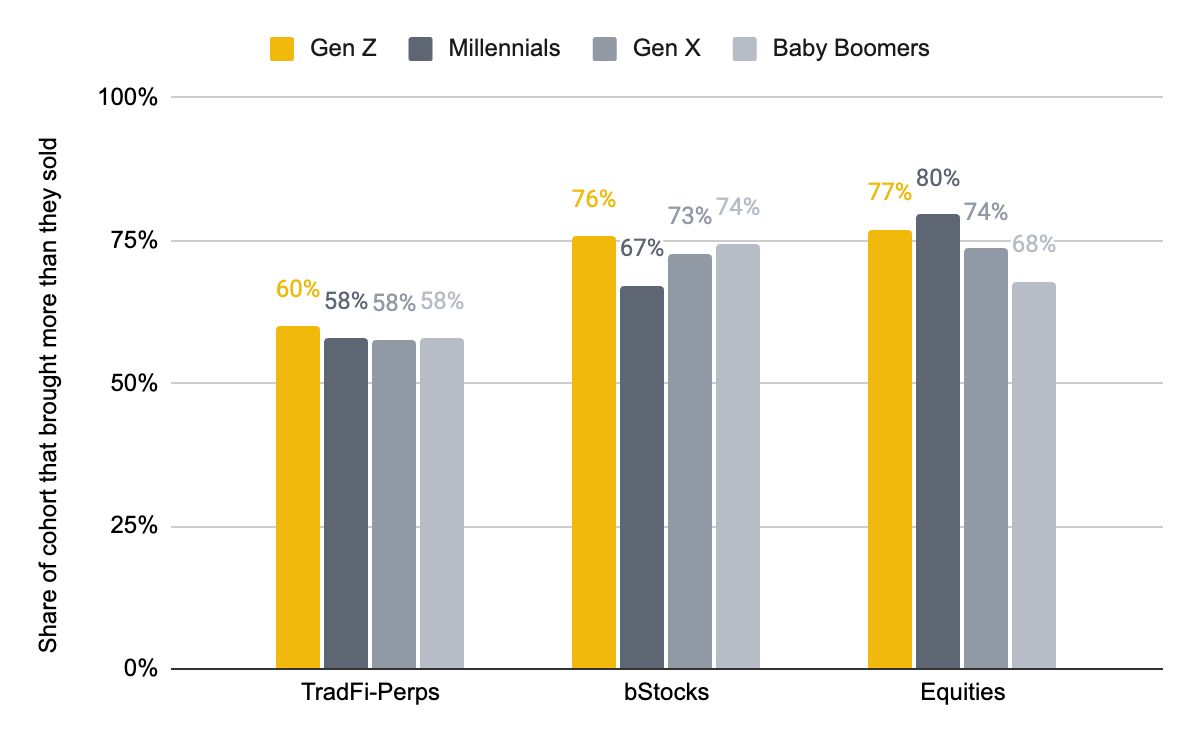
At three trades per month, and with more than three-quarters of accounts in net accumulation, bStocks looked more like a holding and allocation tool than a short-term trading vehicle. Short-term trading was still present, but it did not define Gen Z account behavior.
In the same study, the share of buy-only accounts among Gen Z users was 22% for traditional stocks, 6% for bStocks and 1% for TradFi perpetuals. The gap across products tracked differences in holding period. Equity exposure can be accumulated over time, while perpetual contracts usually involve more frequent opening and closing of positions. In that sense, bStocks behavior sat closer to spot-style holding.
By early August, ETFs accounted for 25% of Gen Z traditional-stock trading volume, up from 14.6% in June. The comparable figure for Millennials was 9.5%. The share of Gen Z equity net inflows going into unleveraged ETFs also rose from 18.5% in June to 21.9% in July. Those accounts were turning over less frequently and using leverage more cautiously, with part of the flow moving toward diversified allocation tools.
U.S. stock exposure kept trading after the closing bell
The article closes with a simple point. Stocks held in a Binance account can be converted into bStocks and back again. Trading continues during market closure, and once the asset is withdrawn on-chain, it can move into wallets and DeFi. Younger users can hold bStocks over longer periods in one account, adjust positions after the U.S. market closes, and keep the same exposure circulating on-chain after withdrawal.
During regular market hours, traditional exchanges remain the main center of price formation for listed shares. After the closing bell, though, bStocks allows U.S. equity exposure to keep quoting, trading and circulating. Wall Street still determines where stocks are listed and settled, but the crypto market is starting to determine how many hours a day that exposure can trade.
The original article also carried a disclaimer stating that markets involve risk, the article does not constitute investment advice, and users should consider whether any opinion, view or conclusion in the piece fits their own circumstances before investing.