

Franklin Templeton crypto CIO Seth Ginns said on July 13 that there is a “big disconnect” between where crypto prices are and where real fundamentals stand. At roughly the same time, several institutional, corporate and sovereign-level developments landed together: BlackRock joined a UK tokenization grouping, Robinhood Chain pushed into the top five DEX chains by trading volume, Hyundai ran a USDT cross-border trade settlement pilot, and Bolivia weighed adding USDT to its national payments system. The MarsBit analysis frames that cluster as a major divergence in the 2026 crypto market.
Seven signals appeared in the same week
The piece says the second week of July 2026 delivered seven developments that looked unrelated on the surface but pointed in the same direction.
Franklin Templeton says prices are detached from fundamentals
On July 13, Seth Ginns, CIO of Franklin Templeton’s crypto business, told CoinDesk: “There’s a big disconnect between where prices are and real fundamentals.”
The article notes that Franklin Templeton manages $1.5 trillion in assets and that Ginns directly oversees Franklin Crypto portfolios. In the article’s reading, the timing mattered as much as the wording: he made the comment while BTC was near $62,000 and market sentiment was weak. It also says any changes in Franklin’s positioning would only become visible in its Q3 13F filing.
According to the article, Ginns highlighted several factors:
- Robinhood’s blockchain initiative shows traditional financial distribution moving onto crypto rails.
- Tokenized money market funds allow investors to earn yield on-chain.
- Revenue-driven token buyback models in DeFi are drawing attention from investors focused on fundamentals and tokenomics.
UK tokenization taskforce listed 54 members
That same day, the UK Treasury-backed Tokenization Taskforce published a list of 54 members. The article says this is not a proof-of-concept sandbox. It comes with a two-year roadmap to move repos, gilts and funds on-chain. The report also identified Ripple as a “hybrid model” and set a target of £44 billion in annual output by 2035.
The roster includes BlackRock, Goldman Sachs, JPMorgan and Morgan Stanley, along with core operators in the UK financial infrastructure stack. The article argues that once those firms appear together in a government-backed tokenization roadmap, the story is no longer just a crypto narrative. It becomes a plan to upgrade traditional financial infrastructure.
Robinhood Chain entered the top five in under two weeks
Citing Bernstein, the article says Robinhood’s blockchain launched less than two weeks ago and has already moved into the top five by DEX trading volume. It puts TVL above $135 million and address count at 800,000. Meme coins, not tokenized equities, are driving current activity, but the infrastructure is already in place. The article adds that Robinhood’s 23 million users give it a distribution base that most crypto-native DEX platforms do not have.
Hyundai completed a USDT cross-border settlement pilot
The article says Hyundai completed a treasury settlement pilot using the USDT stablecoin in cross-border trade between the United States and Mexico. It stresses that this was not a proof-of-concept announcement. It describes the move as a real manufacturing giant using stablecoins in place of traditional cross-border banking rails.
The piece also says Hyundai generates more than $200 billion in annual revenue and argues that if the pilot expands through the company’s global supply chain, the implications would go beyond a limited trial.
Bolivia is considering USDT for the national payments system
Amid a shortage of U.S. dollars, Bolivia’s central bank is considering formally adding Tether’s USDT to the national payments system. The article gives annual transaction volume at $430 million. It describes the case as an example of a developing country using stablecoins as a substitute for dollar liquidity and compares it with El Salvador’s national crypto path, while saying the Bolivian case is more directly practical.
BTC ETFs broke an eight-week outflow streak
After eight consecutive weeks of outflows, BTC ETFs recorded $197 million in net inflows last week, according to the article. It places that number against a broader backdrop: BTC testing $62,000, military conflict in the Middle East intensifying, and expectations for Federal Reserve rate hikes returning. The article’s point is that capital still chose crypto exposure in a risk-off setting.
SBI shifted toward Solana and a yen stablecoin plan
The seventh signal came from Japan. The article says SBI Holdings has pivoted its blockchain strategy to Solana, covering tokenized issuance and a yen stablecoin plan, and is working with Lawson convenience stores on a retail payments pilot. It describes that as an early institutional push in Asia to deploy stablecoins in real payment settings.
How the article defines the “major divergence”
The piece argues that the crypto market’s dominant story over the past decade has been price: when assets rise, how far they rise, and when to sell. BTC volatility, in that framework, became a proxy for confidence across the whole sector.
Its core claim for 2026 is that infrastructure buildout no longer depends on BTC price action:
- Franklin Templeton launched tokenized funds without waiting for BTC to return to $100,000.
- BlackRock joined the UK Tokenization Taskforce without waiting for sentiment to improve.
- Hyundai tested USDT for cross-border settlement without waiting for the SEC to clarify the regulatory framework.
- SBI moved ahead with Solana tokenization plans without waiting for pressure on the yen to ease.
The article says those decisions are tied to five- to ten-year market structure shifts, not three- to six-month BTC cycles. That is the heart of the divergence in its view: leading indicators for infrastructure are set on a different time horizon from the lagging, more volatile signals embedded in price.
Using the article’s wording, Franklin’s CIO sees institutional participation at its strongest level in years, but prices have not reflected that yet. The piece attributes that split to prices still being driven more by retail sentiment and macro liquidity, while infrastructure is being driven by institutional strategy and regulatory roadmaps.
This is not simply a valuation catch-up story
The article warns against a common reading: fundamentals are strong, so prices will eventually catch up. It calls that framing too simple.
Its bigger question is not whether prices recover, but who will collect fees once the infrastructure is fully built. From there, it lays out several traits of the current buildout cycle.
From decentralization-first to upgrades of traditional infrastructure
The UK taskforce is not trying to build a new DeFi protocol. Its stated goal is to run repos, gilts and funds on blockchain rails. The article says that makes blockchain look less like a full replacement system and more like a second-layer operating system for existing finance.
Permissioned and public chains may coexist
The article argues that a 54-member institutional tokenization alliance is unlikely to run entirely on a permissionless public chain. A more plausible setup, in its view, is that permissioned rails handle compliant settlement, while public chains handle circulation and programmability. In that structure, middle layers such as compliant bridges, custody and KYC/AML become critical control points.
Sovereigns and industrial firms are moving faster than expected
Bolivia’s payments discussion, Hyundai’s trade settlement pilot and SBI’s retail payment work are not crypto-native stories in the article’s framing. They are responses to real-world demand for more efficient financial pipes, with crypto technology used as the delivery mechanism.
Stablecoins are shifting from trading tools to economic rails
The article says stablecoins are moving beyond use as trading instruments and becoming pipes for the real economy. Hyundai is not using USDT for speculation, it says, but as a substitute for SWIFT in trade settlement. Bolivia is not discussing USDT for DeFi use, but as a substitute for U.S. dollar cash. In the article’s view, that changes the total addressable market for stablecoins.
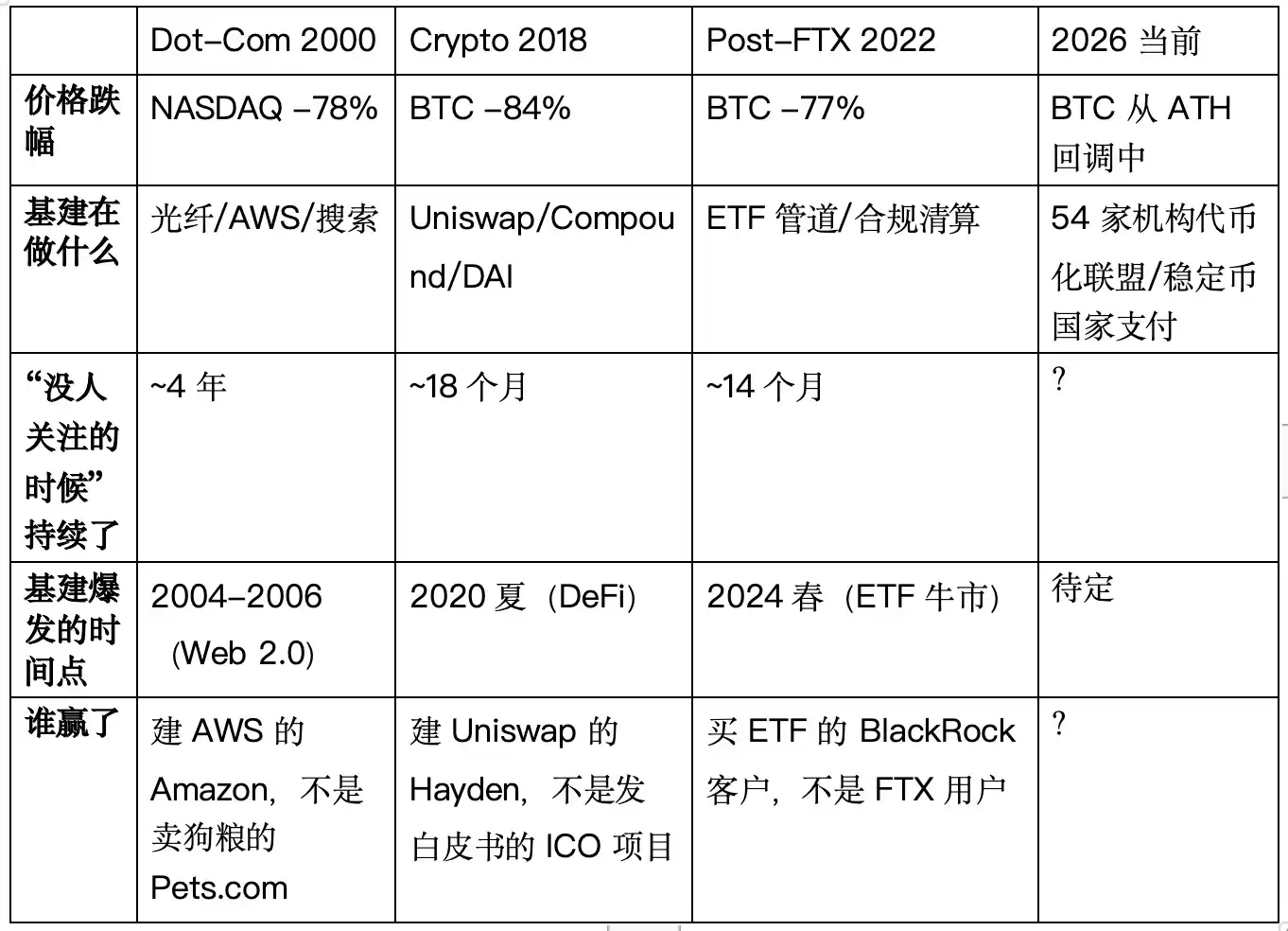
Historical comparisons: three earlier episodes of price-infrastructure divergence
To argue that this sort of divergence is not new, the article looks back at three comparable periods over the last 25 years. It also includes an explicit caution: past cycles do not guarantee future outcomes, and current market structure, regulation and macro conditions differ materially from those earlier periods. The historical parallels are offered only as an analytical framework.
2000 to 2002: the internet bubble burst, infrastructure kept building
The article says the Nasdaq fell from 5,048 to 1,114, a decline of 78%. Pets.com and Webvan collapsed. Amazon stock dropped from $107 to $7, down 93%. Yet Jeff Bezos, in the article’s telling, kept investing and developing what would become Amazon Web Services internally, while Google launched AdWords in 2002.
It also points to broadband fiber buildout peaking between 2001 and 2003. Global Crossing laid 100,000 miles of fiber during the bubble and those assets were later acquired at 10% of cost after bankruptcy. Server infrastructure, e-commerce logistics and search algorithms, the article says, were all built while equity markets were collapsing and attention had moved elsewhere.
Its stated outcome: AWS formally launched in 2006 and became Amazon’s largest profit engine a decade later. Google AdWords became one of the most profitable advertising products in history. The fiber networks built in that darker period later underpinned services such as YouTube, Netflix and Zoom.
2018 to 2019: crypto winter before DeFi Summer
The second comparison is the 2018–2019 crypto winter. BTC fell from $19,783 to $3,122, down 84%, the article says. The ICO bubble broke, but multiple DeFi building blocks were advancing at the same time:
- Uniswap released V1 at Devcon 4 in November 2018.
- Compound completed its seed round and continued building on-chain lending.
- MakerDAO’s DAI reached meaningful scale in 2019.
- Synthetix and Aave, then called ETHLend, pushed through core product iterations.
The article notes that while BTC was bottoming around $3,000, DeFi TVL was still below $500 million and easy to ignore. Yet AMMs, lending pools and price oracles were already being assembled during that low-attention period.
Its stated outcome: in June 2020, Compound launched COMP and kicked off liquidity mining. DeFi Summer followed. TVL rose from under $1 billion to $15 billion, a 15x increase, and the UNI airdrop exceeded $1,200 per recipient, becoming one of the best-known wealth distribution moments in crypto history.
2022 to 2023: after FTX collapsed, BTC ETFs were approved
The third comparison begins with the collapse of FTX in November 2022. BTC fell to $15,599. Sam Bankman-Fried was arrested, and BlockFi, Celsius and Voyager went bankrupt. The industry, the article says, was treated by Wall Street and regulators as a crime scene.
At the same time, traditional financial players were building the access layer for regulated crypto exposure. The article lists three developments:
- BlackRock filed for a spot BTC ETF on June 15, 2023.
- Fidelity, Invesco, VanEck and ARK followed.
- Crypto custody, compliant settlement and market-making infrastructure accelerated behind the scenes.
The article then gives the outcome: the U.S. Securities and Exchange Commission approved 11 spot BTC ETFs in January 2024, with first-day trading volume of $4.6 billion. Over the following 12 months, BTC rose from $25,000 to above $73,000. In the article’s framing, the ETF was not the end of the price story but the point at which markets began repricing infrastructure value.
Three takeaways the article draws from those cycles
From those historical episodes, the piece extracts a common pattern: prices can fall 80%, but if infrastructure construction does not stop, then 12 to 24 months later the market often ends up validating that infrastructure through price.
It says 2026 still differs from the earlier cycles in several ways:
- The builders are different. This time, the leading actors are not crypto-native startup teams. They are BlackRock, Franklin Templeton, JPMorgan, the UK government and Hyundai. The article argues that such projects are less likely to disappear just because BTC drops to $50,000.
- The beneficiaries may be different. In its comparison, crypto-native teams built Uniswap in 2018 and DeFi users captured much of the upside in 2020. In 2026, the tokenization alliances are being built by the world’s largest financial institutions, which means the toll booths may not end up owned by the community.
- The timeline may be shorter. The stretch from post-FTX to ETF approval took 14 months, much less than the four years associated with the dot-com aftermath. If the UK Tokenization Taskforce’s two-year roadmap holds, the article says the first results could appear in 2027 or 2028.
Price and infrastructure are separating as valuation variables
The article closes by returning to the present market. Once BlackRock, with $11.5 trillion in AUM, joins a tokenization alliance, once Hyundai uses stablecoins in actual trade, and once Bolivia’s sovereign system weighs USDT rather than conventional bank channels, crypto’s value narrative no longer rests on BTC price alone, it argues.
It does not claim BTC has become irrelevant. BTC remains the core liquidity anchor for the sector. The article says that if BTC stays under pressure, ETF outflows resume and macro conditions deteriorate through Federal Reserve tightening or higher oil-driven inflation, infrastructure deployment could slow, but it is not expected to stop.
It also adds an explicit qualification: the point of the piece is that valuation logic for infrastructure and valuation logic for price are separating. It is not arguing that infrastructure investing is superior to other strategies. It says infrastructure projects still face risks tied to regulatory delays, technical issues and weaker-than-expected commercial adoption, and that readers should evaluate investment decisions independently.
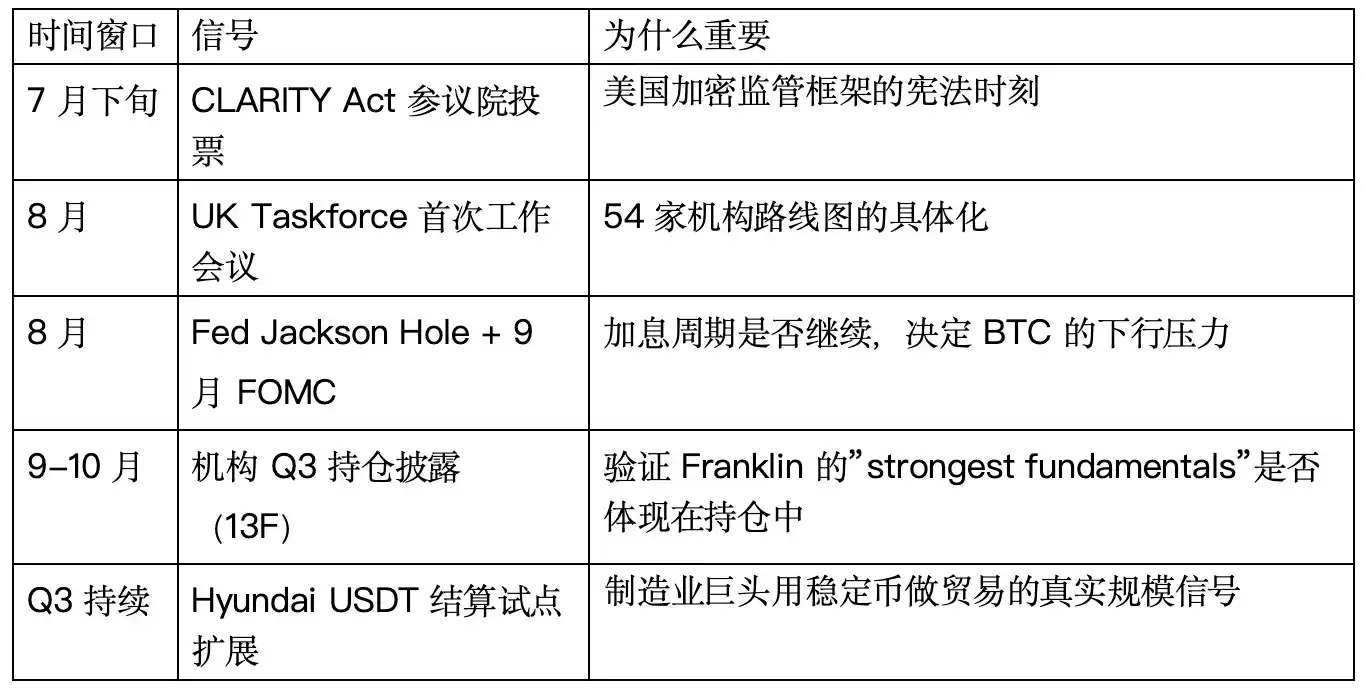
The next 90-day watch window
The original article ends by raising the question of what to watch over the next 90 days, but the input provided here does not include the specific indicators that follow that heading.