
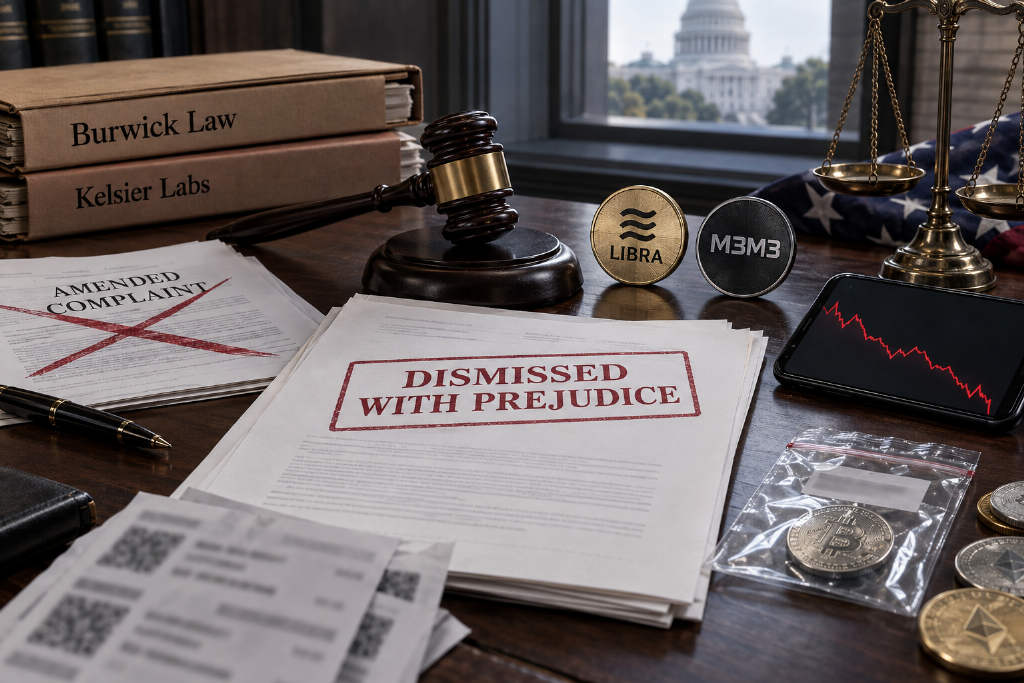
Burwick Law’s lawsuit against Hayden Davis over the launch of LIBRA and M3M3 has been dismissed with prejudice by a US judge. Judge Jennifer Rochon filed the ruling on Tuesday and denied plaintiffs Omar Hurlock and Anuj Mehta leave to file a second amended complaint, calling that step futile.

Court backs motions from Kelsier-linked defendants
Rather than allowing another revised complaint, Rochon granted three motions filed by the so-called Kelsier Defendants: Hayden Davis, Kelsier Labs, Gideon Davis, Charles Thomas Davis, Benjamin Chow, and intervenor plaintiff Dynamic Lab.
Those motions said Burwick Law failed to establish several core points:
- that Meteora was in fact a suable entity;
- that Chow had engaged in fraud;
- that New York courts had personal jurisdiction over the Kelsier defendants;
- and that a consistent pattern of racketeering existed across the six-month token launch timeline.
The report said Rochon’s dismissal was based largely on the view that Burwick Law’s allegations did not meet specific legal requirements.
Ariel Giver, founder of a crypto law firm, said the decision should not be read to mean that “memecoins are legal.” Instead, he said the plaintiffs “sued the wrong thing, under the wrong statute, with the wrong facts.”
Claims focused on M3M3 and LIBRA launches
The defendants had been accused of running a coordinated insider trading scheme tied to the launch of the M3M3 token in December 2024 and LIBRA in February 2025. The report described LIBRA as the token publicly launched by Argentine President Javier Milei.
The plaintiffs were said to have lost tens of thousands of dollars. Nansen Research had claimed that 86% of LIBRA investors lost more than $250 million in aggregate.
Judge also rejected claims of irreparable harm
During the case, attempts were made to stop LIBRA-linked funds from being anonymized, but those efforts did not succeed.
Rochon said Hayden Davis and the other defendants had committed to documenting all of their transactions in the name of traceability. She also said Burwick Law had not shown that the plaintiffs faced “irreparable harm.”
Minutes before the hearing on that motion, a website called Libra Trust went live. The report said it was created five days after a prior freezing order was lifted and had at one point redirected users to a “pure nudism” blog.