
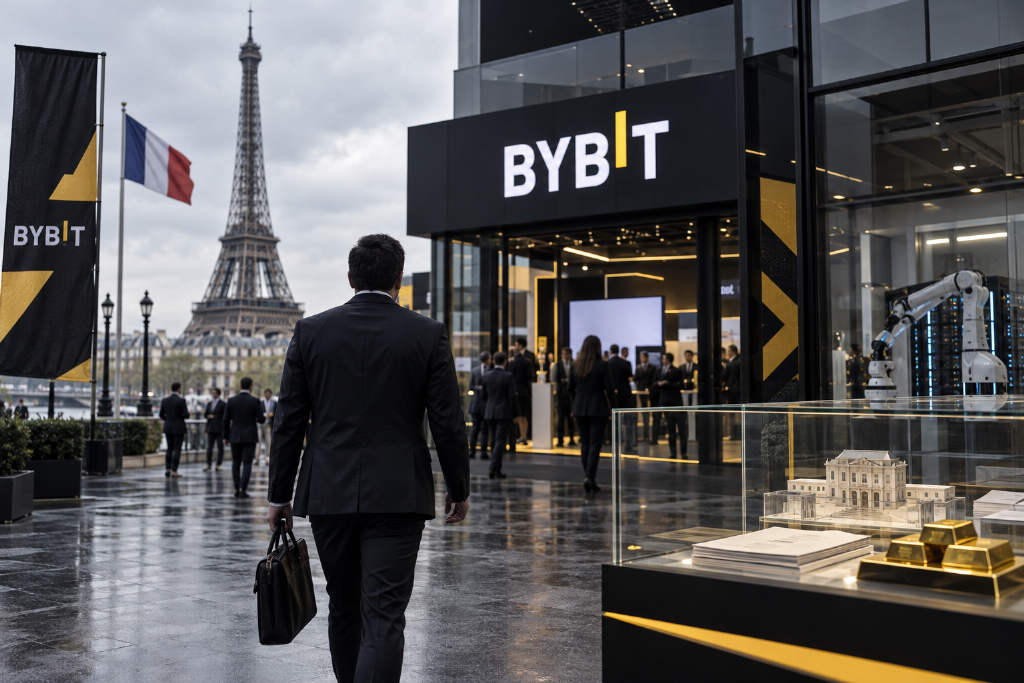
Bybit co-founder and CEO Ben Zhou said retail participation in crypto is about 30% lower than at the market’s most active point, but he described that decline as consistent with prior cycles rather than a sign that this downturn is fundamentally different. Speaking with Cointelegraph at Paris Blockchain Week in April 2026, Zhou said the bigger issue is not whether the market has already bottomed, but what could trigger the next phase of momentum. In his view, AI may be one of those triggers.
The conversation covered the current crypto cycle, the overlap between AI and crypto, the rise of real-world assets, institutional entry, and Bitcoin’s long-term role. Zhou also outlined how Bybit is using AI internally and what he hopes crypto finance could look like by 2030.
Market cycle: retail is down, but Zhou says that fits the usual pattern
The interviewer asked where the market stands now, whether it has already bottomed, whether retail investors have lost some interest compared with the peak, and what kind of catalyst would be needed to make the market excited again.
Zhou said most people he speaks with believe the market has bottomed, and he noted that Bitcoin has recently recovered somewhat. Even so, compared with the period when the market was most active, he estimates retail participation is down by around 30%. He said that is normal. Crypto has already gone through several cycles, and similar pullbacks tend to appear whenever the market is in a low phase. When prices start moving up again, enthusiasm usually returns. For that reason, he said he does not see this cycle as unusually different.
What matters more, he said, is the need for a new catalyst. In past cycles, those catalysts often came from new technology or new forms of innovation. In the previous cycle, meme coins were one example. This time, he said, AI could be the next one, though he added that he cannot say that with certainty yet. About a month and a half earlier, he attended a conference in Hong Kong and said it briefly felt more like an AI event because nearly everyone was talking about AI. He expects a lot of overlap between AI and crypto in the years ahead.
How AI could connect with crypto
Asked how AI might help move the crypto market forward, Zhou said there are at least two direct points of contact if the discussion is focused on AI agents.
First, he said AI agents will need money, and crypto could become the easiest native monetary layer for them to use. Second, AI could help ordinary users carry out forms of intelligent trading that were previously difficult to access. He said users may eventually be able to instruct AI to search for market inefficiencies and price gaps and then execute arbitrage strategies. In the past, that kind of activity required substantial capital and infrastructure. With AI, he said, participation could become easier for ordinary users.
Zhou also said those arbitrage opportunities would likely shrink as more people begin using AI. His point was less about immediate market conditions and more about what could happen over the next few years. Once AI starts trading automatically, buying goods on behalf of users, and carrying out broader economic activity, he said crypto could become a suitable financial base layer for those systems.
How Bybit is using AI internally
On practical use inside the company, Zhou said the effort goes well beyond his own personal experimentation. Bybit has assigned an AI agent to every employee, he said. Each agent has access to the same information that the employee can access, and in some cases the AI may remember details better than the employee does.
He described employee turnover as a major management problem because knowledge often leaves with the person who leaves. New hires then have to rebuild that context from scratch. With AI, he said, that knowledge can be retained. A new employee can ask a question such as how a previous discussion with a partner went, and the AI can explain what happened and how the matter progressed.
That has led Bybit to a specific operating idea: the AI agent should follow the role, not the individual employee. People can change, but the AI tied to that role remains in place. Zhou compared it to a long-serving butler for the position. When a new employee arrives, that person effectively inherits a role supported by an assistant that already holds years of accumulated knowledge.
He added that AI can also take over many tasks that previously required manual work, including entering customer information, finding materials, and searching historical records. According to Zhou, Bybit has already seen a very clear improvement in internal efficiency.
RWA is changing how exchanges are viewed
Looking back over the past 12 months, Zhou said the biggest shift is that the market is no longer talking only about crypto in the way it did two or three years ago. Earlier discussions were centered more on individual projects or assets such as Ethereum and Solana. In recent months, he said, nearly everyone has been talking about real-world assets.
He pointed to questions now being asked across the market: Can gold be tokenized? Can U.S. Treasurys be tokenized? More traditional financial assets are moving onchain, he said, including gold and oil, using crypto rails as the medium for trading. He added that trading volume in traditional financial assets on exchanges is also rising.
Zhou said that while in Paris he had spoken with banks there, and some asked a direct question: if they tokenize attractive fixed-income products, can Bybit help distribute them? That, he said, reflects a broader change. Some traditional financial institutions no longer see exchanges only as crypto trading platforms. They increasingly see them as global distribution channels through which tokenized traditional assets can reach users around the world.
He also described a recent conversation with a family office that wanted to use Bybit not to gain crypto exposure, but to reduce geographic concentration in its portfolio. The goal was to allocate across assets from Hong Kong, Singapore, the U.K., and other regions. The family office asked whether that could be done on the platform. Zhou said that because Bybit offers RWA products tied to those regions, the platform could help with that allocation. In that case, the institution was not coming to Bybit to buy crypto. It was using the platform for global asset allocation and risk diversification.
Why banks are entering crypto
Asked whether banks are genuinely interested in crypto or are simply reacting to a trend they do not want to miss, Zhou said the answer is mixed. He estimated that around 30% of the motivation is FOMO. Those institutions do not want to miss the trend, so they want to understand what is happening, even if they have not fully worked out their long-term plan. As a result, some are making small investments and building relationships first.
He said some traditional financial institutions have already started investing in crypto companies, though the amounts involved are not especially large relative to their own size. In his view, that does not mean all of them have a fully formed strategy. Some are simply choosing to participate early rather than stay on the sidelines.
Zhou said another 50% of the motivation is defensive. If traditional financial institutions do not engage with tokenization and do not enter this market, they may gradually realize that younger users could move directly into crypto-based finance. If that happens and the institutions do nothing, they could lose pricing power, liquidity, and customers. For Zhou, institutional entry is being driven by several forces at once.
What could unlock broader institutional adoption
When asked whether the market is approaching an important stage for large-scale crypto adoption, Zhou said he believes it is. He said regulators are now genuinely starting to understand and accept the technology, including stablecoins and tokenization.
He pointed in particular to the United States. If market structure legislation becomes clearer there, he said, many issues would receive more precise definitions, and that could have a major effect. Zhou said Bybit has had discussions with large banks including Goldman Sachs. Those institutions may already be able to offer Bitcoin ETFs to clients, but their own portfolios may still be unable to participate directly because the regulatory definition of crypto remains unclear.
Once the rules are clearly set, he said, there could be substantial institutional buying. From the perspective of adoption, compliance, and licensing, he described the current period as an important one. He added, though, that retail investors often define a “good year” differently, usually in terms of prices rising by multiples.
Bitcoin’s role: not yet fully mature as digital gold, while stablecoins fit payments better
On how far Bitcoin still is from becoming true digital gold, Zhou said the long-term aspiration remains intact, but Bitcoin still shows meaningful volatility.
He gave a recent example: during the latest decline, Bitcoin fell to around $60,000 before returning to the area of $70,000. For very traditional financial institutions, he said, that level of volatility is still too high, which makes it difficult to treat Bitcoin today as a fully established store of value. He said he believes Bitcoin can eventually get there, but it has not reached that point yet.
At the same time, he said crypto and blockchain technology are already being used by traditional finance in other ways, which itself shows that adoption is happening. After the next real bull market arrives, he said, those institutions may begin allocating part of their portfolios to Bitcoin and other crypto assets.
Over the long run, Zhou said he does not think Bitcoin’s core positioning has changed. Gold itself can also be volatile. When Bitcoin falls, sentiment weakens; when it rises, sentiment shifts again. He also noted that Michael Saylor is still buying.
But when the discussion turns specifically to money and payments, Zhou said he is more inclined to view Bitcoin as a store of value. For everyday spending and payments, he said stablecoins are more likely to be used in the future.
Zhou’s 2030 view: a more open global market for financial assets
Looking ahead to 2030, Zhou said the world still does not have a truly global financial platform. No single platform today can simultaneously offer users access to U.S. assets, Indonesian assets, Japanese assets, European assets, and a broad range of products from other regions. He said that is because financial markets remain fragmented, with separate national and regional systems shaped in part by geopolitics.
He compared crypto’s potential role to what the internet did for information. The internet broke down many barriers to information distribution and gradually created a more equal environment for users around the world at the information layer. Zhou said crypto could do something similar for financial markets by giving people in different regions more equal access to financial assets.
In his example, a user in Nigeria could gain access to the same asset choices and investment opportunities available to users in New York or London. He said that kind of global financial platform does not yet truly exist, but he hopes it will emerge, and he wants Bybit to move in that direction. If that happens, he said, it would represent real financial freedom: the ability for each person to choose the assets they want.
Is it too late to buy Bitcoin now?
At the end of the conversation, the interviewer asked Zhou for a “harsh truth” about crypto that many users may not want to hear. His answer was simple: “It’s never too late.”
He said that whenever he talks to people about Bitcoin, they often respond that it is already too late and too expensive. When he told friends to buy some Bitcoin at $3,000, they said it was too expensive. When it rose to $10,000, they said the same thing.
Zhou said that if someone truly understands the technology, the scale it could reach, and the way it could change the world, then it is never too late to buy Bitcoin.
The original article noted that the guest’s comments do not represent WuBlockchain’s views and do not constitute legal or investment advice, and that readers should comply with local laws and regulations.