
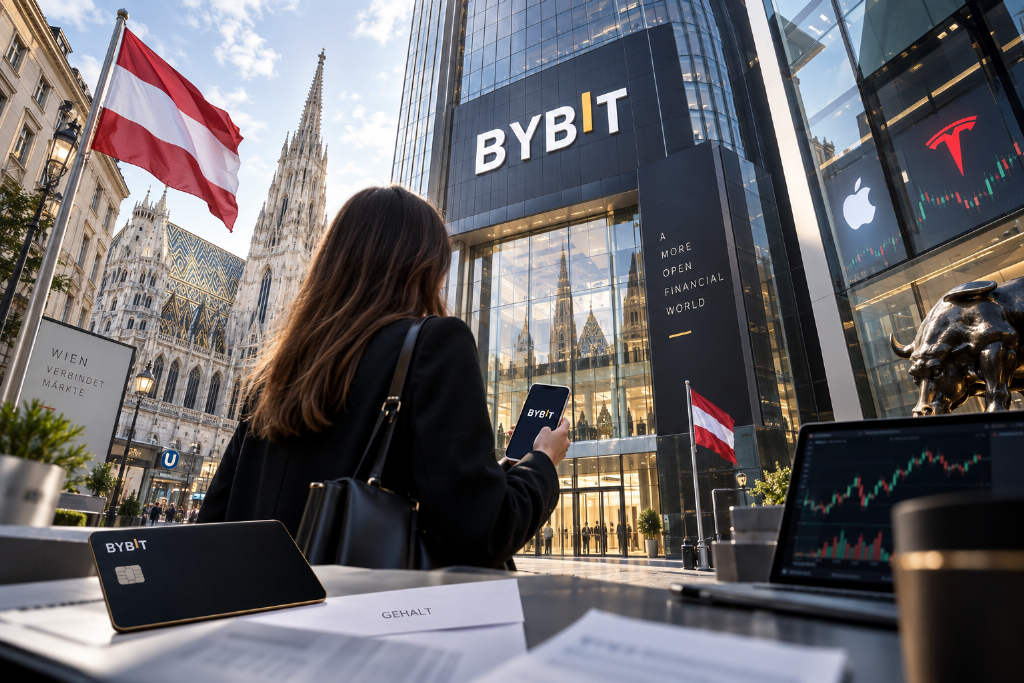
Bybit is building out a broader financial services model in Europe, not just a crypto trading business. In an interview with CoinDesk, Bybit founder and CEO Ben Zhou said the company now has two of the three core licenses it wants in the region and expects to obtain the third in about two months. If that plan stays on track, European users would be able to open an account, receive salary payments, pay utility bills, and trade stocks and derivatives in the same app, alongside crypto.
Three licenses at the center of Bybit’s Europe plan
Zhou said Bybit’s European setup is built around EMI, MiCA, and MiFID approvals.
- An EMI, or Electronic Money Institution, license was issued by Austria’s Financial Market Authority, or FMA. Zhou said it allows Bybit to open bank accounts, process third-party transfers, and provide IBAN accounts.
- A MiCA, or Markets in Crypto-Assets, license is already held in Austria and covers crypto trading across the European Union.
- A MiFID, or Markets in Financial Instruments Directive, license is expected in about two months and would allow the company to offer bonds, derivatives, and stock trading.
「With these three licenses, we will become a combination of Revolut plus Bybit’s existing services, and fully compliant,」 Zhou said.
EMI license adds banking-style functions
According to Zhou, the EMI license gives Bybit access to core banking-level services. Users would be able to hold their own IBAN inside the app, receive salaries, pay utility bills, and make local transfers, while also using stablecoin and crypto trading features.
That would move Bybit’s European offering beyond a pure crypto venue and into a single app that combines payments, account functions, and trading.
Zhou says MiCA by itself is not enough
Zhou was direct about the economics of operating with only a MiCA license. He said that after roughly a year, the approval on its own had not produced profits.
「To be honest, we have operated with the MiCA license for about a year, and it has not brought profits. In Europe, if you want to compete and really make money, you need multiple licenses,」 he said.
He added that crypto by itself is not enough to make users move platforms. 「Unless you build out the full feature set, customers will not move over just because you have crypto. There is a compliance cost, and there is competition, but the most interesting thing about the EU is that you can build a super app in a very compliant way.」
What MiFID would add: stocks, CFDs, and commodities
Zhou said the MiFID license would materially expand what Bybit can offer in Europe. He said it would allow the company to:
- connect directly with brokers such as Alpaca or Saxo Bank so users can hold U.S. stocks including Apple and Tesla;
- offer contracts for difference, or CFDs, tied to gold, silver, commodities, and crude oil;
- support trading in cryptocurrencies and related derivatives.
If the license arrives on the timeline Zhou described, Bybit’s European product set would extend from crypto into a broader menu of traditional financial instruments.
xStocks partnership will remain in place
Bybit already has a partnership base in tokenized stocks. Zhou confirmed that the company’s relationship with Kraken’s xStocks product will continue and said Bybit remains the biggest partner for xStocks at present.
「We do not want to do everything ourselves. In stocks, we also work with other partners. Bybit Global is still the biggest partner of xStocks,」 he said.