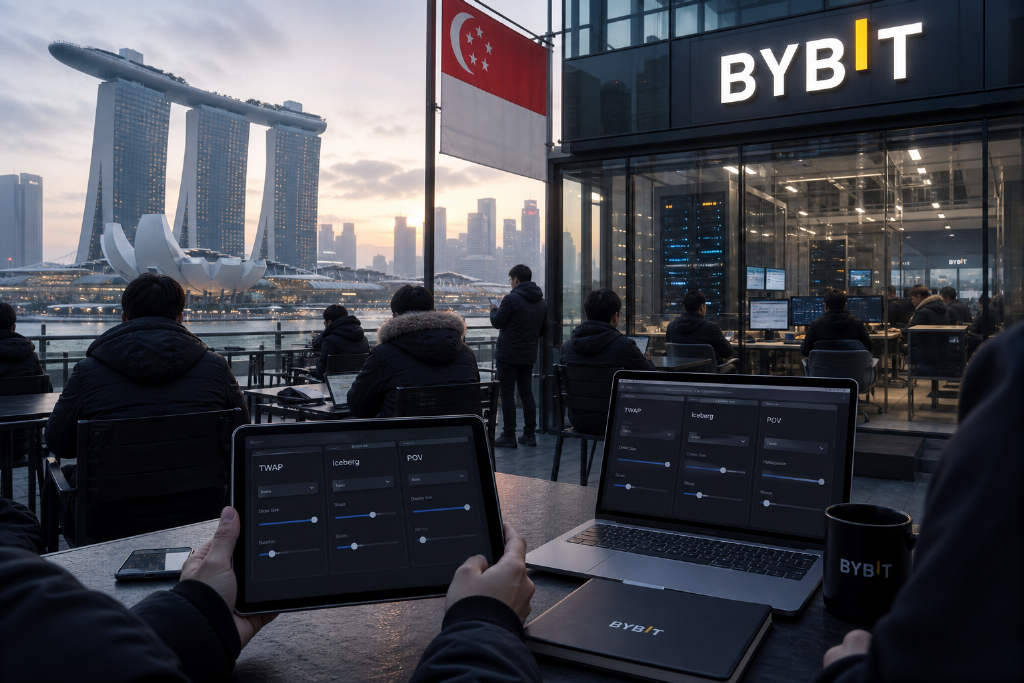
Retail crypto traders are beginning to use execution methods long associated with institutional desks, as tools such as TWAP, Iceberg, and POV move into standard exchange interfaces. In a Foresight News article, ChandlerZ argues that the execution gap between retail and professional firms is starting to shift away from simple tool access and toward parameter choices, data quality, and risk control.
On an institutional desk, a "buy" decision is only the starting point. A complete instruction also needs an execution window, visible size, market participation rate, and price limits. Those settings determine how long an order should run, how much size should be shown each time, how aggressively the system should follow activity, and how to reduce the market impact of larger trades.
Why these tools are now reaching standard user accounts
The article says TWAP duration, Iceberg display size, and POV participation rate can all be expressed as parameters, which makes large-scale deployment possible on centralized exchanges. Because exchanges already connect user accounts, live market data, and matching systems, a single execution engine can serve a large number of accounts once it is built. In that setup, algorithms previously embedded in institutional systems can be placed directly into retail order-entry pages, while technical integration and procurement costs are spread across the platform.
At the same time, DEX aggregators have started splitting execution routes, some protocols offer limit orders and automation interfaces, and on-chain derivatives venues allow users to run trading bots through software. The article says CEX platforms can package complex orders into a unified interface more easily, while DEX platforms preserve on-chain verifiability and self-custody but still have to handle gas fees, wallet approvals, fragmented liquidity, and program access. In both cases, the direction is the same: professional execution tools are moving out of systems used only by a small group of institutions.
Bybit’s seven-tool execution workflow
Foresight uses Bybit as its main case study, describing a trading page that includes seven functions: TWAP, Iceberg, POV, Chase Limit, Scaled Order, Arbitrage, and Webhook signal trading. Together, the article says, they cover execution across time, visible size, liquidity, price, and external signals.
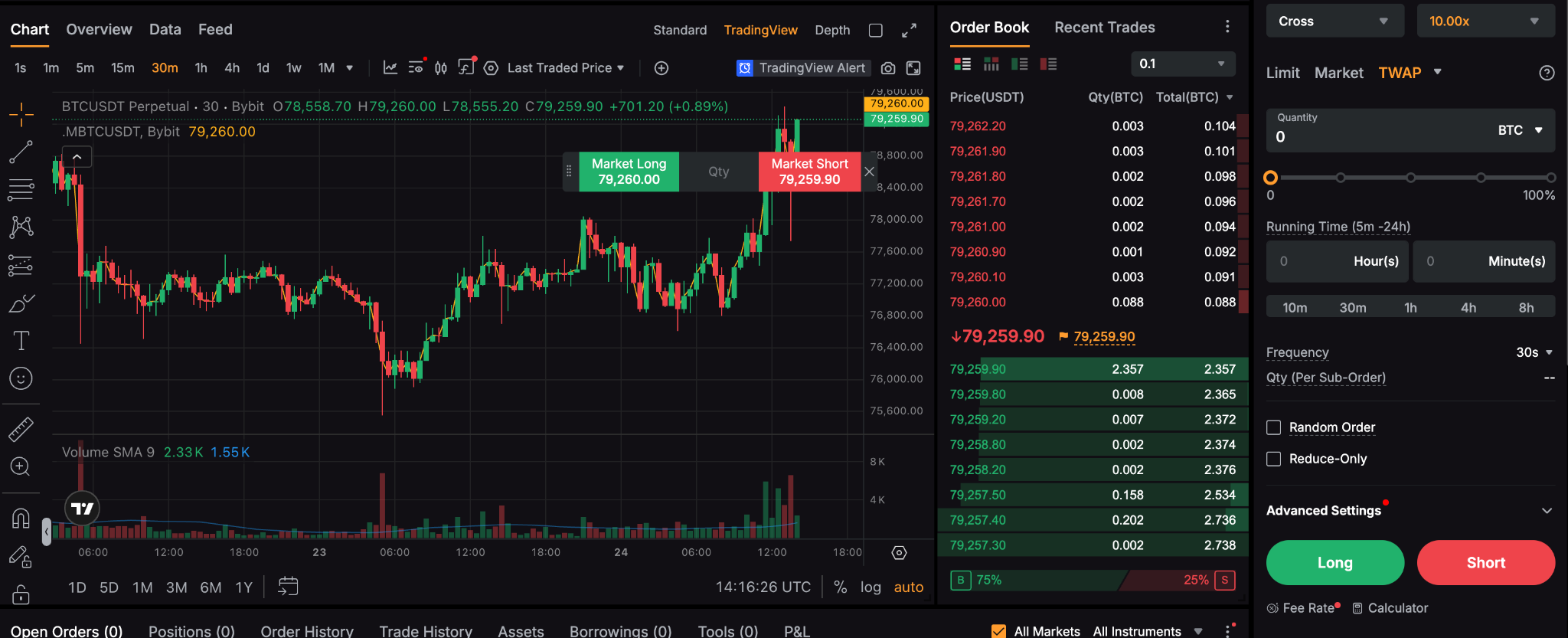
For larger orders that could quickly consume nearby order-book liquidity, TWAP breaks a trade into a sequence of smaller orders based on a preset duration and frequency. Bybit also allows users to add a trigger price, a stop price, and choose market or limit execution. Spreading fills over time may reduce one-time impact, though the article notes that if the market keeps moving in one direction during the execution period, later child orders may still fill at worse prices.
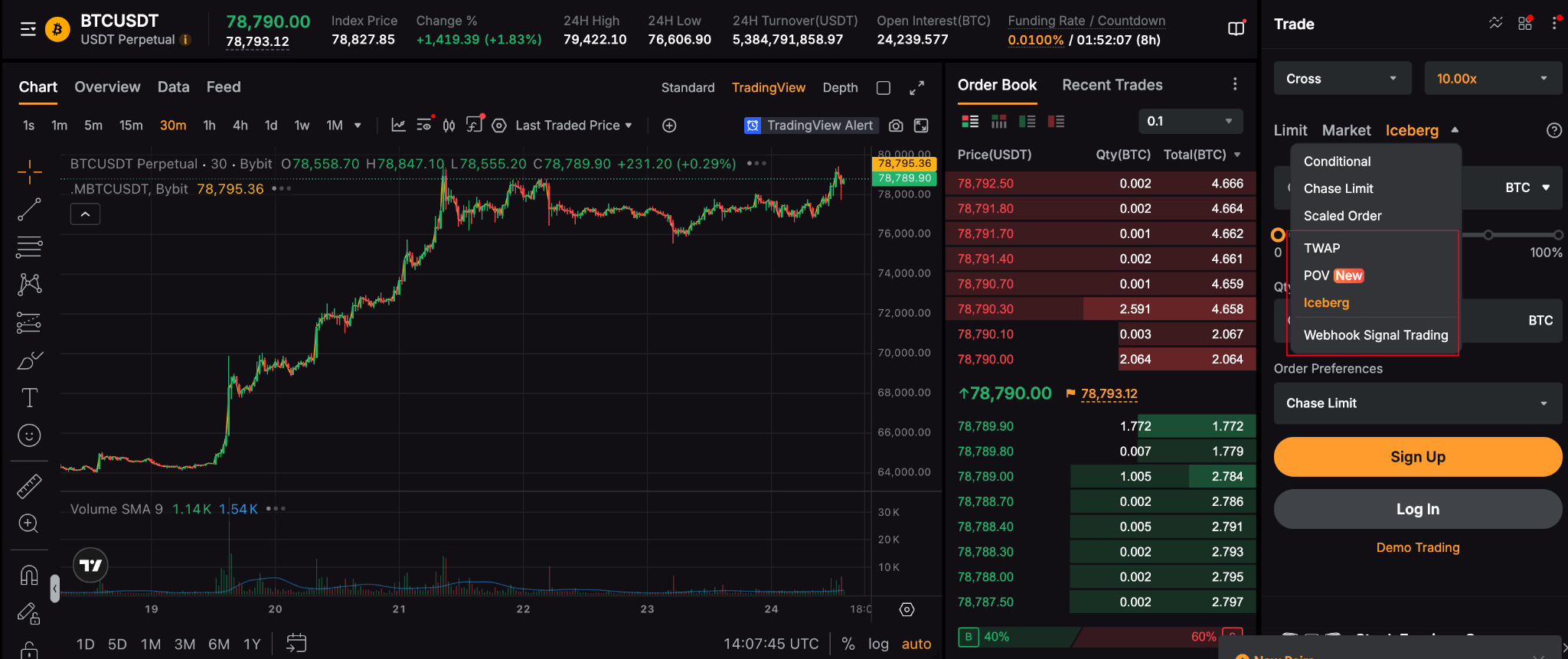
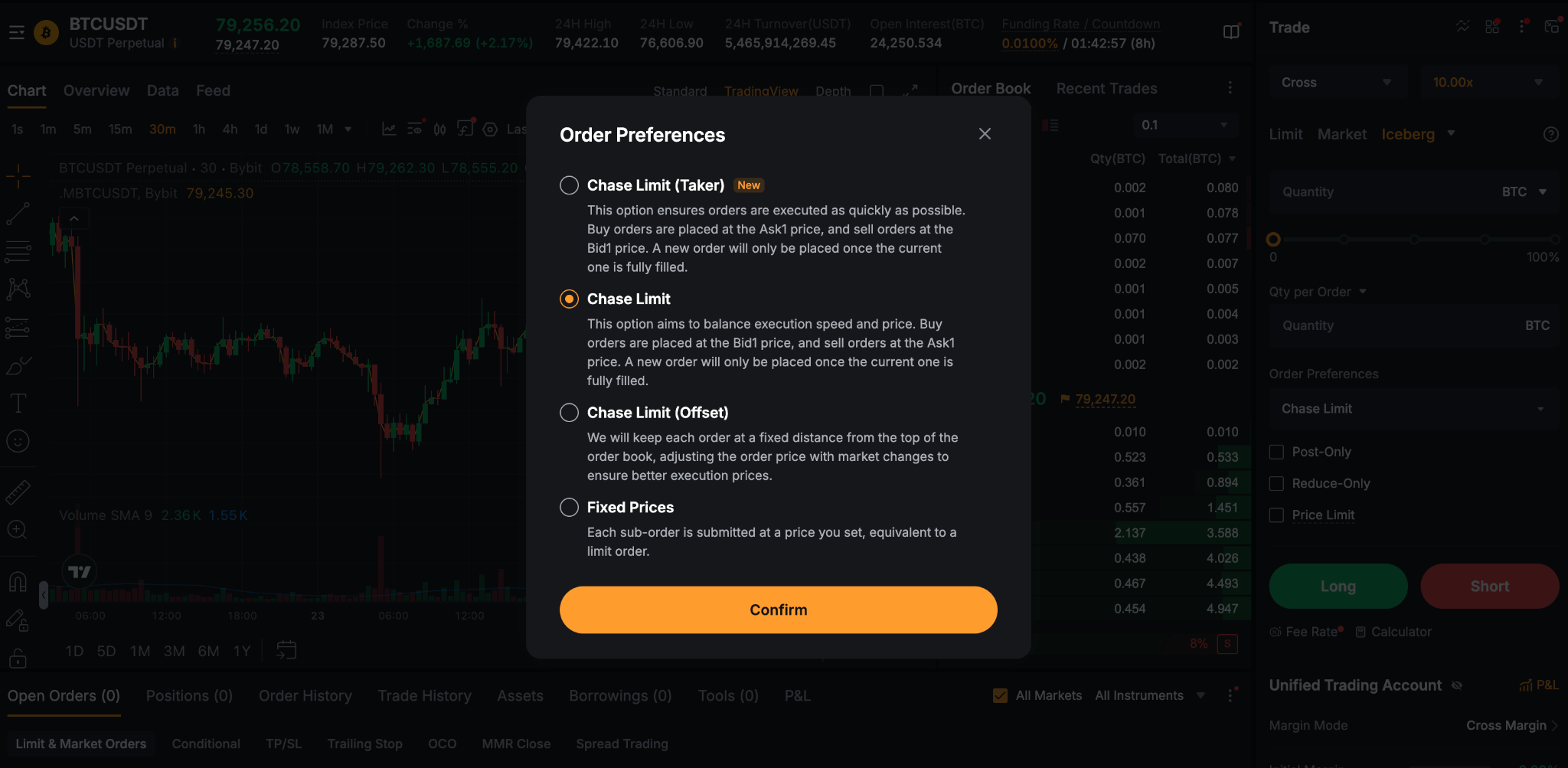
When a trader wants to conceal total size, Iceberg shows only one child order to the market at a time and submits the next one after the current slice is completed. Bybit offers four order-entry preferences for this function, letting users choose based on execution speed, maker status, and the allowed repricing range. That means the size visible in the book does not necessarily reflect the trader’s full intent.
POV differs from TWAP because it responds to how much order flow the market can absorb. After a user sets a participation rate, the system adjusts child-order size according to real-time traded volume or order-book depth. Bybit divides the reference basis into three modes: traded volume, opposite-side liquidity, and same-side order-book liquidity. Execution speeds up when trading activity is strong and slows when depth contracts.
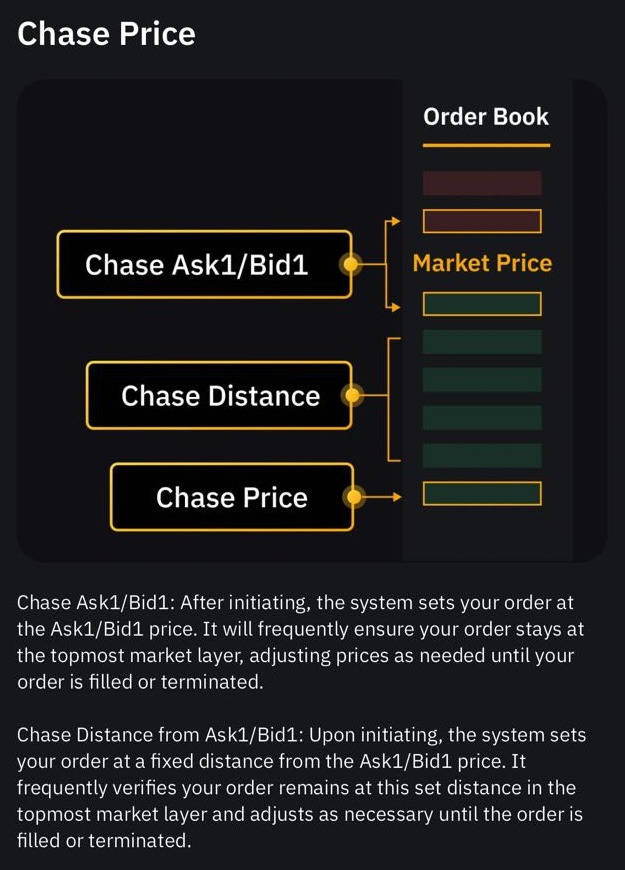
Once a limit order is in the book, Chase Limit can move the order with the best bid or ask if prices keep shifting, reducing the need for manual cancel-and-replace actions. Users can set the chase method, maximum deviation, and trigger price, and the system defaults to Post-only in an attempt to preserve maker status. For traders building or exiting positions across a price range, Scaled Order supports batch placement with four distribution types: uniform, increasing, decreasing, and custom.
Where funding rates or cross-market spreads are involved, Arbitrage places two legs into one workflow to help coordinate entries and exits across spot and perpetual futures positions. The article says the process becomes simpler operationally, but final outcomes are still affected by timing between the two fills, fees, and spread changes.
If the strategy is generated outside Bybit, Webhook can receive TradingView signals and execute perpetual or futures orders under preset conditions. According to the article, that removes the need for users to build a separate middle layer before routing indicators and strategy rules into a live account.
Competition is shifting toward tool depth and execution design
The article compares exchange offerings in one matrix and says Bybit has seven tools, Gate.io has five, OKX has four, Binance has three, and Bitget has two. It adds that the comparison is not only about count. Bybit also provides three POV modes, four Iceberg preferences, four Scaled Order distributions, and chase restrictions within Chase Limit, giving users more ways to adapt execution to different liquidity and price conditions.
As these tools move onto standard trading pages, AI has also lowered the difficulty of learning indicators, organizing rules, and writing simple strategies, the article says. TradingView and Webhook links then connect those signals to live trading accounts. In that setup, ordinary users can first understand one strategy and then let it run continuously. Exchange competition, the piece argues, is starting to center on tool count, parameter depth, and execution efficiency as users compare how an order gets filled, whether they still need to watch the screen manually, and whether strategy signals can reach their accounts directly.
How POV changes retail execution logic
The article gives special attention to POV. TWAP follows a time schedule, while POV adjusts speed to what the market can handle in real time. After a participation rate is set, the system calculates each child order based on traded volume or order-book depth. It accelerates in active conditions and slows when depth thins, aiming to keep execution speed from detaching completely from market capacity.
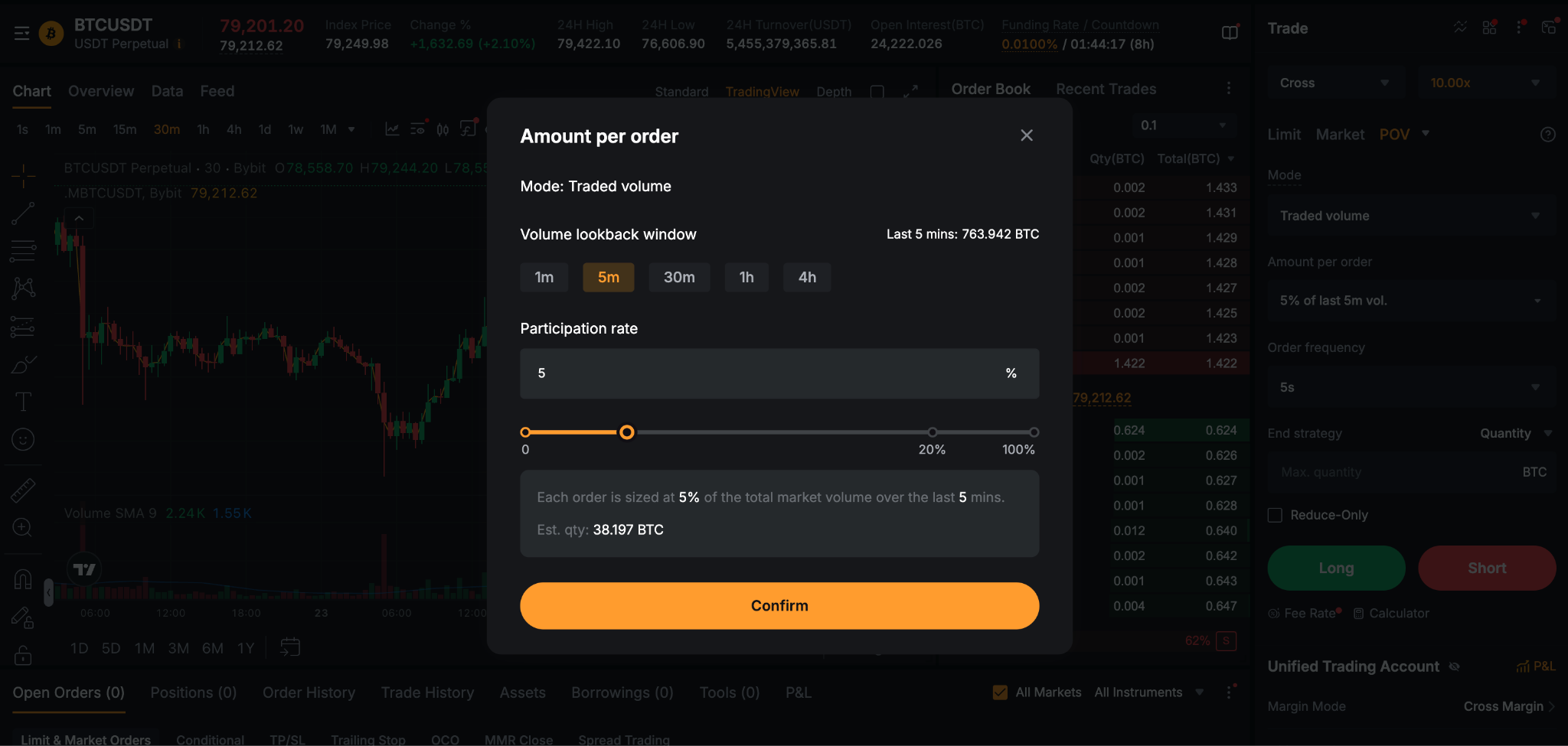
Institutional traders often change the pace of larger directional trades as liquidity shifts. Bybit has turned that logic into three optional modes built around traded volume, opposite-side depth, and same-side depth, which means retail users can choose how an order participates in the market without building the algorithm themselves.
The article also notes the limits. If the participation rate is set too high, POV can still raise impact costs. A poor choice of observation window or liquidity mode can also change execution speed and slippage. Retail traders may now access the same class of execution logic, but the results still depend on trade size, market conditions, and each user’s risk tolerance.
Tool access is closer, but the gap has not disappeared
Being able to split orders, hide full size, follow liquidity, and execute external signals from a standard account means retail access points are moving closer to those used by institutions, the article says. Bybit’s seven tools cover multiple execution stages, and settings such as three POV modes and four Iceberg preferences are designed for different market conditions. Still, differences in position size and capital remain.
Even when the same types of tools appear on a retail trading page, institutions still control lower-latency infrastructure, proprietary data, larger trading capacity, and complete risk systems. The same tool does not guarantee the same outcome. The difference shifts to parameter selection, strategy validation, exception handling, and trading discipline, all of which require long-term skill building.
If these tools are adopted by more ordinary accounts, the article says the order book may see more small child orders, while individual displayed orders become less representative of total trading intent. POV could make part of order flow move with volume, and Webhook may increase automated orders triggered by indicators and conditions. Retail behavior, in turn, may move more toward parameter setting, backtesting, and risk limits. The eventual impact on market microstructure will depend on adoption rates, the share of orders placed through these tools, and changes in slippage.
What the article concludes
In its closing section, the article says TWAP, POV, and Iceberg have entered ordinary accounts, and TradingView signals can now trigger Bybit orders directly. Leaving aside differences in capital and position size, retail traders are at least beginning to use the same categories of execution methods as institutions, with control over execution time, visible size, liquidity participation, and strategy triggers.
The article ends by saying institutions still lead in low latency, proprietary data, and systematic risk control. Exchanges may have solved the access problem, but traders still have to answer three practical questions: how to set parameters, whether a strategy actually works, and how risk should be controlled. The next stage of the gap, it says, will depend more on who can set the parameters correctly and keep risk contained.
The piece also includes a disclaimer stating that markets involve risk, investment requires caution, and the article does not constitute investment advice. Users should consider whether any opinion, view, or conclusion in the article matches their own circumstances, and take responsibility for decisions made on that basis.