
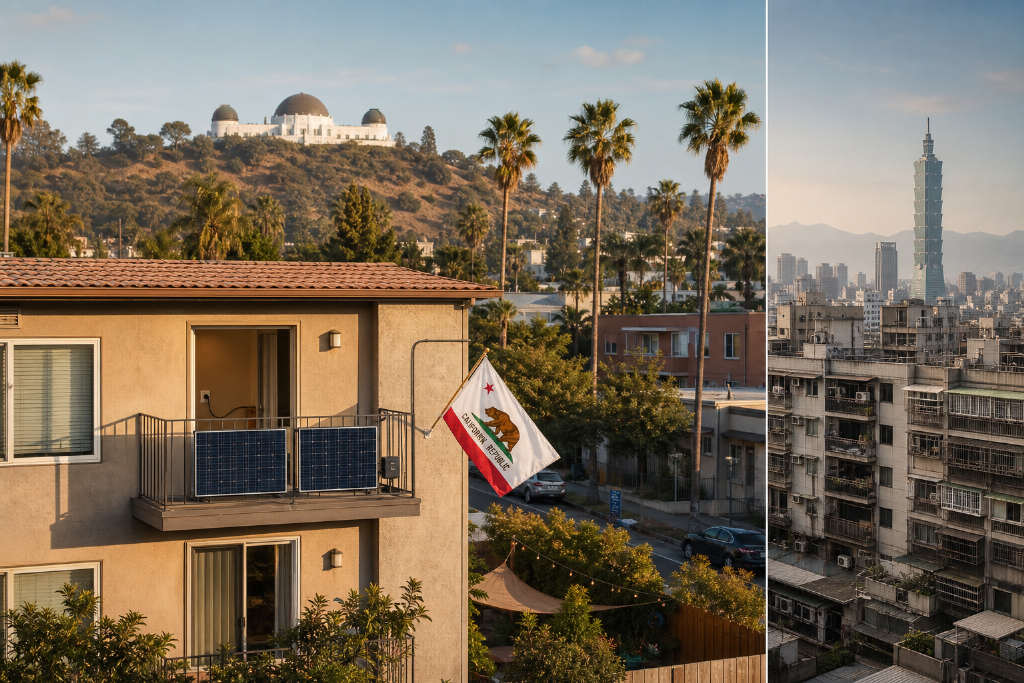
California’s legislature has passed a bipartisan bill that would allow residents to install small plug-in solar systems on apartment balconies or in backyards, according to Bloomberg. If Governor Gavin Newsom signs it before the deadline, the state would become a major test case for wider adoption of small-scale distributed energy in the U.S.
The proposal targets a simpler model of solar generation at a time of rising power bills. Instead of limiting solar access to detached homes or rooftop owners, the bill would let residents use compact systems in spaces such as balconies and small yards.
What the California bill would change
Conventional rooftop solar usually comes with high upfront hardware and installation costs that can run into tens of thousands of dollars. It also often requires a formal interconnection application with the utility, a process that can take months.
The California bill is aimed at removing that barrier for very small systems.
- Plug-in use with a size cap: Residents would be allowed to buy and install systems below 1.2 kilowatts, typically using two to four solar panels, and connect them directly to a standard indoor outlet. The output is described as enough to cover baseline household loads such as refrigerators, lighting and Wi-Fi routers.
- No export to the grid: The systems would be limited to self-consumption and could not send surplus power back into the public grid.
- A sunset clause after utility pushback: Pacific Gas and Electric, or PG&E, California’s largest utility, had opposed the measure on grid-safety grounds. The final bill includes a compromise sunset provision, with the permit exemption currently lasting only until Jan. 1, 2030.
The bill would not take away the ability of landlords or homeowners associations to block installations based on building appearance or fall-safety concerns. Whether tenants will eventually gain a clearer legal right to install the systems is expected to be part of a later policy debate.
How plug-in balcony solar works
A central question is how electricity can flow from a solar panel plugged into a wall outlet without causing a short circuit or an electric shock risk. The key component is the microinverter.
From DC to AC, matched to household power
Balcony solar panels generate direct current, or DC. A microinverter converts that output in real time into alternating current, or AC, that matches the voltage, frequency and waveform of household electricity. Before sending power out, the inverter detects the grid signal present at the wall socket and synchronizes its own output to it.
Nearby appliances use that power first
The report explains that current flows toward the nearest load with the least resistance and slightly lower voltage. As the microinverter creates a small potential difference, appliances already running in the home, such as refrigerators and televisions, will draw the solar-generated electricity first. If solar output is not enough, the grid supplies the remainder.
Anti-islanding protection cuts output during outages
Qualified devices also include anti-islanding protection. If the outlet no longer detects a grid signal, the inverter automatically stops output within milliseconds, preventing backfeed during outage repair work.
Taiwan’s current market is centered on off-grid storage
The article says public interest in balcony generation has risen in Taiwan as electricity pricing structures have changed and net-zero awareness has grown. But Taiwan’s regulatory framework and market setup still differ sharply from those seen in Europe and the U.S.
The mainstream legal option in Taiwan today is an off-grid system. Under that model, balcony solar panels charge portable outdoor battery units, including products such as EcoFlow and BLUETTI, and users then plug appliances into the storage device rather than into the household wiring system.
Because the electricity does not connect to the indoor distribution panel or to Taiwan Power’s grid, no application is required. The setup also provides backup power during outages and can be used outdoors, including for camping. Its drawback is that users must switch appliance plugs manually, and the system cannot automatically offset whole-home electricity use in the way California’s proposed model is designed to do.
Direct plug-in systems still face regulatory barriers in Taiwan
Although Taiwan is a major manufacturing hub for solar hardware and inverters, the article notes that directly connecting a plug-in solar device to a wall outlet would still be treated as an unapproved grid connection under current rules.
Under existing standards from Taiwan Power and the Energy Administration, any generating equipment connected to the grid, regardless of capacity, must be signed off by a professional electrical engineer, pass Voluntary Product Certification, or VPC, and complete a formal interconnection application. For micro-systems in the hundreds of watts, the application cost can exceed the cost of the equipment itself.
A small-scale model under policy review
As electricity demand keeps rising, distributed energy systems globally are moving toward smaller, more appliance-like and more accessible designs. The article frames California’s legislative process as a potential reference point for future discussions in Taiwan over how micro-generation should be managed and whether related rules should be loosened.