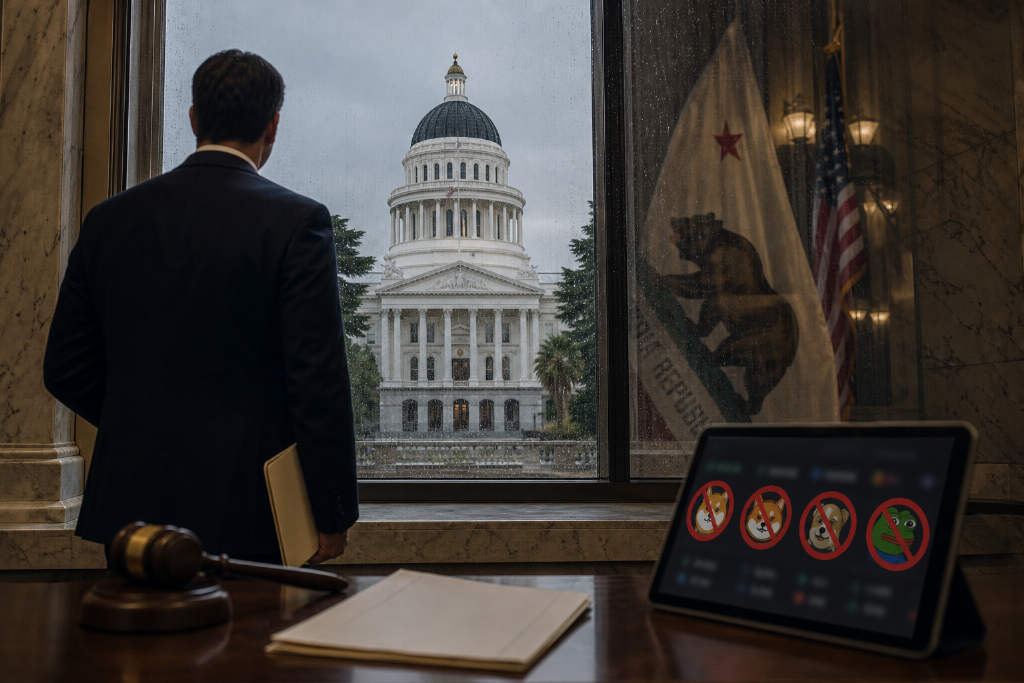
California Senate passes bill restricting public officials’ memecoins

California Senate passes bill restricting public officials’ memecoins

N
News Editor
2026-08-28 12:09:48
California lawmakers have advanced Assembly Bill 2409, a measure aimed at limiting public officials’ involvement in memecoins and restricting how those tokens can be offered to residents in the state. The bill passed the California Senate by a 40-0 vote on Wednesday, according to Legiscan, and the Assembly later voted 78-0 to concur with the Senate’s amendments. It has now entered the enrolled stage and is waiting for the governor’s signature. Under the bill, digital asset service providers would be barred from offering California residents any memecoins issued on or after Jan. 1, 2027, if those tokens are offered by, or in partnership with, federal public officials or state or local public officers. The legislation defines memecoins as digital assets whose value comes mainly from public attention, speculation, or community engagement. Lawmakers tied the proposal to concerns over conflicts of interest and what the bill describes as “pay-to-play arrangements.” The report also points to the Official Trump (TRUMP) token as a live example in the broader debate. Public Citizen said investors tied to the token are estimated to be $3.2 billion underwater, mostly on an unrealized basis. CoinMarketCap data cited in the report shows TRUMP with a $688 million market capitalization, up 53% over the past week after falling 67% over the past year.

California lawmakers passed a bill that would restrict public officials’ involvement with memecoins, citing concerns over conflicts of interest and what it calls “pay-to-play arrangements.”

According to Legiscan data, the California Senate approved Assembly Bill 2409 in a 40-0 vote on Wednesday. The Assembly then voted 78-0 to concur in the Senate’s amendments. The measure has entered the enrolled stage and is now awaiting the governor’s signature.

What the bill would do

The bill would prohibit digital asset service providers from offering California residents memecoins issued on or after Jan. 1, 2027, when those tokens are offered by, or in partnership with, federal public officials or state or local public officers.

It defines memecoins as digital assets whose value is derived primarily from public interest, speculation or community engagement.

As described in the report, the measure also seeks to block the listing to California residents of memecoins issued by federal public officials, framing the issue around conflicts of interest and “pay-to-play arrangements.”

TRUMP token cited in the broader debate

Public Citizen, a nonprofit consumer advocacy organization, said in a Thursday report that investors in the president-linked Official Trump (TRUMP) memecoin are estimated to be $3.2 billion underwater. Most of those losses, the report said, remain unrealized.

CoinMarketCap data cited in the article shows TRUMP as the fifth-largest memecoin by market capitalization, at $688 million. The token rose 53% over the past week, recovering part of the losses from its 67% decline over the past year.

Wider political and legislative backdrop

The article also says the Trump family’s crypto ventures have created obstacles for the passage of the Digital Asset Market Clarity (CLARITY) Act, a US crypto market structure bill.

A bipartisan ethics addendum that has not been made public would reportedly allow Trump to defer capital gains taxes on any required divestitures, which could produce tax savings in the millions.

This article was originally published by Bit.Fan. For more cryptocurrency news and market insights, visit www.bit.fan.
80

Disclaimer:

The market information, project data, and third-party content displayed on this platform are for industry information sharing only and do not constitute any form of investment advice or return commitment.

Cryptocurrency trading carries high risks. Users should fully assess their risk tolerance and make independent decisions. All profits, losses, and legal responsibilities are borne by the users themselves.