
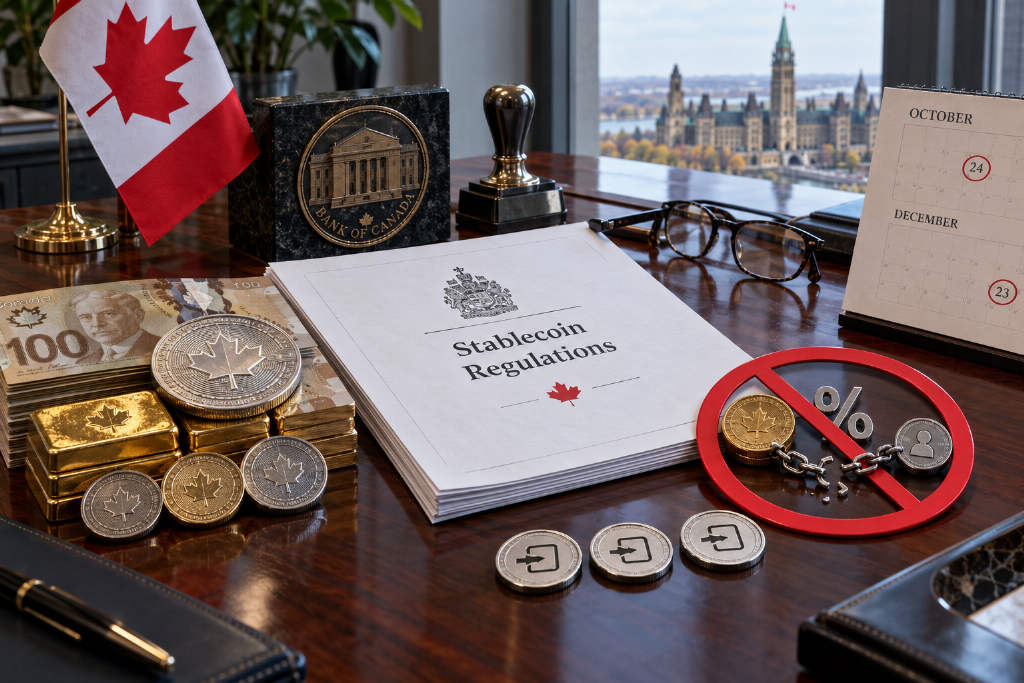
Canada’s Department of Finance published draft Stablecoin Regulations in the government gazette on Oct. 24, opening a 60-day public consultation period that runs through Dec. 23.
The draft sets out implementation rules for the Stablecoin Act, which completed the legislative process in March this year. One of its central provisions is a ban on issuers paying interest to holders, including through third-party structures designed to produce the same result.
No yield for holding, but payment rewards remain allowed
The proposal draws a distinction between holding and using a stablecoin. Issuers would not be allowed to pay any form of interest or return to holders, directly or indirectly, and they would also be barred from using words or symbols that imply a stablecoin offers yield.
Arrangements with third parties would also be prohibited if they allow holders to earn a return from holding the stablecoin, or if they encourage a third party to pay interest to those holders.
The draft makes room for payment-related incentives. Rewards tied to a transaction, rather than to passive holding, would not be treated as interest. In practical terms, cashback or similar rewards for paying with a stablecoin would be allowed, while leaving tokens idle and collecting yield would not.
According to Canadian outlet The Logic, a spokesperson for the Canadian Bankers Association said the group “strongly supports” an explicit ban on both direct and indirect interest payments.
ABMedia also noted that Chain News reported on Oct. 21 that implementation rules under the U.S. Office of the Comptroller of the Currency’s finalized GENIUS Act take a case-by-case review approach to third-party yield arrangements.
Reserves must match supply 1:1
Under the draft, the market value of reserves held by an issuer at the end of each day must be at least equal to the total amount of stablecoins in circulation.
Eligible reserve assets include demand deposits and cash, government debt maturing within three months, overnight repos, and money market funds that invest only in those assets. The proposal does not set allocation caps for each asset class, but it requires reserves to be held with a qualified custodian established under Canadian federal or provincial law.
Redemptions due within three business days
On redemptions, issuers would have to complete a redemption within three business days after receiving a request. The draft also says issuers cannot impose a minimum redemption amount.
Fees would be capped at 1% of the redemption amount. Any increase in redemption fees would need to be posted on the issuer’s website seven days in advance.
Bank of Canada would oversee registration, supervision and enforcement
According to the Department of Finance’s stablecoin framework explanation, the regime would be administered by the Bank of Canada, which would handle registration, supervision and enforcement.
The rules would apply to non-financial institution stablecoin issuers operating in Canada, including both domestic and foreign firms. Banks and other financial institutions already subject to prudential regulation would remain under existing frameworks.
The draft says issuers must register with the central bank before issuing stablecoins. Firms already issuing stablecoins when the rules take effect would be allowed to continue operating if they submit an application within 30 days.
Canada’s finance minister would be able to review applicants on national security grounds. The governor of the Bank of Canada could also grant exemptions to issuers subject to foreign or provincial regimes that are substantially similar.
Annual fees scale with circulation, launch targeted for fall 2027
Supervisory fees would be tiered by size. Issuers with average circulation of at least C$1 billion would pay a base annual fee of C$750,000. Those with average circulation between C$500 million and C$1 billion would pay C$350,000. Issuers below C$500 million would pay C$25,000.
The explanatory note to the draft says the regime is intended to take effect in fall 2027.
Canada’s banking sector is also preparing its own approach. ABMedia said Chain News reported in September that Canada’s six largest banks are jointly studying tokenized Canadian dollar deposits.



