
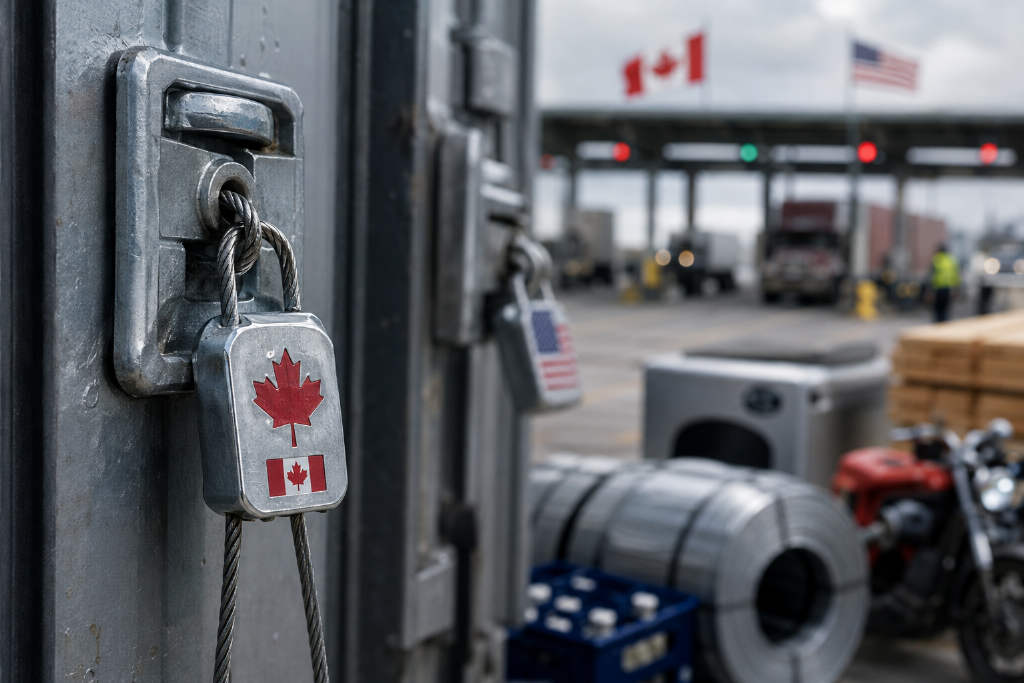
Canada has started imposing tariffs of 15% to 50% on roughly 700 U.S. goods as of 12:00 p.m. Taiwan time, answering earlier U.S. tariffs that reached as high as 50% on about $20 billion worth of Canadian products.
List covers 10 major categories worth about C$27.6 billion
Canada’s finance ministry released the list at the same time. It covers steel and aluminum, dairy products, home appliances, agricultural machinery, pulp, plastics, electronics, lumber, along with cosmetics, cheese, and motorcycles. The total value is about C$27.6 billion, or roughly $19.9 billion.
The report said tariff rates on steel and aluminum products were effectively doubled, with aluminum foil, locomotives, and steel bridges specifically named. The earlier U.S. list, valued at about $20 billion, focused on consumer goods such as alcohol, dairy products, furniture, and apparel.
Bombardier case points back to the U.S. supply chain
The report said Trump had earlier targeted Bombardier, the Montreal-headquartered Canadian company known for its aircraft business. On Monday, he wrote on his own social media platform that the company should move its production lines to the United States if it wanted to keep selling aircraft in the U.S. market.
That stance could also hit American businesses. Bombardier works with more than 2,800 suppliers inside the United States. Its flagship Global 7500 business jet uses wings from Texas, avionics from Iowa, and engines built in Indiana. If such restrictions are enforced, the first damage may fall on U.S. jobs and domestic suppliers.
Michigan and Ohio exporters are in focus
The report framed the dispute as political as well as economic. Exporters in Michigan and Ohio, both closely tied to business with Canada, would be among the first to feel the impact. Those two states are also heading toward November midterm voting.
According to the report, Carney’s calculation is to push the pain of the trade fight onto U.S. manufacturers and buyers first, raising the cost for Washington and increasing the chance of bringing the White House back to the negotiating table.
Brian Clow, a former senior trade adviser in the Trudeau government, said Canada’s goal in rolling out the tariffs was not to fight a trade war for its own sake, but to end it sooner.
Industry and economists warn the spiral may not be over
Industry voices and economists were less optimistic. Flavio Volpe, president of Canada’s Automotive Parts Manufacturers’ Association, said the Trump administration appeared willing to let domestic industries take hits alongside everyone else in order to achieve its objective, meaning the clash could keep escalating.
Oxford Economics estimated that once U.S. tariffs, Canada’s retaliation, and related federal support spending are all included, Canadian economic output could come in about 0.3 percentage points below its baseline scenario. The estimate does not include the risk of any further escalation.
The report also said Trump had warned that starting on Jan. 1 next year, tariffs on Canadian automobiles could rise from 25% to 50%, with auto parts facing the same 50% rate. U.S. Trade Representative Greer also signaled that further measures were possible, including the possibility that some Canadian goods could be shut out of the U.S. market, though no exact timetable was given.