
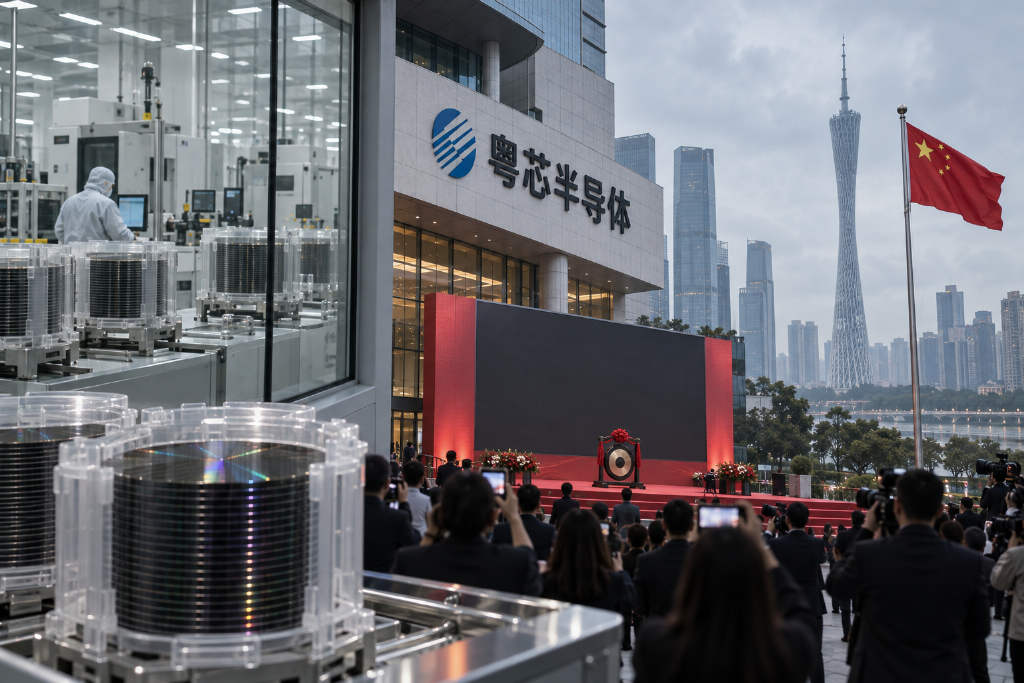
CanSemi Technology began trading on Shenzhen’s ChiNext on Oct. 13, with the stock opening 274.69% higher at 45 yuan per share. Based on a standard allotment of 500 shares, one winning subscription translated into a paper gain of about 16,500 yuan.
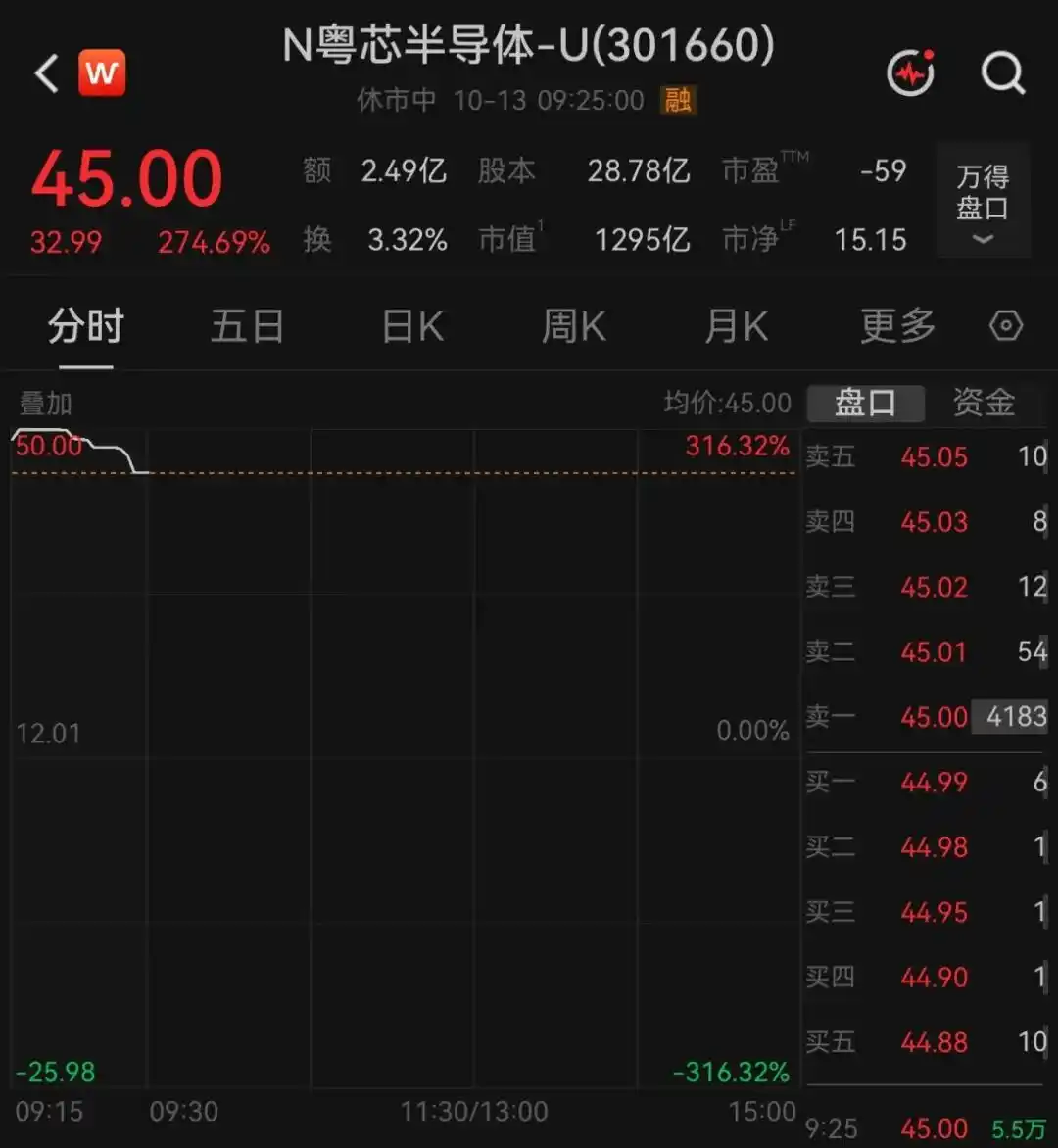
Wind data cited in the report showed that CanSemi priced its IPO at 12.01 yuan per share. The company initially issued 513 million shares, and the total offering expanded to 590 million shares after the over-allotment option was fully exercised.
Nearly half of the proceeds are set aside for expansion
The prospectus described CanSemi as an integrated circuit manufacturer that provides 12-inch wafer foundry services and specialty process solutions. It also said the company is the first 12-inch wafer manufacturer cultivated in Guangdong province to enter mass production.
For the online tranche, the number of valid subscription accounts reached 14.4354 million, with valid subscription volume totaling 423.383 billion shares. After the callback mechanism was triggered, the final online issuance came to 179 million shares, and the winning rate was 0.0423786759%. A total of 358,848 winning numbers were issued, with each number eligible to subscribe for 500 A-shares of CanSemi.
The final strategic placement totaled 256.323 million shares. The final online issuance was 179.424 million shares, while the final offline issuance was 153.795 million shares. Online investors gave up 468,976 shares, which were underwritten by GF Securities for 5.6324 million yuan.
CanSemi plans to raise a total of 7.5 billion yuan in the IPO. The proceeds are intended for a 12-inch integrated circuit analog specialty process production line project (Phase III), a specialty process technology platform R&D project, and supplementary working capital. Of that total, 3.5 billion yuan is slated for capacity expansion, 2.5 billion yuan for R&D, and 1.5 billion yuan for working capital.
The company said that if the actual net proceeds fall short of 7.5 billion yuan, the gap will be covered through its own funds and bank loans.
Capacity utilization climbed to 96.38%
The expansion plan reflects the company’s current production profile. According to the prospectus, capacity utilization was 55.23% in 2023, 84.79% in 2024, and 96.38% in 2025, indicating that overall capacity was approaching saturation. Its production-sales ratio reached 99.47%.
CanSemi said there is still a gap between its capacity scale and that of leading global wafer foundries, and that gap has constrained its ability to sustain rapid growth. The company said accelerating capacity construction is important for business expansion and for improving its overall market competitiveness.
On the demand side, the prospectus cited Statista data showing that the global analog chip market is expected to reach $116.04 billion by 2028, while China’s analog chip market is projected to hit 258.77 billion yuan. The filing also said China’s self-sufficiency rate in analog chips rose from 9% in 2019 to about 16% in 2024.
No controlling shareholder or actual controller
The prospectus said CanSemi has no controlling shareholder and no actual controller. Its top five shareholders are Yuxin Zhongcheng, Guangdong Semiconductor Fund, Guangzhou Huaying, Science City Group, and SDIC Venture Capital, each holding no more than 17%.
The company warned that its dispersed ownership structure could reduce the efficiency of decision-making by the shareholders’ meeting and the board on major matters, which in turn could lower governance efficiency and create operational risks. It also said control of the company could change in the future, bringing potential risks to operations and development.
Revenue rose, but losses continued
From 2023 to 2025, CanSemi posted revenue of 1.044 billion yuan, 1.681 billion yuan, and 2.582 billion yuan, respectively. During the reporting period, cumulative wafer shipments exceeded 1.2 million units.
Even so, the company remained in the red. Net profit attributable to shareholders of the parent company was negative 1.917 billion yuan, negative 2.253 billion yuan, and negative 2.346 billion yuan in 2023, 2024, and 2025, respectively. As of the end of the reporting period, undistributed profit stood at negative 10.081 billion yuan.
In the prospectus, CanSemi said wafer manufacturing typically involves a long ramp-up cycle and a gradual release of capacity, and that asset depreciation has had a major effect on financial performance. Depreciation expense for machinery and equipment was 1.519 billion yuan, 1.702 billion yuan, and 2.302 billion yuan over the three years.
The company also said it has maintained large-scale R&D spending since its establishment, with R&D accounting for a relatively high share of revenue. R&D expenses were 605 million yuan, 446 million yuan, and 422 million yuan during the reporting period.
CanSemi said the scale of losses is expected to narrow in the coming years, but depreciation and R&D expenses will remain high. Combined with share-based payment expenses generated by equity incentives, the company said it may still face continued losses in the short term.
The company also warned that, given the capital-intensive nature of the wafer foundry business, any shortfall in fixed-asset construction, capacity ramp-up, or yield could delay the timing of a return to profitability. Based on assumptions including continued revenue growth during the forecast period, a gradual recovery in gross margin, progress in capacity construction and ramp-up, commercialization of R&D results, market expansion in line with original plans, and timely receipt of government subsidies at a reasonable level, CanSemi said it expects to achieve break-even on a consolidated basis as early as 2029.
The report was originally published by the WeChat account Zhongxin Jingwei (ID: jwview), written by Dong Wenbo and edited by Wei Wei and Chang Tao. Wind was cited as a data source in the story.



