
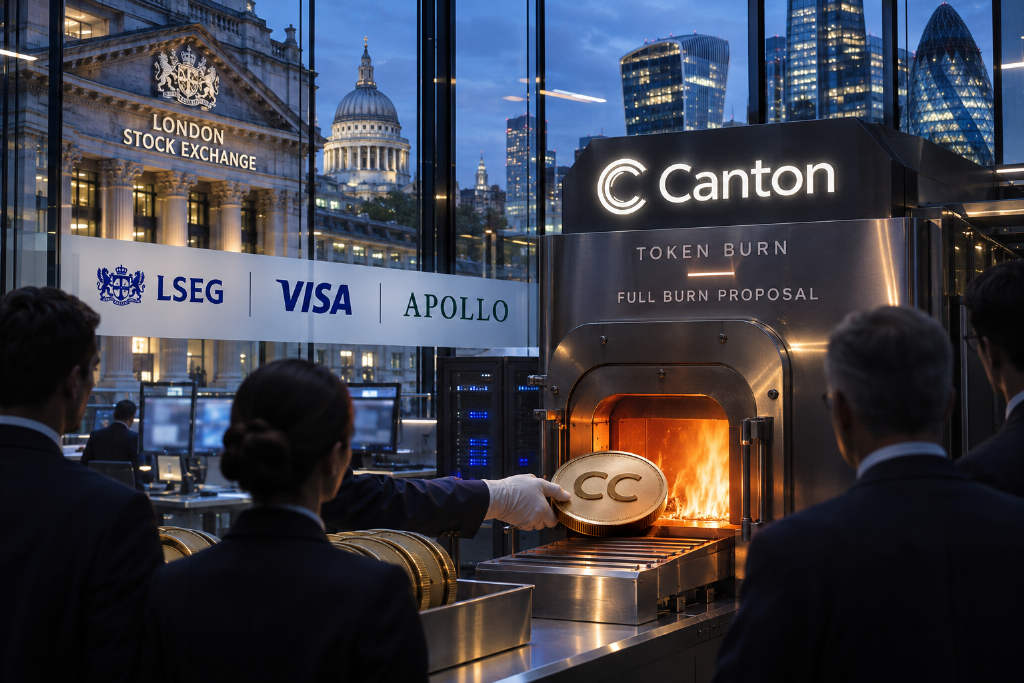
Canton has approved a governance change that will fold private institutional settlement traffic into the same CC token burn loop used on its public layer. In October, the network’s super validator committee unanimously passed CIP-0129, a proposal described as a "Universal Burn" reform. Under the plan, all production synchronizers on the network will have to pay for traffic costs by buying and burning CC on the open market starting in 2027.
The change comes as Canton’s fee capture has climbed sharply. A report from Alea Research, cited by TechFlowPost, says Canton generated more network fee revenue than Tron, Solana and Ethereum mainnet in every quarter of 2026. In the third quarter alone, the network recorded $157.5 million in fees.
How Canton links settlement activity to CC burns
Canton is a public blockchain network built for traditional financial institutions. Transaction participants can view only the portions directly tied to them, while the network’s global synchronizer coordinates cross-contract settlement states without reading private data.

That architecture turns network usage into token demand. Validators buy network throughput at a fixed fiat price of $60 per megabyte, convert that amount into CC based on the daily closing market price, and burn the tokens on-chain.
Alea Research says the network gives commercial banks shared infrastructure while keeping positions and business-sensitive information hidden from one another.
Fee revenue led major chains through the first three quarters
According to the report, Canton’s total on-chain fee revenue exceeded that of Tron, Solana and Ethereum mainnet in each of the first three quarters of 2026. As of Sept. 30, Canton’s DeFi total value locked stood at about $8.1 million, but the report argues that TVL is a poor fit for measuring the economic activity of a trillion-dollar inter-institutional settlement network.

One example cited in the report is the Broadridge repo platform built on Canton technology. In September, it cleared and settled an average of $357 billion in U.S. Treasury repo transactions per day. Custodians were also processing large volumes of over-the-counter derivatives settlements on the network. Those real-world financial flows ultimately map onto the public token layer and create on-chain burn demand for CC.
Current burns already offset most new issuance
The report says current public-market traffic burns are already enough to offset 69% of new token issuance, up from 11% a year earlier. Its model suggests that roughly one-third more burn volume from current levels would be enough to bring CC to full supply-side deflationary balance.
At CC’s Oct. 26 closing price of $0.0994, the token’s circulating market capitalization was about $3.95 billion. Alea Research says that values CC at roughly 6.3 times the scale of network traffic burns. Using the 648.5 million CC minted in September as the base, the report calculates a theoretical break-even token price of $0.0752.

Using the Oct. 26 official closing price, the dollar value of traffic consumed in September would have been enough to burn about 76% of the month’s newly issued CC. In other words, less than one-quarter of the gap remained before issuance would be fully neutralized.
Newly minted CC is shifting toward applications
Canton’s issuance curve is also moving more heavily toward ecosystem builders. In September 2026, selected applications received 73% of all newly minted CC, while the share allocated to super validators fell to 14%.
The report describes a dynamic subsidy formula: for every $1 of real traffic consumption an application brings to the network, the system returns about $1 worth of newly minted CC as a reward. Alea Research says that mechanism helped attract developers during the network’s early phase and brought token burns and application subsidies close to a closed loop over recent months.

The fixed U.S. dollar pricing model for network traffic also acted as a stabilizer during token price weakness. In the 30 days through Sept. 30, CC’s secondary-market price fell 26% and short-term total network traffic dropped 27%, yet the actual dollar value of CC burned stayed near full levels, according to the report.
CIP-0129 removes the split between private and public pricing
The newly approved proposal is designed to eliminate the old divide between public-layer traffic and private standalone synchronizers. From 2027, every standalone synchronizer running production business will move away from the traditional annual license-fee model.
Instead, institutions will pay under the same standard as the public layer, buying throughput for their standalone synchronizers by burning CC on-chain. The report notes that a rigid flat transaction price across all operations would squeeze high-throughput, low-margin use cases such as high-frequency micropayments and market making.

To address that, the Canton Foundation set out a phased rollout. Phase one is scheduled for the first quarter of 2027 and will introduce a case-by-case tiered burn discount system. Phase two is set for the third quarter of 2027 and will add automated commitment discounts and volume-based pricing.
Large financial institutions are embedded in governance
The governance shift is tied to deep participation from major financial institutions. The report says Visa and Apollo joined in March, while London Stock Exchange Group, Paxos and Marex were approved in late September. The eight super validator institutions form the network’s consensus base and are also seen as a source of future institutional settlement activity.
Sensitivity model for the deflation break-even point
Alea Research says token burn and issuance rates will eventually meet at an equilibrium price. Based on the 648.5 million CC minted in September, the model puts that theoretical break-even price at $0.0752. At the Oct. 26 closing price of $0.0994, September traffic burns would already cover about 76% of new issuance.

The report adds that while the theoretical issuance ceiling still has room to rise, a second step-down in the issuance curve is preset for early 2027, which would slow the release of new tokens. Public-market traffic burns already offset 69% of new issuance, and Alea Research argues that if trillion-dollar institutional transaction flows are fully routed into the burn mechanism after 2027, Canton’s token value-capture loop will move into a new phase.
TechFlowPost, citing Alea Research, says Canton has built a settlement blockchain that lets traditional financial institutions coordinate while preserving data privacy, and that the universal burn mechanism is meant to convert real institutional settlement flow into on-chain buying power and token destruction.




