‹ BackNewsCanton

Canton

MEV Cannot Be Designed Away, and the Real Fight Is Over Who Prices Ordering Rights
MEV
2026-09-29 07:01:10

MEV Doesn’t Disappear. It Changes Form Across Market Structures

Jascha Samadi argues that the right question is not whether a market has MEV, but who controls the pricing power over transaction ordering. In his framing, ordering value behaves like conserved energy: whenever a ledger processes valuable shared state in sequence, execution order carries economic value. That value can be auctioned, hidden, burned, or renamed, but it does not vanish. The article compares four settings. Ethereum turns ordering value into a visible market through searchers, builders, relays, validators, and proposer-builder separation. Canton removes the public market around ordering, but not the discretion itself, shifting it toward synchronizer operators within a permissioned and privacy-heavy architecture. Traditional finance, in Samadi’s view, spent decades burying the same rent inside payment for order flow, dark pools, and last look, with enforcement records exposing how hidden ordering advantages were monetized over time. Hyperliquid, by contrast, is presented as a case that formalizes execution priority through public auctions and then burns the fees, pushing the proceeds into a public pool rather than private bilateral arrangements. His conclusion is narrow but sharp: every venue that orders valuable state transitions produces ordering value. The real distinction between systems is whether that value is openly priced, who captures it, and whether the resulting rents are observable and redistributed or quietly absorbed by whoever sits closest to the sequencer.


190
MEV Doesn’t Disappear. It Changes Form Across Market Structures
MEV
2026-09-29 06:56:10

MEV Is Not Eliminated by Design. It Just Moves to a Different Layer.

Jascha Samadi argues that maximal extractable value, or MEV, is not a flaw that certain architectures can simply remove. His core claim is narrower and more structural: wherever a system processes valuable shared state in sequence, ordering itself carries economic value. That value can be auctioned in public, embedded in legal arrangements, hidden inside bilateral relationships, or redirected to a shared pool, but it does not disappear. The article compares four settings. Ethereum turns ordering into an open market through searchers, builders, relays, validators, and order flow auctions. Canton removes the public market around ordering, yet still leaves discretion with sequencers and operators, especially in private deployments where most volume settles today. Traditional finance, Samadi writes, has spent decades packaging the same rent under labels such as payment for order flow, dark pools, and last look, with enforcement records showing how opaque systems can still monetize queue position and informational advantage. Hyperliquid takes a different route by openly auctioning execution priority and burning the proceeds, making the price visible rather than implicit. His conclusion is that the meaningful distinction is not whether MEV exists. The key questions are who controls ordering, whether access is competitive or assigned, whether the rent is observable or hidden, and where the proceeds ultimately go.

190
MEV Is Not Eliminated by Design. It Just Moves to a Different Layer.
Quant
2026-09-28 06:45:41

QNT jumps about 300% as TCH picks Quant, putting tokenized bank deposits in focus

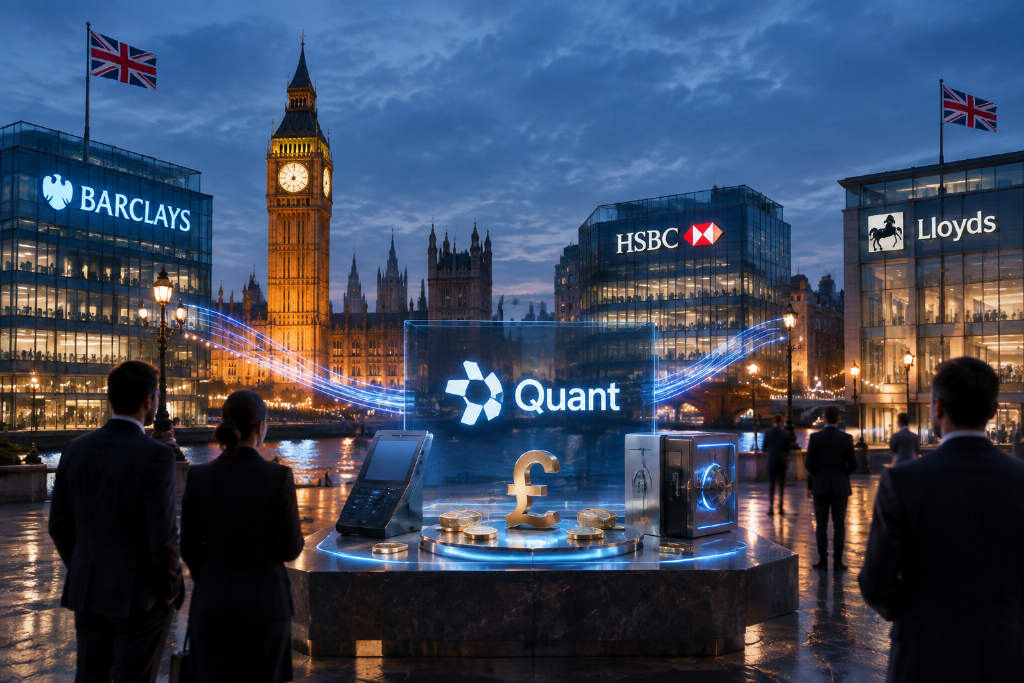
Quant’s QNT has climbed about 300% over the past week, rising above $270 with 24-hour trading volume topping $600 million after The Clearing House selected Quant as the technology provider for its On-Chain Money Initiative. Two days later, seven major U.K. banks, including Barclays, HSBC and Lloyds, used the Quant platform to complete what the report described as the first real-customer payments using tokenized pound deposits. The article argues that the market move is tied less to Quant operating a blockchain and more to its role as an interoperability and orchestration layer. Through Overledger, Quant connects different blockchains and legacy banking systems while remaining compatible with existing payment rails such as RTP and CHIPS. That architecture matters because a network involving 25 U.S. banks is unlikely to force every participant onto the same chain. The report also contrasts tokenized deposits with stablecoins, saying banks favor deposits because they remain bank liabilities on balance sheet and do not disintermediate deposits. Beyond QNT, it highlights Canton’s CC as the closest comparable asset, CANTO as a smaller and riskier RWA-linked play, LINK as an indirect infrastructure beneficiary through data, oracle and cross-chain services, and XRP and XLM as older payment-settlement narratives that may face pressure if banks choose blockchain upgrades over wholesale replacement of existing systems.

320
QNT jumps about 300% as TCH picks Quant, putting tokenized bank deposits in focus
MUFG tests blockchain settlement for Japanese government bond trades
Digital Asset raises $355 million with Shinhan Financial Group and SC Ventures joining