

Jascha Samadi argues that MEV cannot be designed away. If a ledger executes transactions against valuable shared state, ordering carries economic value. That value can be auctioned, hidden, regulated, renamed, or destroyed, but it does not vanish.
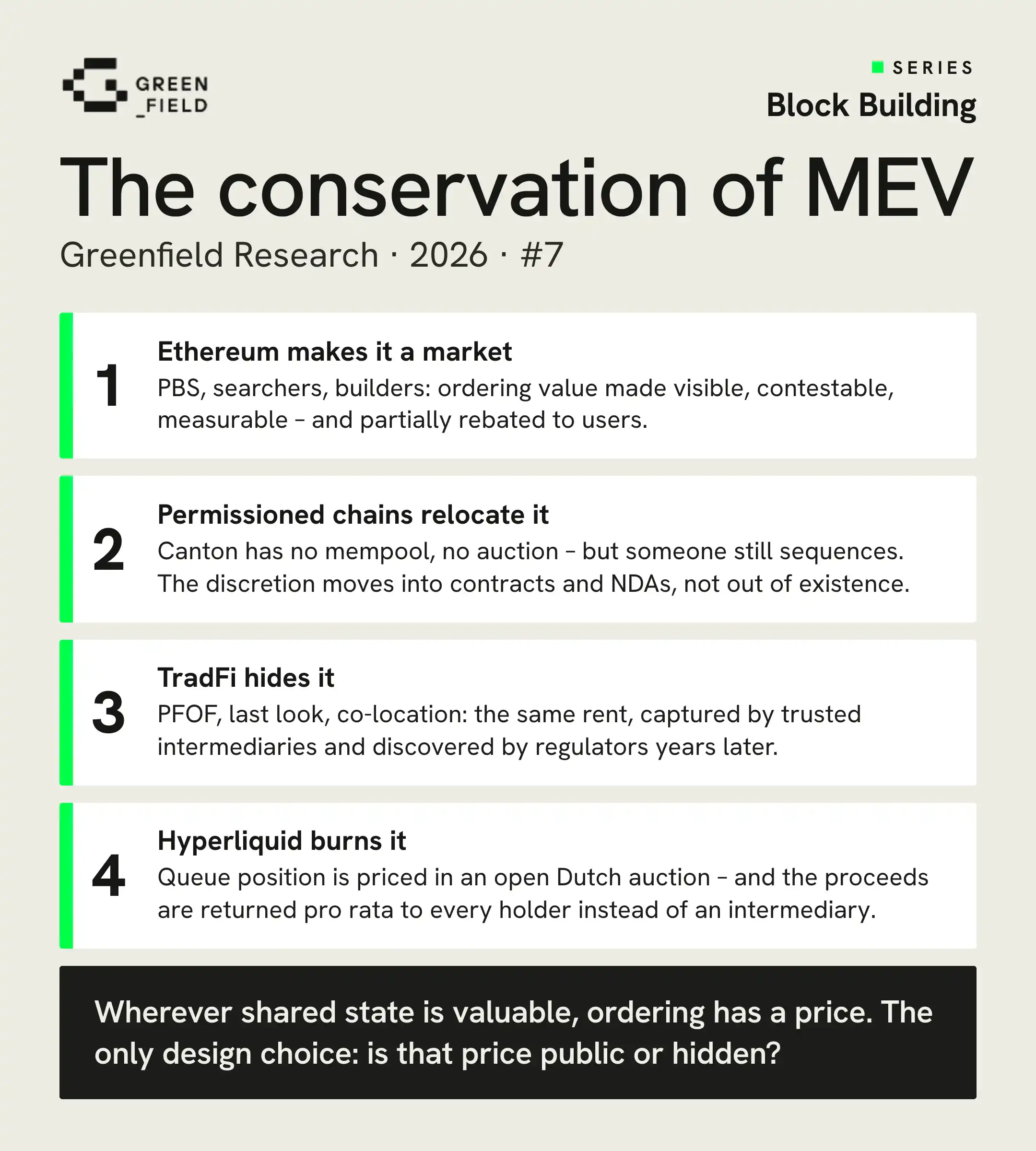
In his framing, the real question is not whether a system has MEV. The real question is who gets pricing power over ordering and whether that price is visible.
Why ordering keeps its value
The piece compares transaction ordering to conservation in physics. Once multiple actors share state and transactions must be applied in sequence, position in that sequence changes outcomes. Two trades hitting the same liquidity pool are not interchangeable if one lands first and gets a better price. A liquidation is usually available to the first caller. An arbitrage window often belongs to the transaction that reaches the state transition ahead of others.
Under that structure, queue position becomes access to an economic opportunity. If access is scarce and valuable, it will not remain unpriced for long.
Samadi says his team has spent the last few years working inside and around the transaction supply chain, from the click in a wallet to final placement in a block, and around the market structure that forms along that path. The article traces how ordering value is conserved across four institutional settings: open markets, private ledgers, regulated intermediaries, and public auctions.
He also notes that the essay extends a broader block-building series that already covered an introduction to blockspace markets and both the demand and supply side of Ethereum block building since 2024.
Ethereum prices ordering in the open
In Samadi’s account, permissionless blockchains make MEV legible because of a small set of foundational choices. Anyone can run a node and verify history. Anyone can submit a transaction. The right to participate in consensus, produce blocks, and extend the chain is open, gained through capital or work rather than granted by a gatekeeper. Most important, every participant replicates the same ledger, and every node re-executes transactions against a single global state.
That shared state is what gives these systems their composability. A lending protocol can read from an oracle it never coordinated with, accept collateral issued by a third party, and be wrapped by an aggregator that nobody had to approve, all inside a single atomic transaction. Samadi says much of what is genuinely new in onchain finance comes from permissionless composability on top of commonly verifiable state.
The same design also creates the less celebrated side effect. If everyone shares one state, transactions must be applied in some order, and because many touch the same state, that order changes results. Ethereum is the clearest example of what happens once that value becomes identifiable.
An industrial transaction supply chain has formed between the user wallet and the final block: searchers, builders, relays, and validators. Searchers scan the public mempool and chain state for extractable opportunities, including cross-pool arbitrage, liquidations, and, at the predatory edge, sandwich trades around visible user orders. Builders assemble candidate blocks and sort transactions and bundles to maximize total block value. Under proposer-builder separation, validators no longer build blocks themselves. They auction block construction through relays to the highest-bidding builder. Upstream from that, order flow itself has become an asset that wallets and apps can sell to whoever gets the right to interact with user transactions.
This setup is often described as parasitic, and Samadi concedes that parts of it may be. His sharper point is that PBS is what a market for a scarce resource looks like after that resource has been openly recognized. Ordering was always valuable. Ethereum’s architecture made that value visible, contestable, and measurable.
In that light, later research agendas such as order flow auctions, MEV rebates, encrypted mempools, and batch auctions are not attempts to deny the phenomenon. They are attempts to govern it by deciding who captures ordering value and how much of it returns to the users who created it.
Canton removes the market, not the discretion
The article then turns to permissioned networks, focusing on Canton. Samadi argues that Canton reverses each of the public-chain design choices above, deliberately and coherently, but what it removes is the open market around ordering, not ordering value itself.
Canton has no global state and no global transparency. It is structured as a network of networks. Each participant runs its own validator and holds only the contracts for which it is a party, with data propagated strictly on a need-to-know basis. That privacy model extends inside single atomic transactions. Counterparties on one branch of a transaction do not see the others. In the example used in the article, a bank handling the bond leg of a delivery-versus-payment settlement would not learn the commission terms in another leg of the same atomic submission. There is no public mempool. Pending transactions are not broadcast; they are delivered only to stakeholders. The sequencing layer is blind, with synchronizer operators ordering cryptographic commitments without seeing transaction contents.
Samadi says Canton’s stance on MEV follows almost mechanically from those design choices and rests on four mechanisms:
- No public mempool to snipe, because pending order flow is never openly broadcast.
- Blind ordering, since operators cannot front-run what they cannot read.
- No ordering market: no searcher or builder auctions, no priority-fee bidding, and no PBS supply chain. Sequencing is treated as a utility function performed by identified institutions under contract and legal liability.
- Ordering rules live at the application layer, so exchange-style fairness rules such as price-time priority can be enforced by smart contract logic rather than by validator behavior.
The adoption figures cited in the piece are large by any standard. Broadridge’s distributed-ledger repo platform settles roughly $8 trillion to $9 trillion in monthly repo volume on Canton infrastructure, or about $354 billion a day. Samadi describes it as the largest tokenized real-world-asset settlement platform currently running. Public tracking data shows roughly $345 billion in represented asset value on the network, and claimed monthly throughput near $9 trillion.
He says those numbers fit the flagship use case. Interbank repo and collateral markets care more about privacy, permissioning, and legally recoverable finality than censorship resistance. Banks are not going to broadcast funding positions into a public mempool, and regulators are not likely to license critical market infrastructure where a software fault could create irreversible loss.
Still, Samadi narrows the issue. Did this architecture eliminate MEV, or did it do something more familiar to it?
His structural observation is simple: someone is still sequencing. On Canton, ordering discretion does not disappear. It moves to synchronizer operators on the public layer and, in private synchronizer deployments, to a single company. He notes that the vast majority of volume today is actually settled in the latter environment.
That means discretion remains, only now it is non-competitive and non-observable, constrained by confidentiality agreements and service terms rather than removed by cryptography. In his view, the strongest claim a permissioned network can make under a headline of “no MEV” is narrower than it sounds: there is no permissionless market for MEV, and there is no public evidence that anyone is extracting it. Those are not the same statement.
The article offers a second explanation for why observed MEV appears close to zero on such networks. It may reflect the use case as much as the architecture. Canton’s flagship workflows today are bilateral repos and pre-arranged delivery-versus-payment settlements. Those workflows contain little contested shared state. When price, size, and counterparties are fixed before a transaction reaches the ledger, there is not much to sandwich or race for. Samadi says the current record is better described as “not yet falsified” than “proven absent.”
The real test would come when the same kind of network carries competitive market structure: a shared central limit order book, a liquidation engine, oracle-triggered margin calls, or a tokenized Treasury market trading at scale. Then ordering at the synchronizer would become economically decisive again, and the actors best positioned to capture it would be those with latency advantages, physical proximity, or stronger relationships with operators. The rent would not disappear. It would migrate into privileged and opaque channels, such as preferred connectivity that never appears on a fee schedule or informational proximity that is never formally disclosed.
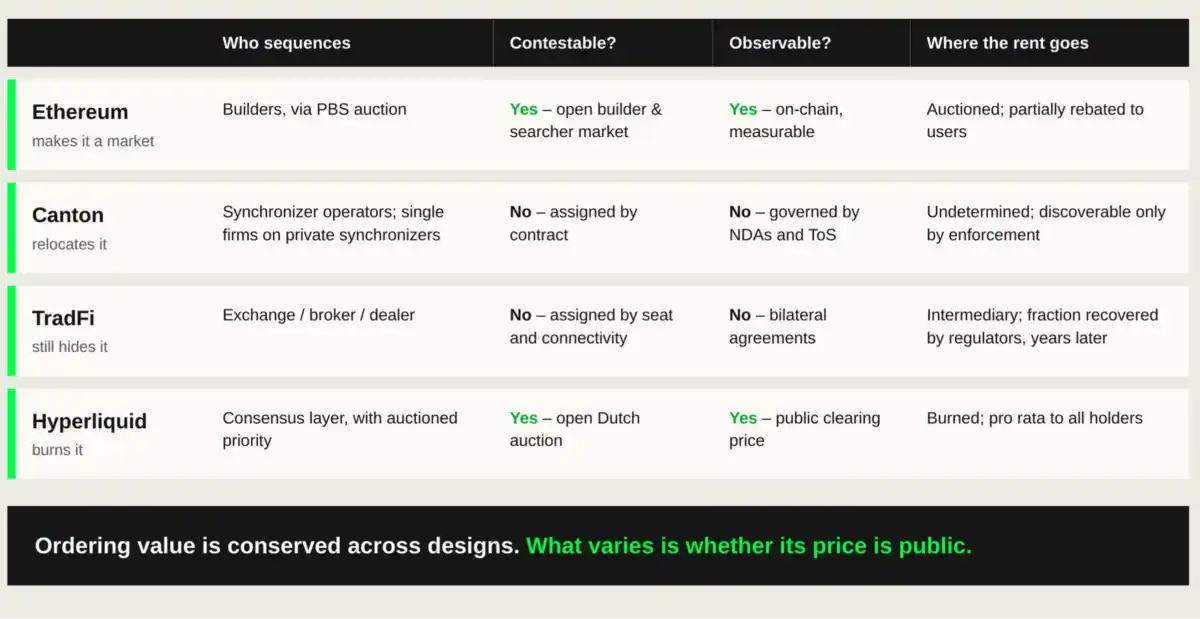
For that reason, Samadi says the architecture reintroduces trusted intermediaries with sequencing discretion at the ledger level and rebuilds the trust model of traditional finance. The next question is whether that trust model has a strong record on this exact issue.
Traditional finance has hidden the same rent for decades
Samadi argues that traditional finance has operated under the “trusted intermediary with ordering discretion” model for decades, and its enforcement history shows that opacity did not stop rent extraction. Opacity is what made the extraction profitable.
He rejects the idea that legacy market structure solved what crypto now calls MEV through proper rules and responsible intermediaries. From his perspective, MEV is a structural property of valuable shared state plus sequential execution, and every venue has both. Traditional finance did not remove the problem. It prohibited parts of it, regulated it imperfectly, and pushed extraction into channels that victims could not observe in real time.
The article lists a series of examples. Payment for order flow turned retail order flow itself into a monetizable asset. In 2021 alone, U.S. brokers collected roughly $3.8 billion in payment for order flow, the value of seeing and internalizing order flow through bilateral arrangements between brokers and wholesalers that were invisible to customers whose orders became the product. Robinhood paid a $65 million SEC settlement in 2020 over misstatements tied to the execution quality associated with that arrangement.
Dark pools were marketed as protection for institutions against predatory order flow, yet the settlements Samadi cites point in the opposite direction. Barclays paid $70 million in 2016, and Credit Suisse paid $84.5 million, over misrepresentations about how their dark pools operated, including cases where high-frequency order flow that customers were told had been excluded was in fact allowed to trade. ITG paid $20.3 million in 2015 for operating an internal desk in its own dark pool that traded using confidential customer order information.
In foreign exchange, Barclays paid $150 million in 2015 over its use of last look, which gave dealers the option to reject trades after seeing how prices were moving, and over coordination around sharing customer order information ahead of benchmark fixes. The article says industrywide fines for this kind of conduct have exceeded $10 billion.
Samadi sees a common pattern in all of those cases. Ordering value was real. Extraction was carried out by trusted intermediaries sitting in the sequence. The affected side could not observe it in real time. The facts surfaced only years later through whistleblowers and enforcement. That, in his description, is what “MEV-free by design” looks like when imported into a ledger context: rent on sequencing is adjudicated by compliance departments and discovered by regulators after the fact, not priced openly by the market.
Hyperliquid puts the rent into a public auction
Samadi presents Hyperliquid as a transparent alternative. It takes the same structural rent, moves it into an open auction, and directs the proceeds into a public pool.
Hyperliquid has long been described as MEV-resistant because it has no public mempool and handles ordering at the consensus layer. On a narrow mempool-extraction standard, Samadi says that description is fair. But execution advantage did not disappear. It rarely does. Priority still accrues to actors that achieve lower latency through engineering. Mature market makers gain queue position through infrastructure optimization and network proximity, something he says is functionally equivalent to colocation. That advantage has existed for a long time, carries material economic value, and remains accessible only to firms with the capital and access needed to build it. Rent was already being captured. It just was not visible on a dashboard.
In April this year, Hyperliquid formalized that dynamic by introducing priority fees. The mechanism, as described in the article, is a repeated public Dutch auction denominated in HYPE. What it auctions is exactly what low-latency traders had previously been buying indirectly through engineering: earlier access to incoming transaction data and earlier placement in the execution queue.
The effect can be measured with unusual precision. For each basis point paid in priority fees, end-to-end latency improves by about 45 milliseconds. What used to be a private and implicit advantage constrained by engineering capacity becomes an explicit, public, continuously repriced market open to all participants.
Samadi separates two features of this design. The first is that it formalizes a paid priority tier, which can itself be criticized. A visible queue-position tax now exists where there was not one before. But, he argues, the right comparison is not a market without priority. It is the same priority layer when it was allocated invisibly through capital expenditure and connectivity while appearing to cost nothing.
A public and priced advantage is more honest, in his view, than an implicit and free one. A visible market can be measured, debated, capped, and redesigned. An invisible market gets discovered only after the fact.
The second feature is where the proceeds go, and Samadi treats that as the genuinely novel market-structure element. The fees are burned. The clearing price for execution priority does not go to the venue operator, is not shared with favored counterparties, and is not buried in a bilateral agreement. It is removed from supply, which he says is economically equivalent to distributing it pro rata to all holders of the network asset HYPE.
He contrasts that with the way equivalent value flows in legacy markets. Colocation fees accrue to exchange shareholders. Payment for order flow is split between wholesalers and brokers under contracts that end clients never see. Information rents in dark pools and last look accrue to those holding privileged seats until enforcement claws back part of the gain. Hyperliquid, by contrast, places the same structural rent, the value of position in the sequence, in public view, lets a permissionless auction discover its price, and routes the proceeds to a public pool.
The queue still exists. What changes is that its price becomes public, and its economic benefit is shared with every holder instead of being settled inside closed bilateral structures.
Samadi does not claim this design removes ordering value. He says it accepts that the value cannot be removed and chooses to price and redistribute it in the open.
The line that matters is whether the price is public
The article closes with a broad comparison across architectures. The meaningful distinction is not “MEV” versus “no MEV.” Any venue that orders valuable state transitions will generate ordering value as a matter of structure.
The sharper questions are these: Who holds sequencing power? Is that power competitive or assigned? Is it observable or hidden? Are the rents priced and redistributed in the open, or quietly captured by the parties closest to the sequencer?
Permissioned networks answer those questions through governance: named operators, legal accountability, and institutional guarantees. For pre-arranged settlement workflows, where ordering often carries little value from the start, Samadi says that answer may be sufficient, and current adoption reflects that.
For competitive markets, he says the evidence from crypto’s short history and traditional finance’s much longer history points the same way. When ordering value is denied, it tends to be captured in the dark. When it is acknowledged, it can be priced, audited, and returned to the market that created it. In that sense, MEV is conserved across designs. The difference is whether its price is public.