
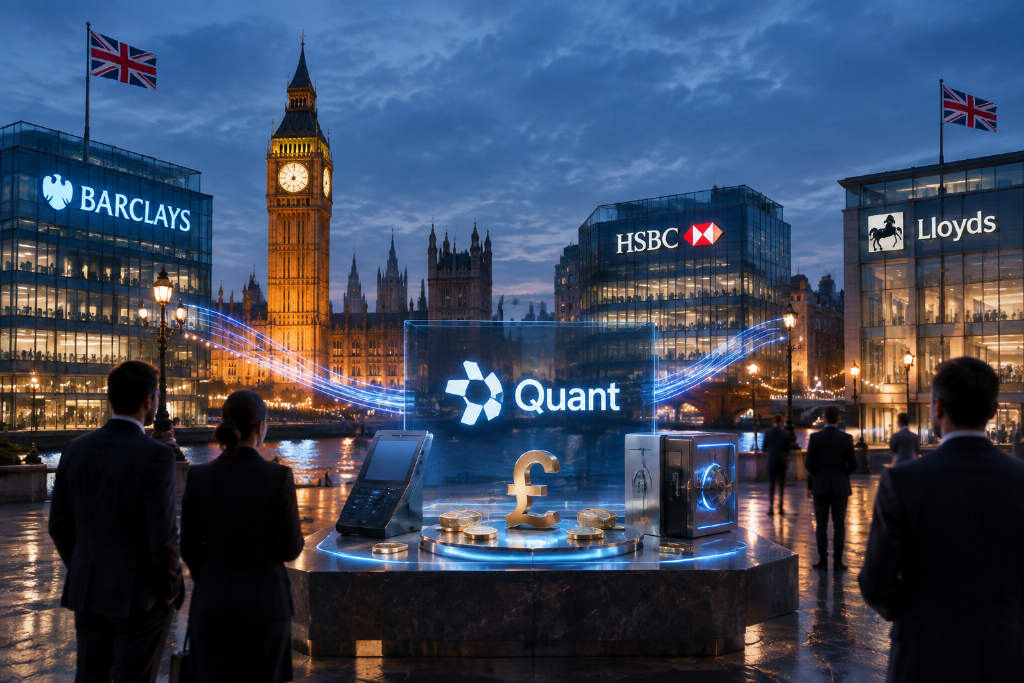
Quant’s QNT has risen about 300% over the past week, moving above $270, while 24-hour trading volume topped $600 million. The main trigger, according to the source article, was The Clearing House’s Sept. 24 decision to select Quant as the technology provider for its On-Chain Money Initiative.
Two days later, on Sept. 26, seven major U.K. banks completed what the report described as the first real-customer payment transactions using tokenized pound deposits through Quant’s platform. The banks named in the article included Barclays, HSBC and Lloyds.
The report said TCH clears and settles more than $2 trillion each day and operates core U.S. banking payment rails including RTP and CHIPS. It also said 25 major U.S. banks are participating in the initiative, with launch expected in the first half of 2027.
The immediate catalyst behind QNT’s rally
Quant founder Gilbert Verdian described the partnership as 「the defining step in the global transition to programmable money」. That pushed attention toward what Quant is actually supplying to banks and why the announcement mattered for the token.
Quant is not a blockchain operator
The article’s central point is that Quant does not run its own blockchain. Its main product, Overledger, is an interoperability layer that lets different blockchains and legacy systems communicate and transact with each other.
In the tokenized deposit setup described by the report, Quant acts as an orchestration layer. It coordinates how tokenized deposits move through clearing and settlement across different bank systems while staying compatible with existing payment infrastructure such as RTP and CHIPS.
Why that role matters for banks
The business value, as framed by the article, is that banks do not need to migrate onto a single chain. Each institution can keep its own technology stack, while Quant sits in the middle to translate and coordinate. The article argues that this is the core reason TCH chose Quant, because a network involving 25 banks is unlikely to require every participant to use the same underlying blockchain.
The U.K. deployment has already moved beyond proof of concept, the report said. The Sept. 26 transactions included a real mortgage refinancing scenario in which funds were released automatically after confirmation of the property title transfer. The article treated that as a shift from testnet-style demonstrations to actual customer funds in production.
Tokenized deposits are different from stablecoins
Before turning to other assets, the report drew a sharp line between tokenized deposits and stablecoins.
USDC and USDT, it said, are stablecoins issued by non-bank institutions and backed by reserve assets such as Treasuries and cash. Holders have a redemption claim on the issuer, but the tokens themselves are not bank deposits and are not covered by deposit insurance.
Tokenized deposits, by contrast, are bank liabilities issued by regulated commercial banks. They remain on bank balance sheets and are protected by deposit insurance. Putting deposits onchain changes the recording and transfer mechanism through blockchain technology, but does not change the legal nature of the asset: it is still a bank deposit.
The article said that structure is more attractive to banks because it avoids deposit disintermediation. Funds stay inside the banking system, with settlement taking a different form. That, in its view, explains why TCH, as a bank-owned institution, is advancing tokenized deposits rather than embracing stablecoins.
Canton and CC as the closest comparable trade
Beyond QNT, the report pointed to several assets with direct or indirect exposure to tokenized bank deposit infrastructure. The closest comparison was CC, tied to Canton Network.
Canton, built by Digital Asset, was described as a privacy-focused institutional blockchain. The article listed participants including DTCC, Goldman Sachs, BNY Mellon, Tradeweb, Deutsche Börse, HSBC, Broadridge, BNP Paribas and Visa.
It also said JPMorgan’s JPMD tokenized deposit is already running on Canton and identified January 2026 as the launch date. DTCC plans to carry out U.S. Treasury tokenization on Canton, while Deutsche Börse’s digital securities settlement platform is also built on the network.
The report framed the distinction between Quant and Canton in simple terms. Quant provides interoperability between different systems. Canton offers a unified institutional transaction network. One is a translator, the other is a platform.
CC’s fully diluted valuation is about $5.5 billion, with a ranking of around 24, according to the article. Its fee model uses token burning: transaction fees are priced in dollars, paid in CC and burned after payment. At the same time, the report noted that CC has no maximum supply cap, with ongoing issuance distributed through rewards for validators and application developers. Whether burn outpaces issuance depends on actual network usage.
CANTO as a smaller-cap, higher-risk RWA narrative
The article also mentioned smaller-cap assets. Canto, an EVM-compatible Layer 1 in the Cosmos ecosystem, positions itself around 「NeoFinance」 and decentralized financial public infrastructure. Its design includes a zero-fee DEX, a lending market forked from Compound v2 and the NOTE stablecoin.
According to the report, Canto has brought RWA tokenization onchain through Fortunafi and Hashnote, channeling U.S. Treasury yield into crypto rails. But unlike Quant and Canton, which are aimed at banking infrastructure, Canto was presented as an RWA access layer for DeFi-native users rather than interbank settlement infrastructure.
The article described CANTO as a much smaller asset with market capitalization in the tens of millions of dollars, limited liquidity and very high volatility. On that basis, it placed CANTO in a different risk bucket from QNT and CC, calling it a high-beta small-cap expression of the RWA theme.
LINK as an indirect infrastructure beneficiary
On the infrastructure side, the report said Chainlink provides Data Streams, Proof of Reserve, NAVLink and CCIP for Canton. Chainlink Labs has also become a super validator for the Canton Global Synchronizer.
It added that Chainlink was a core technology provider in Swift’s tokenized asset settlement pilot. LINK, in this framing, is not a pure tokenized-deposit trade. Still, each step that brings banking infrastructure onchain increases demand for oracles and cross-chain messaging, making LINK an indirect beneficiary of the trend.
XRP and XLM face narrative pressure, not direct replacement
The article grouped Ripple’s XRP and Stellar’s XLM into a separate category. Both have long been tied to the cross-border payments and settlement narrative, but the report argued that their positioning differs from tokenized deposit infrastructure.
XRP and XLM were described as closer to an effort to replace SWIFT-style payment networks. Quant and Canton, by contrast, were framed as technologies that add blockchain settlement on top of existing banking systems. In the article’s shorthand, the first approach is about replacement, while the second is about upgrade.
The report concluded that recent developments, including what it called the SEC’s 「innovation exemption」 for tokenized stocks and TCH’s choice of Quant, point to a clearer path favored by banks: using blockchain to upgrade banking infrastructure rather than replacing banks with crypto networks. On that reading, the setup is more supportive for Quant and Canton, while creating a form of narrative pressure for XRP and XLM.