
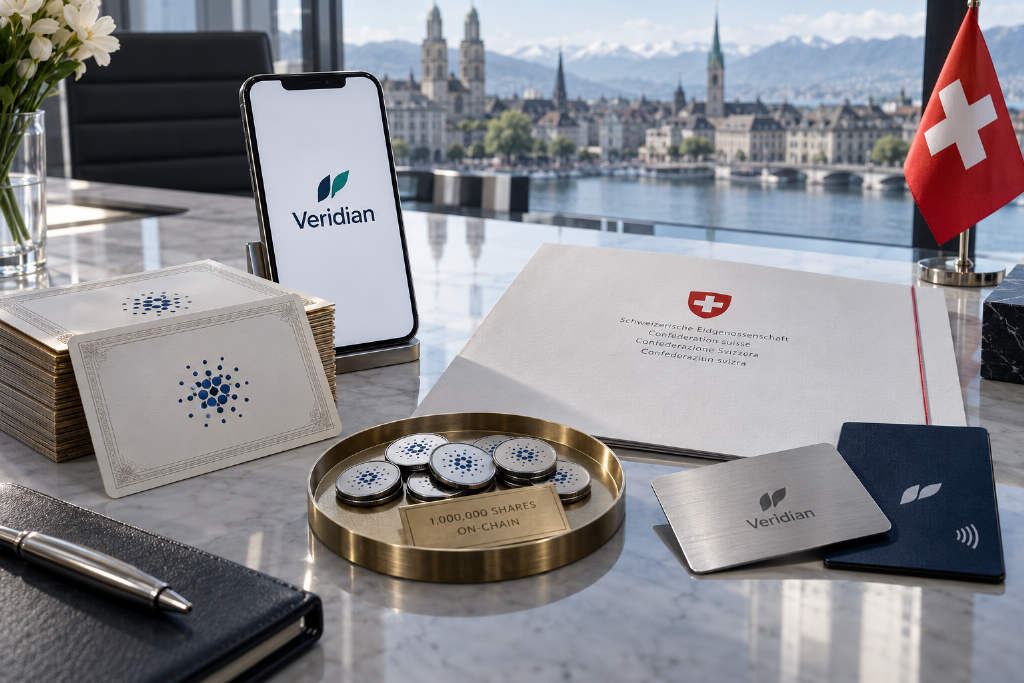
The Cardano Foundation has spun out its digital identity project, Veridian, as an independent Swiss company and tokenized most of its shares on the Cardano blockchain. CoinDesk reported that Veridian is the first company to use Cardano’s new programmable-token standard, CIP-0113, for equity, although the tokenized shares are not being offered to the public.
Veridian is based in Switzerland and will operate as a standalone company. It is building tools for governments, businesses and AI agents to prove identity and define what they are authorized to do online. The company is led by Thomas A. Mayfield, a blockchain engineer who previously led decentralized trust and identity solutions at the Cardano Foundation.
The foundation said Thursday that Veridian plans to seek strategic investors in 2027. In an emailed statement to CoinDesk, Cardano Foundation CEO and Veridian chair Frederik Gregaard said, 「Veridian is the first to tokenize its own shares on the new CIP-0113 that we announced yesterday.」
He said the company has 1 million shares in total and that most of them have been tokenized. 「People have talked about tokenized equity for years, and now there’s an operating company on Cardano doing it.」
CIP-0113 gets its first live equity use case
The transaction gives Cardano its first live example of the programmable-token framework introduced on Tuesday. CIP-0113, short for Cardano Improvement Proposal 0113, lets an issuer attach rules to a token, including who may receive it and, where required, whether it can be frozen, seized or transferred.
Those features are aimed at regulated products such as stablecoins, funds and tokenized securities, where issuers may need to enforce identity checks, sanctions controls or court orders when assets change hands. Veridian’s shares give the standard an equity application rather than a purely theoretical one.
Identity wallet already live
Veridian uses the open technical standards KERI and ACDC to issue digital credentials. The goal is to let people, companies and software agents prove identity or authority without storing that information in a central database.
The Cardano Foundation said Veridian’s mobile wallet is live on iOS and Android. It also said the company has mapped Utah’s digital identity requirements. Utah’s SB 275 took effect in May and created the state’s State Endorsed Digital Identity Program.
Why the foundation separated Veridian
Gregaard said the Utah framework, along with rising demand to verify AI agents acting on behalf of people or companies, created the rationale for separating Veridian from the nonprofit foundation.
Masumi, an AI-agent payment and identity network built on Cardano by Serviceplan Group and NMKR, already uses Veridian. The companies said it allows a counterparty to verify an agent’s credentials before making a payment and revoke them if the agent is compromised.
「AI agents will need verifiable identity too,」 he said. 「Veridian can serve that market better as its own company.」