
Castle Labs Research says the real contest in tokenized real-world assets has moved beyond raw issuance numbers and total value figures. In its latest report, the firm argues that tokenization alone no longer creates much differentiation. The harder question is what happens after an asset comes onchain: can it become productive capital rather than just another wrapped representation of a traditional financial product.
The report, translated by TechFlow, uses Mantle as its main example and frames the next stage of RWA development around one idea: utility.
RWA supply is growing, but utility is the real constraint
Castle says nearly every protocol and ecosystem is now pushing into RWA, launching new assets and pointing to market size or listing counts. On their own, those numbers say little. If nobody uses the assets, the result is fragmented liquidity rather than new value.
That is why the report argues RWA needs to do more than mirror traditional finance. To see broader adoption, tokenized assets have to offer something extra on top of the offchain instrument they represent. The next competitive phase, in Castle’s view, will be decided by utility rather than inventory.
The report notes that Kraken, Robinhood, Crypto.com, xStocks, Backed, Securitize, Ondo, Franklin Templeton, BlackRock and a wider list of exchanges, custodians and tokenization platforms are already rolling out their own routes to tokenized asset access. Listing the asset is now the easy part. The real issue is whether that asset can work as efficient capital once it reaches the chain.
Accessibility and composability sit at the center of Castle’s framework
The report organizes the discussion around two dimensions: accessibility and composability.
On accessibility, Castle says access to capital has never been evenly distributed. Geography, regulation, brokerage relationships and minimum investment thresholds have historically mattered more than information or research quality. Digital assets have already changed part of that equation, and the report points to stablecoins as the clearest example. In high-inflation regions, many people now prefer to store savings in stablecoins instead of weaker local currencies.
Castle says tokenization aims to do something similar for traditional financial instruments. US Treasuries, stocks, ETFs and pre-IPO allocations are being redesigned as digital tools that can exist onchain and reach a broader global user base. The report also notes that Nasdaq is moving toward 24/7 trading.
In Castle’s telling, the first phase of the RWA wave focused on building the initial infrastructure under increasingly supportive regulatory processes. Stablecoin frameworks, market structure proposals, Europe’s MiCA regime and tokenization pilots from large financial institutions helped move the sector closer to the mainstream.
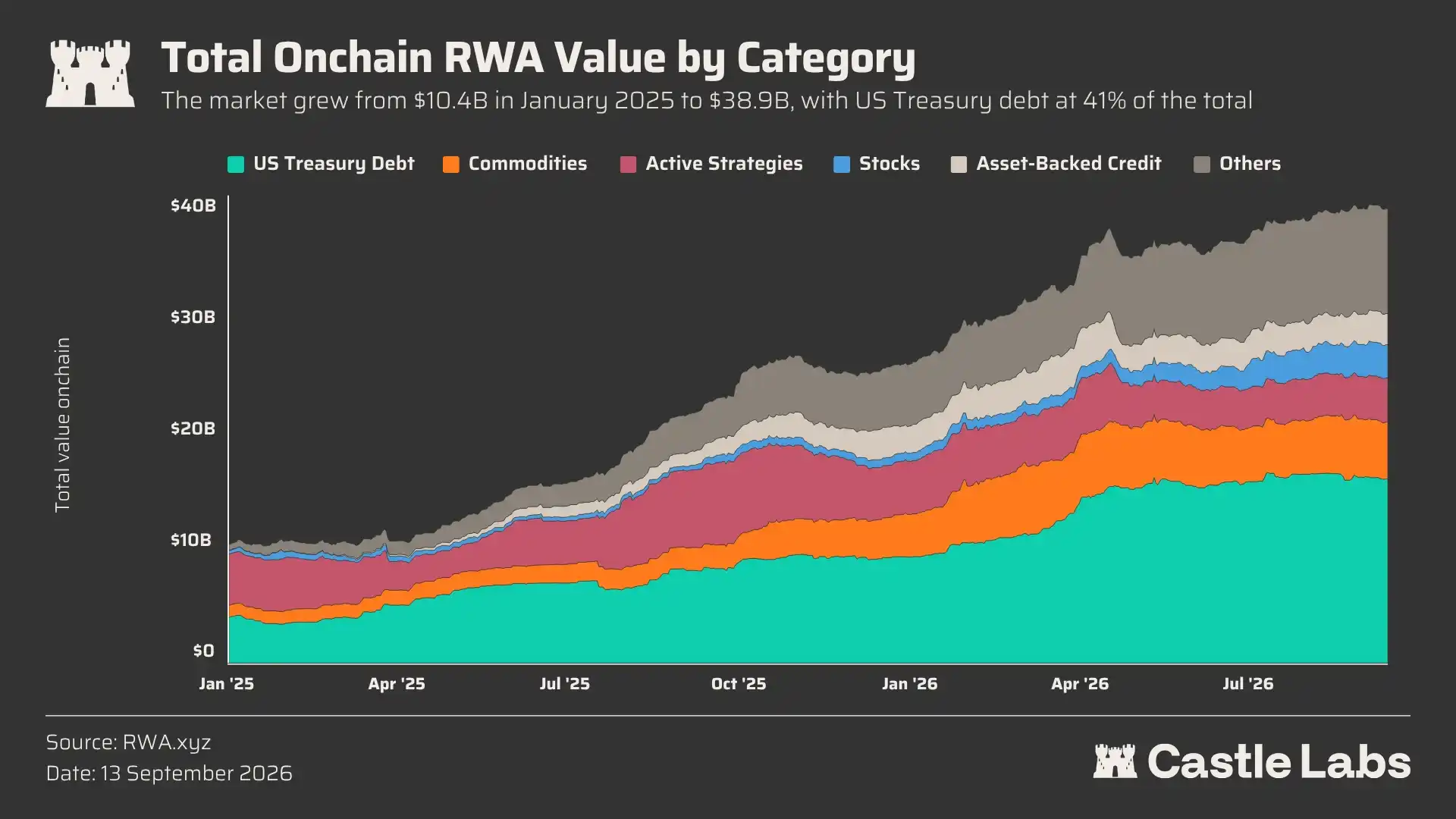
That buildout pushed the onchain tokenized asset market past $38 billion, according to the report. US Treasuries account for more than $15.9 billion. Other categories include commodities at $4.9 billion, active strategies at $3.6 billion, asset-backed credit at $2.56 billion and equities at $2.52 billion.
Castle’s conclusion is that accessibility has improved in a visible way. Users can now reach a wide set of asset classes across multiple networks. From here, the emphasis shifts less toward adding even more listings, though long-tail assets are still expected to grow, and more toward the second promise of RWA: capital efficiency and composability.
24/7 trading will not be unique for long
As access broadens, Castle says a new question comes into focus for both institutions and retail users: how can these assets be used more deeply inside existing onchain ecosystems to generate additional value.
The report says 24/7 trading will soon stop being a crypto-only selling point because that feature is also becoming part of traditional equity market structure. RWA, as a result, has to evolve from a simple digital representation of a traditional asset into something capital-efficient and programmable.
Castle argues that tokenization has already improved access to traditional financial instruments, but those instruments still need to be embedded in the wider onchain stack to become more useful. The report ties that need to several developments it lists together: the move toward 24/7 trading, the growing role of Tradexyz as an RWA venue, rising institutional participation and expectations of greater regulatory clarity.
For tokenized assets to become productive, Castle says they need deep liquidity, the ability to serve as collateral, the ability to combine across venues and open access. Without that, they do little more than increase fragmentation.
Mantle as a case study in staged RWA buildout
Castle uses Mantle to show how a network can approach both accessibility and composability at the same time.
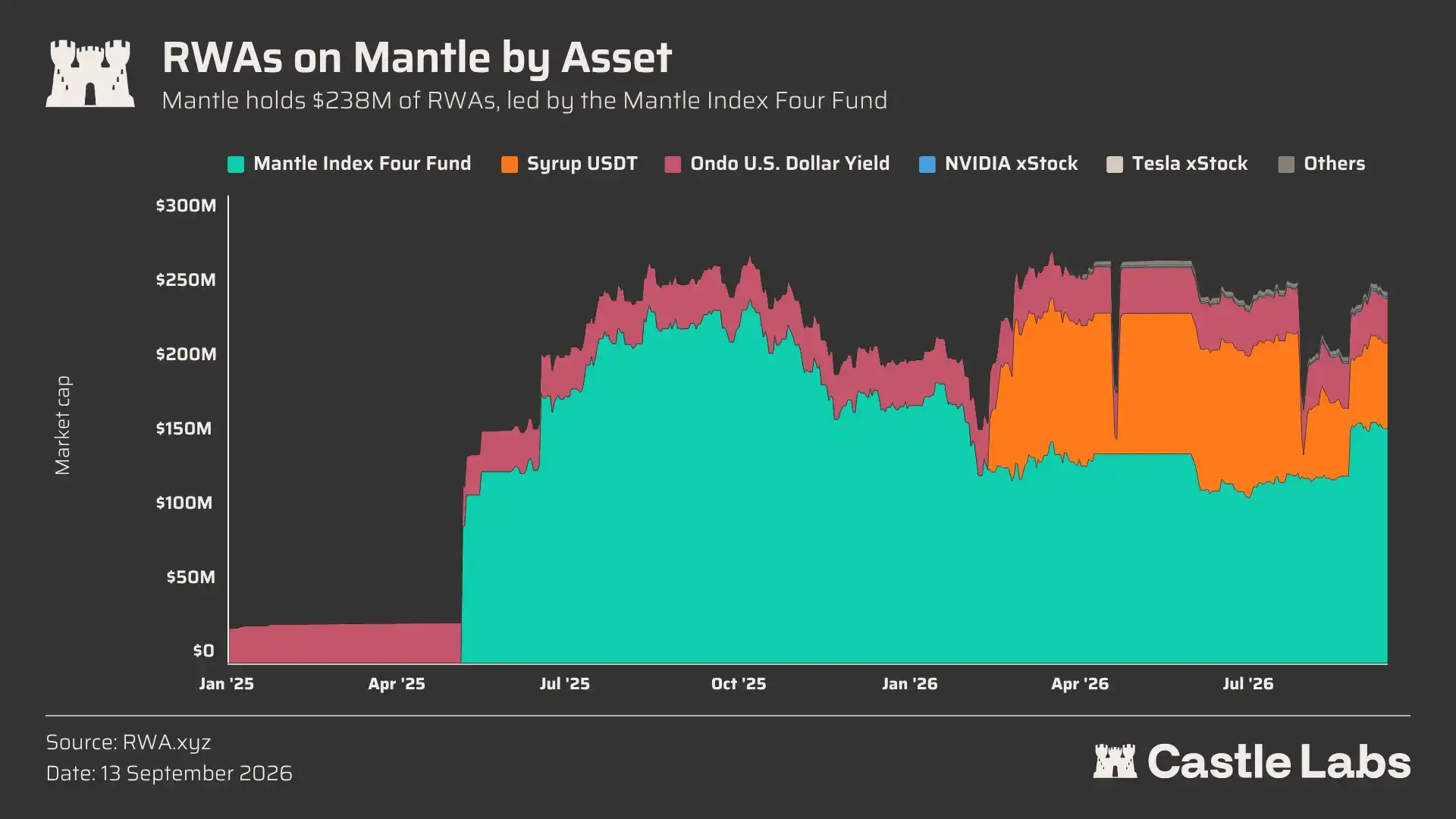
According to the report, Mantle’s ecosystem currently hosts more than $225 million in RWA assets. More than 60% of that value sits in Mantle Index Four Fund, an active RWA strategy fund. Another 21% is represented by syrupUSDT, tied to credit or yield exposure in Maple markets. Ondo USDY accounts for 15%, giving users tokenized US Treasury and dollar yield exposure. xStocks make up 2%, representing tokenized stock and ETF exposure.
Castle says Mantle’s roadmap mirrors the transition now underway in the sector.
It starts with infrastructure: fiat on- and off-ramps, vendor integrations, tokenization-as-a-service platforms and decentralized exchanges. That base is needed before the ecosystem can scale.
Next comes a phased rollout of key assets so liquidity can be directed carefully. Once the foundation is solid, the network can focus on listing a broader set of assets and giving users more choice.
After quantity stops being the main issue, the priority shifts to quality: execution, practical usefulness and composability. In the report, that means deeper onchain and offchain liquidity, stronger integrations and the ability to move, trade and borrow against these assets.
Only after those parts are in place does user acquisition and distribution become a bigger priority. Castle adds that these stages are not fully separate. User acquisition runs through the whole process, but there is still a better and worse time to push it. Pulling users into an empty ecosystem with rich incentives can produce farming activity without real conversion.
xStocks on Mantle: controlled rollout, then execution support
The report uses Mantle’s xStocks launch to show how this staged model works in practice.
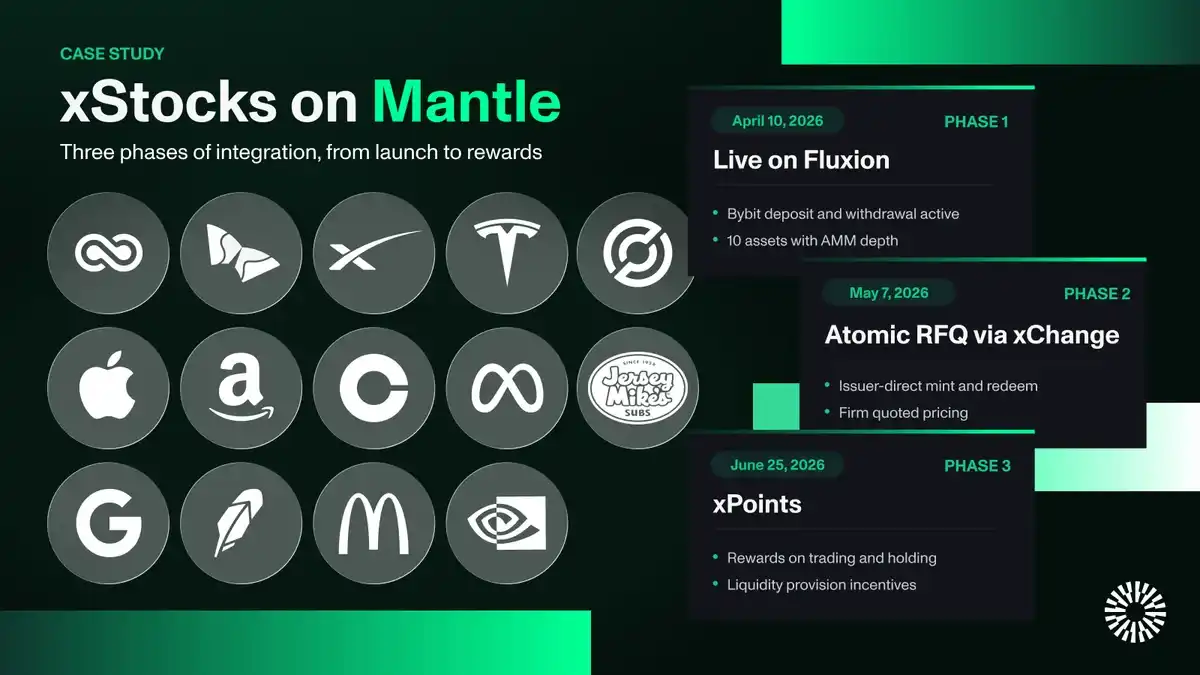
Mantle first listed only 10 assets on its native DEX, Fluxion. Castle says that gradual release helped automated market makers maintain reasonable depth.
That onchain liquidity was then supplemented by xChange, xStocks’ own platform, through an atomic RFQ system. Castle says this mattered because price execution is one of the first things investors from traditional finance and institutional circles compare when they assess an RWA product.
The report is blunt on this point: if RWA wants to compete with traditional financial equivalents, execution quality has to be comparable. If the core trading experience falls short, the rest of the value proposition becomes secondary.
Castle also notes that the final piece of Mantle’s xStock activity went live at the end of July through an xPoints-driven incentive campaign aimed at adoption.
User acquisition and Mantle’s distribution link with Bybit
Castle says unrestricted onchain access to a broad set of assets offers a clear advantage over traditional finance. To improve access and distribution, Mantle has worked closely with Bybit to put its products in front of the exchange’s user base.
Still, the report says that once Nasdaq moves into 24/7 trading, the field of competition shifts from access alone toward settlement, liquidity and composability.
Before going deeper into Mantle, Castle breaks RWA users into several segments.
- Crypto-native users who have never traded traditional financial assets: tokenization brings stocks, funds and money-market products onchain and opens access to instruments that were previously limited to traditional finance institutions.
- Traditional retail users: these users can do more with the same assets they already trade in conventional markets.
- Traditional institutional users: they are looking for regulated and compliant setups that improve capital efficiency for onchain trading of traditional assets.
The report says the exact mix will vary from one ecosystem to another, but the segmentation is useful because every platform is competing for the same pool of users. That makes differentiation critical.
Asset types also bring different holder profiles. Mantle Index Four Fund holds most of Mantle’s onchain RWA value, but because of its institutional character it has only six holders, according to the report.
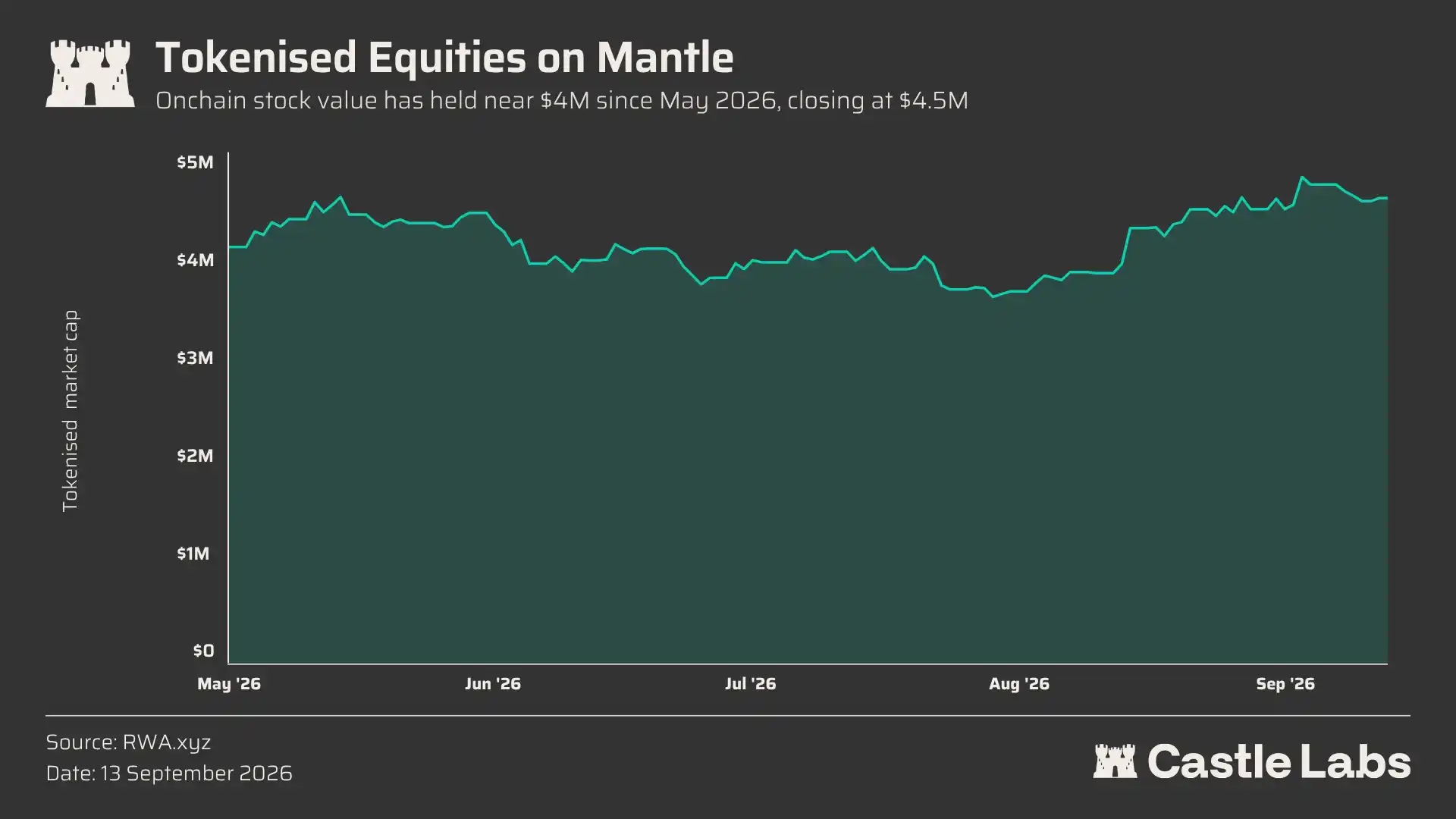
xStocks, by contrast, has shown stronger retail growth and has climbed to more than $4.4 million since launching in March. Castle says retail acquisition, especially around equities, has been a major focus over the past few months.
The most widely held onchain assets at the moment are Tesla xStock, CRCL xStock, NVIDIA xStock and Alphabet xStock.
Bybit’s reach and Mantle’s concentration in yield-bearing assets
Castle says Mantle also benefits from its relationship with Bybit, a larger centralized exchange. Through that link, Mantle assets have access to a distribution network that reaches more than 40 million users.
That relationship has grown tighter as Mantle’s RWA strategy expands. The report says Bybit recently extended its Dual Asset product to support 10 tokenized stocks from xStocks, including TSLAx, METAx, CRCLx and HOODx. Dual Asset is described as a structured product that lets users buy or sell crypto at a target price while earning yield.
Castle uses that example to highlight Mantle’s emphasis on practical use. It says 96% of the value in Mantle’s RWA stack is concentrated in yield-bearing assets, with more than half in active strategies, 25% in asset-backed credit and 14% in US Treasuries.
The report treats that as a clear point of differentiation for Mantle: a network where tokenized equities can move between CEX liquidity, onchain venues and DeFi.
A tokenized stock trapped inside a single application offers product access and little more, Castle says. If that same asset can enter DeFi or a CEX to support lending or generate yield, it starts to function as efficient capital.
Stocks are only one piece of the picture
Castle says equities are just one part of Mantle’s broader RWA mix. Listing recognizable names is an easy way to keep users engaged. The report cites SKHYX in July and the more recent listing of Jersey Mike stock after its IPO. It describes the addition of a mid-cap consumer name as a useful test of whether real onchain demand exists for those assets.
There are other asset types as well. Castle says more than 49% of the first-day deposits into Openstock’s pre-IPO vault came from Mantle. It also says Fluxion has just added support for RWAlpha yield strategies, becoming the first venue on Mantle where users can access yield products tied to tokenized equities.
Mantle also recently joined the Global Dollar Network, or GDN. The report describes it as a Paxos-led initiative built around USDG, a regulated stablecoin that is now live on Mantle alongside AUSD, USDe, USDY and USDT0.
By combining native onchain users with external distribution channels, Castle says Mantle can address both audiences at once: CEX users on one side and users looking for integrated yield products on the other. The xStocks connection with Dual Asset is offered as an example.
How Castle says RWA ecosystems should be judged
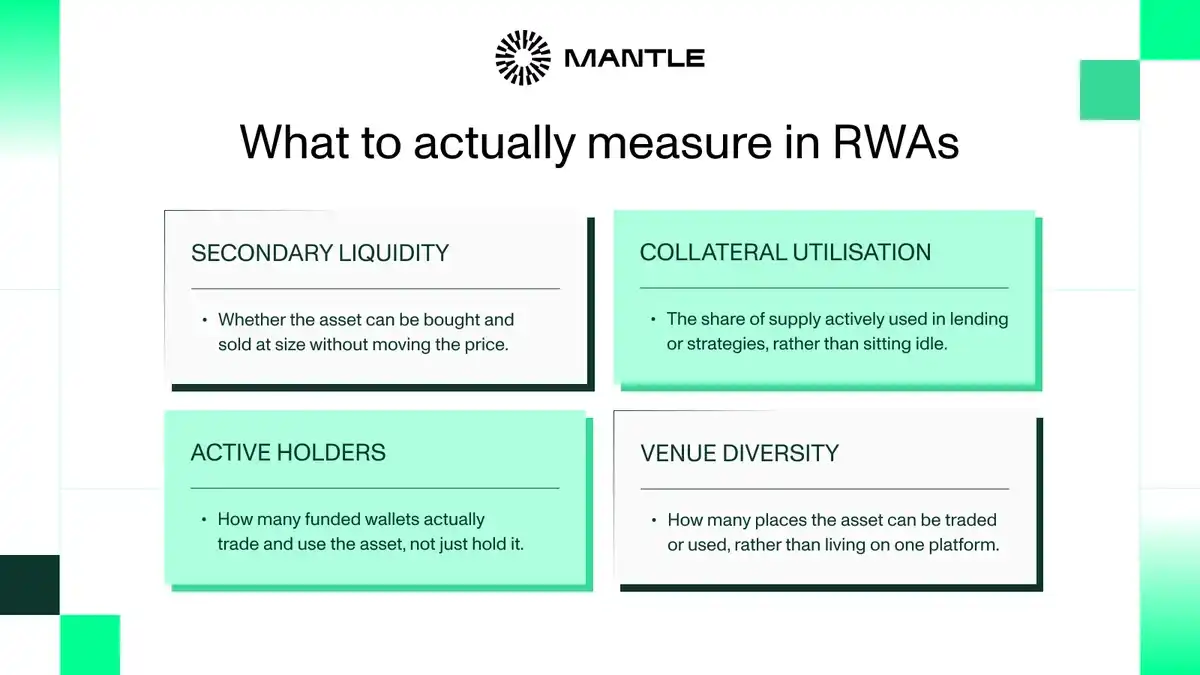
Near the end of the report, Castle narrows the discussion to a more practical scorecard. Early tokenization rewarded the ability to bring assets onchain, it says. The next phase will reward the ability to make those assets useful.
In Castle’s framework, a useful RWA ecosystem creates two kinds of benefit.
First, it can bring liquidity onto the chain from outside the ecosystem. Tokenized equities, money-market funds, credit products and active strategies can pull in capital from users seeking traditional finance exposure, institutions looking for crypto-native distribution or asset managers that want faster settlement and broader reach.
Second, productive RWA can create stickier liquidity. A user who arrives only to buy a tokenized stock may leave after the trade. A user whose tokenized asset can be deployed into strategies, used in DeFi, pledged as collateral or paired with stablecoins has more reasons to stay. The more uses capital has, the more durable it becomes.
Castle then lays out several questions it sees as more meaningful than headline issuance totals:
- Can users move assets between exchanges, wallets and DeFi venues?
- Is there real secondary-market liquidity, or only theoretical tradability?
- Can the asset serve as collateral under conservative risk parameters?
- Are there active strategies built around these assets?
- Are oracle design, custody and legal packaging clear enough for institutions?
The report reduces the user-side requirements to four elements: access, movement, liquidity and use.
Access means users can reach assets that were previously hard to buy, including US stocks, ETFs, money-market funds, Treasury-backed products, pre-IPO allocations or offchain strategies.
Movement means the asset can leave the application where it was first bought. If an instrument technically sits onchain but cannot move freely into wallets, DeFi venues or other platforms, it looks more like a traditional account balance than a user-owned asset.
Liquidity means users can enter and exit with acceptable depth and spreads. Without that, access is weak and does not compare well with traditional execution.
Use means the asset can be placed into strategies, paired with other assets, used to earn yield or posted as collateral.
Institutions care less about access and more about distribution, settlement and integration
Castle separates the institutional perspective from the retail one. Institutions can already access many of these assets, the report says. Their real questions are about distribution, settlement, liquidity, reporting, custody, compliance and how tokenized assets connect with crypto-native demand.
That means the institutional value proposition is not simply cheaper access. It is faster distribution into markets that already understand these products, combined with links between issuance, liquidity, custody, cross-chain movement and DeFi usage.
Castle ends with a broader claim about where the market is heading. The future of RWA is no longer about listing assets for the sake of listing them. It is about turning those assets into productive instruments that can move, settle, trade, serve as collateral and integrate with the rest of onchain finance.