

RoboParty, a full-stack open-source bipedal humanoid robotics startup, has completed consecutive angel++ and Pre-A financing rounds totaling nearly 500 million yuan. The Pre-A round was solely funded by Contemporary Amperex Technology Co. Limited, or CATL.
The deal stands out because CATL invested through its group strategic investment entity, a structure the report described as relatively uncommon for the company. RoboParty was founded by Huang Yi, a 22-year-old entrepreneur born in 2004. While studying at Harbin Institute of Technology, Huang built a bipedal humanoid robot called AlexBot in his freshman year and open-sourced the full stack. The robot was later replicated and used by more than 10 companies and universities, according to the report.
From Harbin to Shanghai
Huang said one of the happiest moments in entrepreneurship came from tinkering alone and getting a drone to fly. He entered the Future Technology College at Harbin Institute of Technology in 2022. In his freshman year, he won an award in a national university technology competition with an amphibious drone project for land and air use. He then built AlexBot with a roommate within several dozen days and released it as open source, gaining early recognition while still a student.
The team first worked out of an 80-square-meter office in Harbin with only about 10 members. In February 2025, Huang graduated one year early and started RoboParty in Shanghai with several classmates from Harbin Institute of Technology, focusing on research and development for full-stack open-source bipedal humanoid robots.
The company later drew technical talent from Harbin Institute of Technology, Tsinghua University’s Yao Class, Peking University’s elite computing program, Zhejiang University, Carnegie Mellon University and Stanford University. The report said the team is heavily made up of people born in the 2000s, with interns also involved.
Open-source hardware and software stack
Huang observed that embodied-model companies often lack robot bodies, while existing body makers mostly run closed systems that do not fit the needs of different model developers. RoboParty’s answer is an open-source full-stack embodied platform. The company publishes everything from the robot body to modules and says it combines complete-machine R&D, vertical integration, mass-production capability, foundation-model capability and an open ecosystem.
In January this year, RoboParty launched RPO, a full-stack open-source bipedal humanoid robot project presented as an entry-level open-source platform for global developers building from zero to one. The report said RPO has drawn nearly 10,000 followers across the global developer community, more than 2,000 stars on GitHub and close to 1,000 orders from developers, universities, research institutions and model teams worldwide.

RoboParty said RP1 will go online in the fourth quarter this year, targeting higher performance, stronger reliability and continued development and deployment in more complex real-world scenarios.
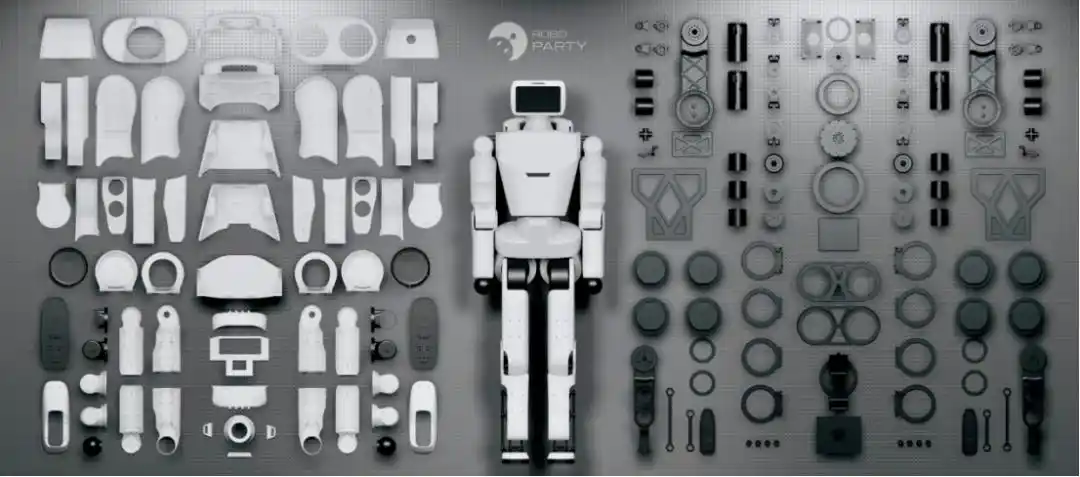
Its robots are designed to be disassembled, assembled again and modified, making them a practical starting point for developers. The company’s customers also include robotics model companies that need real hardware for demos and industrial users that need co-design across body architecture and software-hardware systems.
Party OS and core open-source tools
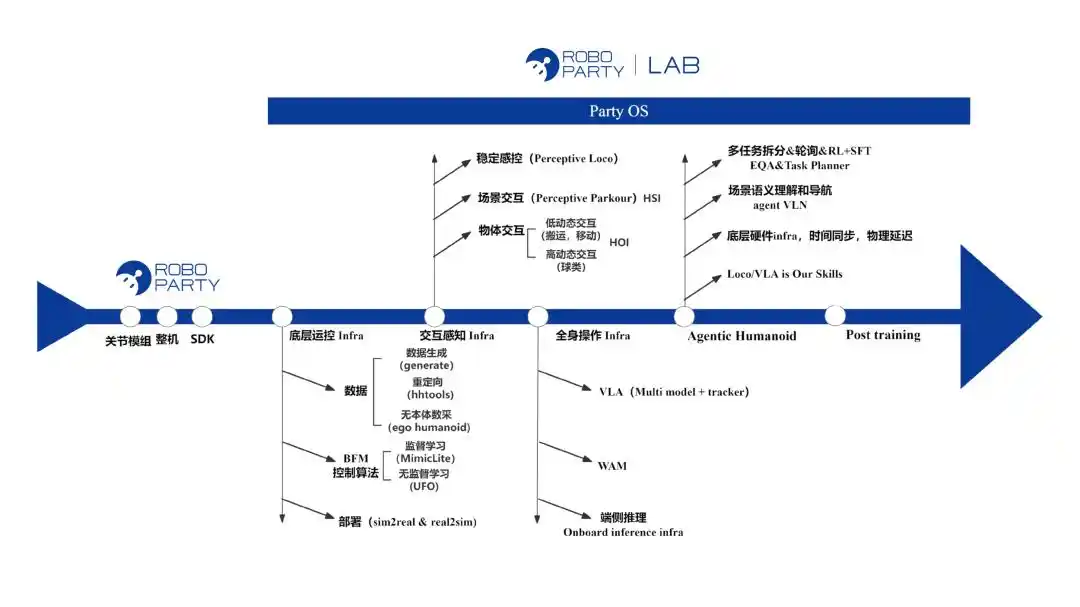
RoboParty argues that open-source robot bodies alone do not solve the main bottlenecks in embodied R&D. Questions around where data comes from, how actions are processed, whether the training framework is stable and how policies are deployed to physical machines remain time-consuming and complex. To address that, the company built Party OS, a reusable, verifiable and extensible development base intended to package those lower-level capabilities into a complete system.
So far, RoboParty has open-sourced three core tools around Party OS: MimicLite, UFO and Human-to-Humanoid Tools. They target general motion tracking, unsupervised reinforcement learning control and motion retargeting. The report said the tools have received a strong response from the open-source community.
In RoboParty’s structure, the robot body brings in customers, revenue and access to real-world scenarios, while Party OS accumulates data and experience in physical interaction. Together they form what the company sees as a co-evolving full-stack embodied platform.
Six rounds in eight months
The report said investors repeatedly described Huang as restrained, focused, deeply technical and unusually clear-eyed about business for his age.
In RoboParty’s early days, the team had already spent several million yuan on R&D and was running short on cash. Huang said a listed company approached the startup with an attractive proposal, offering funding and promising to lock in more than 100 overseas orders. He turned it down. In his view, chasing volume before technology, production capacity and brand were mature would only create superficial success. At that stage, the company needed to build foundational ecosystem capabilities, and the quality of orders mattered more than the quantity.
RoboParty later secured a seed round in the summer of 2025 worth tens of millions of U.S. dollars from Matrix Partners China, Xiaomi Strategic Investment, Galaxy General and Lightsource Founder Fund. Huang said that without that seed financing, the company might not have survived.
After that, the financing pace accelerated to almost one round every month or so. Investors that joined after Matrix, Xiaomi and Galaxy General included SenseTime Guoxiang Capital, Baidu Ventures, Huaying Capital, Pudong Venture Capital, Shanghai Future Industry Fund, Anchuang Capital, Saina Capital, Baichuan Capital and Shunwei Capital.
Following progress in open-source humanoid-body development, developer ecosystem building, whole-machine engineering, mass-production preparation and Humanoid Foundation Model development, RoboParty added CATL as a new investor. The report described CATL’s direct investment through its group strategic investment arm as a move with clear signaling value and one that may also fit into broader industrial-chain coordination.
It added that the two sides will jointly explore more possibilities for humanoid robots in upstream and downstream industrial-chain collaboration, real manufacturing and complex work scenarios.
No bet-on clauses in current terms
According to the report, none of RoboParty’s current investment terms include performance-based repurchase clauses. That was presented as a rare sign of trust in the company’s product potential and real-world scenario value. It also suggests RoboParty is being viewed as more than an open-source label, but as a full-stack platform that could move into manufacturing, energy, supply chains and complex operational settings.
Huang also said more investors are approaching the startup on their own, adding that the term-sheet scale for the next round is already considerable.
Chasing SOTA with lower compute and latency
Huang has asked why the market has not produced a robot stronger than Unitree’s G1 after two years. In his view, some companies in the sector keep changing direction, wasting resources by pushing mass production before verifying product-market fit or forcing commercialization too early.
That is why RoboParty has put technical metrics and product performance first from the start. Huang said several hundred orders matter less than attracting 100 high-quality developers. Once the team stays aligned, the main task is to move fast.
The internal target is to “stay SOTA,” meaning state-of-the-art performance on recognized benchmarks. The company regularly studies existing robots in detail and lists pain points on a whiteboard, including loud noise, slippery soles and the lack of remote emergency stop. The report said a single review can produce 20 to 30 separate issues, followed by targeted attempts to solve them.
Even internal meetings are organized through a communications-theory framework, Huang said. Documents are used to transmit facts, face-to-face conversations are used to transmit emotion, and meetings are reserved for disagreements and decisions that cannot be handled asynchronously.
The report said that in just half a year, RoboParty built systematic R&D capability spanning core motor modules, motion-control algorithms, whole-machine product definition, open-source systems and supply-chain implementation. An original spending plan in the millions of yuan quickly expanded into financing above 100 million yuan.
Off-policy Tracker and INTACT
One of the company’s latest updates is its self-developed Behavior Foundation Model, or BFM, called Off-policy Tracker. The report said it has reached SOTA performance in core tasks including full-body motion tracking. Its related open-source training system, MimicLite, used only eight NVIDIA 4090 GPUs and roughly four hours of training to beat key SONIC metrics while cutting compute demand to about 1/500 of traditional approaches.
Two weeks later, the team introduced a new framework called INTACT based on a JEPA World Model approach. It converts state-conditioned motion intent directly into action chunks and achieved about a 300-fold reduction in planning latency. The report added that Turing Award winner Yann LeCun publicly praised the work.
Huang said open source can help embodied AI technologies scale faster. The report compared the idea to a communications system: differences in hardware architecture and control algorithms make knowledge and experience hard to reuse across robots. Open-sourcing models and toolchains is like introducing channel coding and standardized protocols, while experience flowing back from developers into the community can create a large feedback loop and speed up convergence across the field.
Huang said he is not worried that open source will erase the company’s moat, arguing that closed-door development only leads to inefficient competition built on sameness. In his words, as long as the team keeps iterating, making the market larger has little downside.
The original article was published by the WeChat account PEdaily (ID: pedaily2012) and written by Yu Mengying and Zhou Jiali. MarsBit republished the piece.