
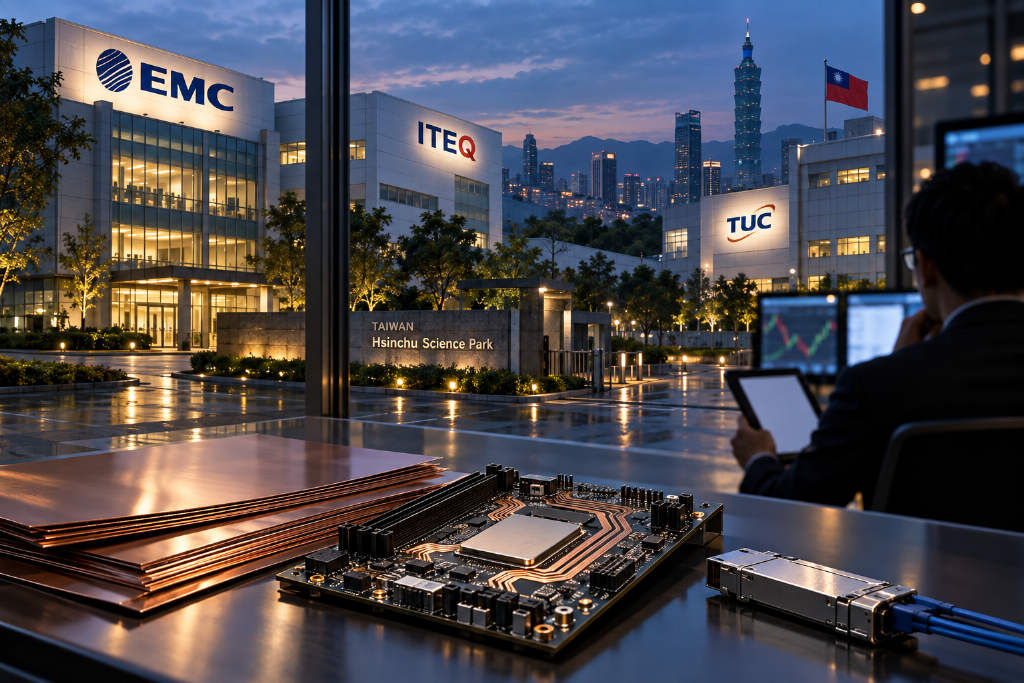
A market rumor that co-packaged optics, or CPO, could replace high-speed copper transmission hit Taiwan’s copper clad laminate, or CCL, names hard on Sept. 17. Elite Material Co. (6213) was pushed to limit down, EMC (2383) fell more than 7%, and Taiwan Union Technology (6274) dropped more than 6%. Supply chain players later rejected the claim, saying the market had become too optimistic about the timing of CPO adoption and had overstated the impact on motherboard CCL specifications. By Sept. 18, all three stocks had turned higher, each rising more than 2.8%.
Rumor tied CPO adoption to a downgrade in motherboard CCL specs
The selling started after a technical argument spread widely on social platforms. The claim said that once CPO matures, high-speed signals in AI servers and switches will be converted into optical signals directly at the main chip, leaving only lower-speed control signals such as PCIe Gen 5 on the PCB motherboard. Under that scenario, M4-grade CCL would be enough.
That would challenge the main thesis that has supported CCL stocks over the past two years: faster transmission standards driving higher CCL specifications and higher ASP.
The rumor also argued that as SerDes moves into the 448G generation, the transmission path for high-speed copper signals on PCBs will shrink sharply. In that view, the shift from copper to optics under CPO would become more visible, and the upgrade path for CCL makers would move away from ultra-low-loss materials toward different priorities such as higher layer counts, higher voltage resistance, and power delivery stability.
Sept. 17 sell-off intensified during trading
The narrative spread quickly during the session. Elite Material fell to limit down in early trading, with volume reaching 25,900 lots and more than 960 lots still queued on the sell side at the limit. Foreign investors were net sellers of 12,000 lots in Elite Material in a single day. EMC and Taiwan Union Technology also dropped 7% and 6%, respectively.
The move stood out because the broader Taiwan market rose 0.96% to 46,288 points on the same day.
Supply chain rebuttal focused on three points
Supply chain sources and institutions responded on X with three main arguments.
1. CPO remains limited to scale-out switches
They said CPO is still mainly used in scale-out switches, meaning long-distance transmission nodes between racks and across data centers. Global shipments are estimated at fewer than 20,000 units in 2026 and fewer than 50,000 units in 2027, which they described as a limited volume base.
By contrast, scale-up networks, including short-distance board-to-board interconnects inside GPU clusters and NVSwitch systems, still rely heavily on high-speed copper interconnects. That segment remains the main source of demand for M8 and M9 ultra-low-loss CCL, and the rebuttal argued that CPO does not yet pose a material threat there.
2. CPO addresses long-distance transmission loss and power use, not every internal electrical link
According to the supply chain view, CPO is meant to solve signal loss and power consumption in long-distance high-speed transmission. It does not eliminate all high-speed electrical connections inside servers. On that basis, equating CPO adoption in scale-out switches with a downgrade of motherboard CCL to M4 does not hold up technically.
For that scenario to become reality, CPO would need to penetrate both scale-out and scale-up applications at scale. The supply chain response said that point is still far away.
3. Upgrade priorities may change, but the broader move to higher specs remains
Even if CCL makers accept that the direction of upgrades could shift, the conclusion is not that specifications will move lower. The argument instead is that every new motherboard generation will still be upgraded, with the focus moving from ultra-low-loss materials toward higher layer counts, higher voltage resistance, and more stable power delivery.
Jeff Pu says new NVSwitch products still use PTFE and M8/M9 CCL
GF Securities Managing Director Jeff Pu also weighed in. He said CPO will not enter server compute motherboards in the near term. He added that even next year’s NVSwitch NPO/CPO version will still use higher-spec CCL internally, with a hybrid structure combining PTFE substrates and M8/M9 ultra-low-loss copper clad laminate.
That means even a flagship CPO version of NVSwitch would still rely on high-spec CCL, which runs against the idea that CPO adoption will lead to lower CCL specifications. Jeff Pu said PTFE remains the core theme behind CCL upgrades at the current product stage.
All three major CCL names turned positive by noon on Sept. 18
As of 12:00 p.m. on Sept. 18, the three major CCL stocks had all moved back into positive territory, reversing the pricing dislocation triggered by the previous day’s sell-off.
- EMC (2383) rose NT$135 to NT$4,830, up 2.88%.
- Elite Material (6213) rebounded from its limit-down level, rising NT$14 to NT$509, up 2.83%, with intraday volume still holding at 16,000 lots.
- Taiwan Union Technology (6274) gained NT$40 to NT$1,360, up 3.03%, showing the strongest rebound among the three.
ABMedia said the synchronized recovery on Sept. 18, following the sharp sell-off on Sept. 17, pointed to a pricing error driven by rumor rather than a deterioration in fundamentals.