EMC

CCL
2026-09-18 04:34:48

CCL stocks rebound as supply chain pushes back on downgrade claims tied to CPO

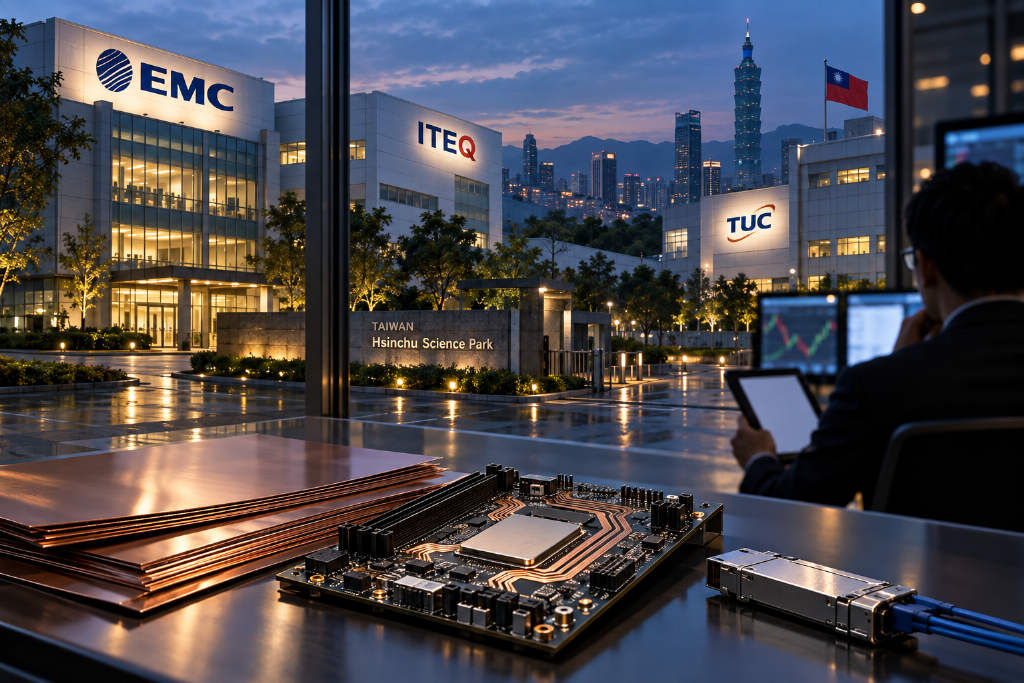
A market rumor that co-packaged optics, or CPO, could replace high-speed copper transmission and drag motherboard copper clad laminate specifications down to M4 triggered a sharp sell-off in Taiwan’s CCL names on Sept. 17. Elite Material fell to limit down, while EMC and Taiwan Union Technology dropped more than 7% and 6%, respectively. The move drew attention because it came even as the broader Taiwan market rose 0.96% to 46,288 points. Supply chain sources and institutions later challenged that narrative on X, arguing that the market had overstated both the pace of CPO adoption and its impact on high-end CCL demand. Their case centered on three points: CPO is still largely confined to scale-out switches, not scale-up interconnects inside GPU clusters; it addresses signal loss and power consumption in long-distance high-speed transmission rather than eliminating all internal electrical links in servers; and even if upgrade priorities shift, each new motherboard generation is still expected to move to higher specifications. GF Securities Managing Director Jeff Pu added that CPO is unlikely to enter server compute motherboards in the near term, and that even next year’s NVSwitch NPO/CPO version will still use a hybrid structure built on PTFE substrates and M8/M9 ultra-low-loss CCL. By noon on Sept. 18, all three major CCL stocks had turned positive.

410
CCL stocks rebound as supply chain pushes back on downgrade claims tied to CPO
glass substra
2026-09-02 08:03:16

Glass substrate adoption may hinge on a 2027-2029 ramp, with TSMC CoWoS seen as the key marker

Rising demand for heterogeneous integration in AI chips is pushing package sizes sharply higher, and that has brought glass substrates back into the center of semiconductor discussions. A Statementdog industry report cited by ABMedia says advanced packaging has expanded from "2x reticle" to "4 to 5.5x reticle" in two years, increasing warpage risk and making glass one of the most closely watched material options for next-generation packaging. The report separates two very different uses of glass in packaging: temporary carriers used during manufacturing and removed afterward, and glass substrates or interposers that remain inside the finished product. The second category is drawing most of the market attention. Glass is being considered because it offers adjustable coefficient of thermal expansion, high rigidity, and a very flat surface, traits that can help control warpage and support finer wiring and higher layer counts. At the same time, commercialization still faces major hurdles in TGV reliability, copper adhesion, and inspection methods for transparent material. According to the report, limited commercialization could begin in 2027, possibly in optical communications, while larger-scale production may not arrive until 2028 to 2029. The report says the most important signal for a real volume ramp will be whether Taiwan Semiconductor Manufacturing Co. (TSMC) introduces glass substrates into CoWoS packaging lines, with that window estimated at late 2028 to early 2029.

870
Glass substrate adoption may hinge on a 2027-2029 ramp, with TSMC CoWoS seen as the key marker
NVIDIA
2026-08-27 04:44:00

NVIDIA Rubin Ultra material review lifts PTFE names in Taiwan as CCL and PCB stocks rally

PTFE-related names in Taiwan’s equity market surged after investors focused on a possible materials shift tied to NVIDIA’s next-generation AI computing platform, Rubin Ultra. Taimide Tech and Asia Electronic each hit limit-up at the open for a third straight session, reaching record highs of NT$352.5 and NT$86.6, with monthly gains of 108% and 76%, respectively. The broader move also lifted CCL makers such as EMC and ITEQ, along with PCB names including Fuljo and Gold Circuit Electronics. At the center of the trade is a market discussion compiled by semiconductor technology researcher @stfbutnou, who said Rubin Ultra’s orthogonal backplane is being evaluated with a "PTFE plus silica filler" filmless route instead of the long-used "M9 resin plus quartz cloth" design. Final material selection is expected in the fourth quarter of 2026. The report also stressed that PTFE is not necessarily replacing glass fiber across the board, with different materials likely to coexist depending on signal integrity, mechanical strength and thermal expansion requirements. Even with the stock rally, all Taiwanese suppliers mentioned remain in the customer qualification stage, with no confirmed mass-production orders yet. The market is now watching three points: Rubin Ultra’s final material choice, certification progress at Taiwanese suppliers, and whether PTFE, copper foil and lamination capacity can expand fast enough to support eventual volume production.

2160
NVIDIA Rubin Ultra material review lifts PTFE names in Taiwan as CCL and PCB stocks rally
MAGNE.AI
2026-08-26 08:00:22

MAGNE.AI pushes beyond a Web3 phone into edge AI and agent infrastructure

MAGNE.AI is no longer being framed only as a Web3 smartphone project. Public materials reviewed from RootData, regulatory filings and the company’s own disclosures show a broader buildout across devices, edge AI, identity rails and machine payments. On the hardware side, MAGNE Phone Gen1 is listed at the PVT P2 stage after Pre-EVT and EVT P1, with first-batch manufacturing targeted for the third quarter of 2026. The company has also published FCC-linked materials, a 3D phone structure viewer and staged production updates. On the enterprise side, MAGNE AI BOX is being positioned for private AI and edge-compute deployments, with a Release Gate framework, one local run validation for a Qwen3.6-35B-A3B Q4_K_M artifact, and a Gate 1 plan to build three prototypes for performance, thermal, offline and recovery testing. Agent Pay, meanwhile, has shown a local contract demo and testnet evidence, but end-to-end HTTP 402 flows are still under development and production payments are not open. MAGNE.AI disclosed a $2.64 million strategic follow-on round on Aug. 5, 2026, bringing cumulative public financing to $12.64 million by its own account. Even so, the article argues the key questions now are delivery, prototype validation, public testnet payment proof and whether community participation can convert into actual device users.

1290
MAGNE.AI pushes beyond a Web3 phone into edge AI and agent infrastructure
EMCD
2026-08-10 08:02:39

EMCD launches miner support program with up to $30 million in financing and fee relief

EMCD, a global cryptocurrency mining pool and infrastructure provider, has rolled out a miner support program that offers up to $30 million in total support value for eligible miners through financing, fee reductions, and partner benefits. The launch comes as mining economics remain under pressure. CoinShares data for the first quarter of 2026 put Bitcoin hashprice at about $28 per PH per day, down 50% from the peak seen in October 2025 and marking a post-halving low. Hashrate Index data cited by CoinCentral in April 2026 showed roughly 252 EH/s of hashrate had already gone offline, as miners running older machines struggled to remain profitable. Network difficulty also fell for three straight adjustments for the first time since July 2022. EMCD said miners can apply for collateralized liquidity loans starting at a 3.9% annual rate, 60 days of zero pool fees, discounted Vnish firmware, and partner terms on equipment purchases and data center services. The company said the package is available globally and is designed around real mining cash-flow cycles rather than a standard crypto lending structure.

1840
EMCD launches miner support program with up to $30 million in financing and fee relief
Yageo
2026-07-29 01:02:06

Yageo investor meeting draws focus as MLCC price hikes test whether the stock can stabilize

Yageo’s second-quarter investor conference is in focus on July 29 after a sharp sell-off in Taiwan equities pushed the passive component maker’s stock down by more than 50% from its July 1 record high. The broader market tumbled on July 28, with Taiwan stocks posting their second-largest point drop on record, while passive component names were hit by deleveraging and emotionally driven selling. Even so, the industry backdrop described in the source remains tight. Japanese supplier Taiyo Yuden said it will raise multilayer ceramic capacitor, or MLCC, prices starting Sept. 1, citing high raw material costs and sustained demand for higher-end orders. South Korea’s Samsung Electro-Mechanics, the world’s second-largest MLCC supplier, has also reportedly raised product prices as demand for high-spec AI server motherboards increases. Yageo, the world’s third-largest MLCC supplier, reported record revenue for both June and the second quarter. June revenue reached NT$15.359 billion, up 2% from a month earlier and 38.91% from a year ago. Second-quarter self-reported consolidated revenue came in at NT$44.456 billion, up 16.5% quarter over quarter and 35.7% year over year. Investors are watching management commentary on margins, customer acceptance of price increases, AI revenue mix, capacity utilization, and inventory restocking in automotive and industrial markets.

730
Yageo investor meeting draws focus as MLCC price hikes test whether the stock can stabilize
EMCD
2026-07-27 12:11:50

EMCD launches miner support program with up to $30 million in backing

Bitcoin mining pool and crypto finance platform EMCD said on July 27 that it has rolled out a Miner Support Program offering up to $30 million for eligible miners. The package includes financing, fee reductions, and discounts tied to hardware and infrastructure partnerships. The announcement comes as Bitcoin miners continue to face sharp profitability pressure after the halving. CoinShares Q1 2026 data showed hashprice had fallen to about $28 per PH per day, down 50% from its October 2025 peak and marking a post-halving low. Hashrate Index data also showed roughly 252 EH/s had left the market as weaker economics forced many older machines offline. EMCD said its program includes collateralized liquidity at a 3.9% annualized rate for miners under cash pressure, a 60-day mining pool fee waiver, Vnish firmware discounts for older or less efficient rigs, and procurement and data center support for capacity expansion and hashrate migration through partner networks. Founded in 2017, EMCD said it operates a Bitcoin mining pool across more than 120 markets, manages over 30 EH/s of hashrate, and ranks among the world’s top 10 Bitcoin mining pools.

1430
EMCD launches miner support program with up to $30 million in backing
South Korea
2026-07-20 01:55:26

South Korea Opens Sanctions Process Against Dunamu as FSC Plans AI Surveillance for Crypto Markets

South Korean regulators took center stage in the past 24 hours after launching a sanctions process against Dunamu, the operator of Upbit, and outlining a broader push to tighten oversight of the virtual asset market with artificial intelligence. According to Yonhap, authorities have sent an inspection report to Dunamu following a 44.5 billion won hacking incident, starting a formal sanctions procedure whose outcome remains uncertain because there is no direct penalty rule for hacks or computer system failures under the current framework. Separately, KBS reported that South Korea’s Financial Services Commission said it has completed about 40 investigations into unfair virtual asset trading in the two years since the Virtual Asset User Protection Act took effect, and has referred or reported more than 30 cases to judicial authorities. The FSC said the next phase of oversight will include an AI-based monitoring system capable of real-time market surveillance, second-level price manipulation analysis, and automated detection of suspicious accounts and trading ranges. The broader market update also included missed U.S. stablecoin rulemaking deadlines under the GENIUS Act, a South Korean roadmap for won internationalization and won-denominated stablecoins, fresh liquidation data from Coinglass, new figures on Bitcoin mining concentration, tokenized stock activity, and security developments involving Ostium.

1880
South Korea Opens Sanctions Process Against Dunamu as FSC Plans AI Surveillance for Crypto Markets