
Taiwan’s printed circuit board industry has crossed the NT$1 trillion threshold for the first time, with the Taiwan Printed Circuit Association, or TPCA, estimating this year’s total domestic and overseas output value at NT$1.1365 trillion, up 24.2% year over year. The group said the upcycle could extend through 2030.
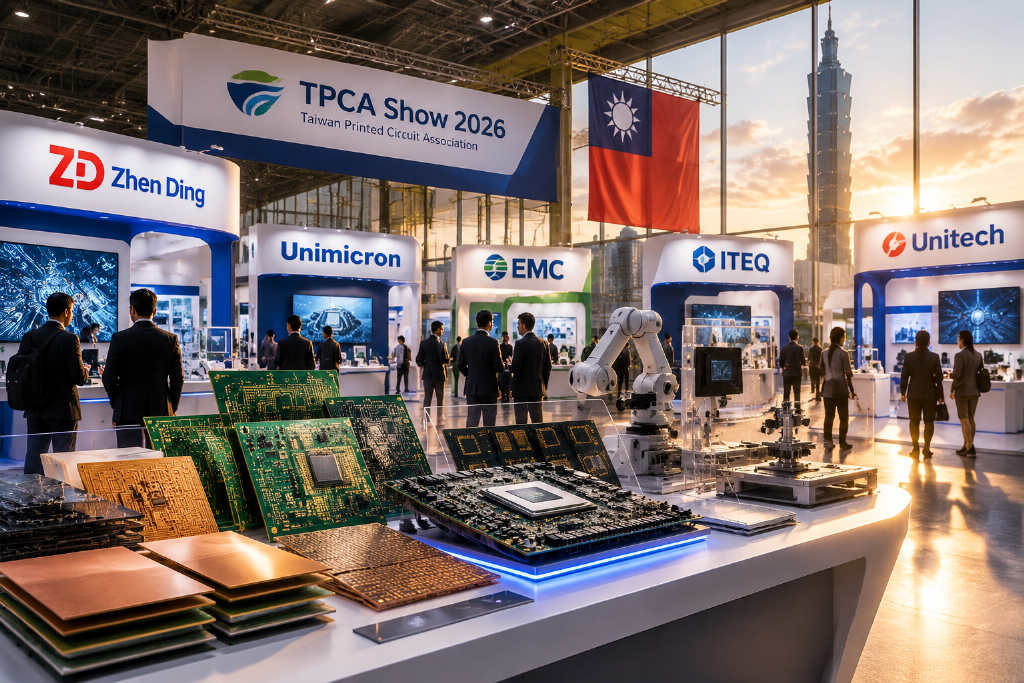
The figures were presented as TPCA Show 2026 opened on Oct. 20, bringing together senior executives from five major PCB companies: Zhen Ding-KY, Unimicron, ITEQ, EMC and Unitech. The executives broadly agreed that AI is driving the industry’s next phase of upgrading.
TPCA says supply pressure is building upstream
TPCA also said PCB substrate materials could face a roughly 20% supply gap by 2027, underscoring a broader strain in upstream supply.
According to an Economic Daily News report cited in the source article, TPCA chairman and Unitech chairman Chang Yuan-ming said in his opening remarks that the industry will keep expanding investment in response to AI development, with the aim of keeping advanced manufacturing and R&D in Taiwan. He said the sector also wants to take part in the joint development and definition of next-generation AI hardware specifications, becoming a co-developer and definer of new-generation products.
As AI computing competition and capital spending continue to rise, the value of the PCB industry has increased as well. Unimicron chairman Chien Shan-chieh said Taiwan has the world’s most complete and competitive electronics supply chain, and that substrate, HDI and flexible board output all ranked first globally last year. That, he said, makes coordination across the industry even more important.
Unimicron sees a 20% substrate material gap in 2027
Chien said AI is pushing hardware into what he described as a golden period, and that the industry needs to move from operating on its own to building a coordinated ecosystem. In his view, PCB substrate capacity expansion has to advance in step with the rest of the supply chain.
He said shortages are no longer limited to substrates and have spread to equipment and raw materials. Based on that assessment, he projected a roughly 20% shortfall in PCB substrate materials by 2027.
Chien added that the expansion bottleneck has shifted from the capacity of a single plant to overall supply availability. To keep the industry growing, he said, companies need stronger localized or regionalized supply chains for key materials and equipment, reliable access to water, electricity and land, and closer industry-academia cooperation to train talent. He also said customers now expect PCB makers to be more than manufacturers, serving as technology enablers, providers of supply-chain resilience and long-term partners.
Zhen Ding invests early, ITEQ sees strength lasting to 2030
Zhen Ding chairman Shen Ching-fang said AI demand continues to heat up and that tightness in upstream materials has not eased. Supply of the company’s high-end products is also constrained, he said, and most of the cost increases have already been passed on to customers. That has led the company to invest ahead of demand so it can supply customers on time when new platforms enter mass production.
CCL makers also struck an upbeat tone. ITEQ chairman Tung Ting-yu said AI continues to push demand for advanced materials higher, and that demand for high-end copper clad laminates could keep growing next year. He said strong industry demand and favorable conditions may continue through 2030.
EMC chief executive Tsai Hsin-hui said the company is positioned to capture growth in high-speed electronic materials whether demand comes from AI GPUs and ASICs, co-packaged optics, AI CPUs, or high-end servers and high-speed transmission switches.
PCB shares rise in midday trading
PCB-related stocks moved higher during trading on Oct. 21. As of 12:00 p.m., EMC was locked at limit-up at NT$823, Zhen Ding-KY had risen 6.22% to NT$581, Unimicron was up 4.27% at NT$1,100, Unitech had gained 2.41% to NT$46.70, and ITEQ was up 1.11% at NT$5,000.
The source article said institutional investors are watching whether companies with advanced materials and substrate capacity can keep improving their order intake and pricing power while AI demand remains strong and upstream material supply stays tight.



